Who signs their name? RPGs and authorship

Roleplaying is a creative exercise.

I forget this, sometimes. Pretty continuously, as a matter of fact. I play a lot of roleplaying games on a regular basis in my life, and I also do creative work outside of them. Every so often, I find myself frustrated at a lack of creative energy, and I try to figure out where it all went. Keeping in mind how much writing I’ve done in the games I’m playing gives context to that, context it’s easy for me to forget about.

It’s group storytelling, and that’s a fair bit of work. Everyone’s writing.

So, if you’re reading this and you’re a player, or especially a GM, give yourself a pat on the back and a bit of a break every so often. Whatever spot you’re in, you’ve been doing more creative work than you might realize. That’s something to be proud of! Honestly, you can probably count it as creative writing practice, if you feel the need to categorize activities as productive or they nag at you.

However, it’s not quite the same thing. Writing is an exercise in omnipotence, among other things. You sit down in front of a page, and it can be anything you set your mind to. You can make people up, and you can kill ’em off. You can invent new concepts out of nothing. There’s a lot of things you can write about, and nobody can really stop you. Which, heck. If that sounds fun, and the prior paragraphs are resonant? Consider this a call to action! Stop reading someone yell about a niche art medium and their hot takes on it, and go write something that satisfies you. Live your best life, and make what you want to make. It’s important. Writing is a lovely experience, and there’s essentially nothing in your way but the energy cost of getting started and keeping going.

That’s not true of RPGs. Those have a lot in your way. If you sit down to play an RPG, and just start declaring whatever you want, in the way that a writer would, you’re gonna make your friends mad at you. None of them came here to watch you be omnipotent while they sit around. If you want to arbitrarily make someone up and then kill them off, you’re going to get protests along the way. Probably, someone pulling out a rulebook to cite at you, saying why you can’t do that.

Writing doesn’t really have a “you can’t do that”. It has “you shouldn’t do that,” which is a different kind of thing. RPGs, however, are made of both.

When writing, you make something true by writing it. Or, semi-true. You can write lies. You can write through perspectives that lie about what they see! But writing something places it into the world, into the understanding of the readers. And that’s a simple action.

When playing an RPG, how do you do the same thing?

Well, probably, you write it. Or, speak it. (We’re having [writing] include [storytelling] here, so the distinction isn’t too relevant right this minute.) And then you look around the room for approval, and get a yes or no depending on how the other players react.

How the other players react is determined by the rules of the game, the roles you occupy, and the expectations of how it works. Or, in other words – “am I allowed to write this?” is the fundamental question that rules design is made to answer.

Mother, may I?

When playing a GMed RPG (which this post will mostly focus on, though I think it’s applicable to other dynamics), there’s an elephant in the room. The GM. When you turn to the room and silently ask for approval for the latest thing you wrote into the world, usually, they’re the ones who get to actually say yes or no. The other players don’t really have a vote in the same way.

They do have a vote in a way. If they ooh and ahh and go “yeah, that would be cool,” or something to that effect, that means something, right? But if all that happens, and the GM says no despite that, then their vote didn’t really matter.

A GM narrates a world. Narrating is, as we’ve defined it, writing. They say something, and lo, it is the case. There’s a chandelier in this room. The sun is setting. The captain’s impassive stare flickers, ever so briefly, with a smile. They can do this about almost anything, and have it be accepted. In fact, they kind of have to – if they don’t, none of the other players will have an idea of what’s going on, or have much of anything to do, beyond of their own initiative. Being a writer is one of the jobs of being a GM. A full writer. They have the omnipotence.

Suppose you’re a player, and a GM writes at you. “Your character opens the door, spots an old man, draws their sword and stabs him.”

What’s your first response to that?

Some variation of “What? No I don’t!”, right?

Now, that’s kind of an extreme example, and in less extreme versions, it can get blurry. But it makes the point well. The GM can write the world just fine, but if they say what a PC does, that’s overstepping a boundary, in a way that it naturally can’t be when a writer says what a character does in their story. The GM’s domain isn’t supreme, it’s just almost that.

In fact, let’s formalize that concept, it’ll be useful. An authorial [domain of authority] is a space where a given player has the power to write, as we’ve defined writing here. The baseline dynamic set up here gives the GM a [domain of authority] covering all the world, except for the actions of a select set of entities, the PCs. Each PC has one player, whose [domain of authority] covers the actions of that one PC, and nothing else. Nobody has quite the same level of power as an author of a book does, but the GM gets pretty close, and the players get pretty close to nothing.

Since social dynamics trend towards wanting to feel “fair,” for as nebulous a concept as that may be, it usually blurs a bit more than that.

Suppose you’re a player in this scenario. You have a thing you want to see happen. It’d be exciting, and cool, and satisfying, and, you know, whatever other positive emotions you feel like. How do you get that?

There’s a lot of answers, but, the simplest method, really – you ignore whatever rules govern what’s going on, you turn to the GM, and you go, “hey, wouldn’t it be cool if this happened?”

I’ve done that. A lot of people have done it, in my experience. It’s a pretty natural impulse, especially if you’re less cognizant of the power dynamics in authorship being explored here. There’s a person whose job it is to narrate things, you have a cool idea for them to narrate, go for it!

That’s a pretty straightforward expression of authorial power. The player had a vision of something they wanted to have happen or exist, and their actions made it be written into the world. It’s certainly extending beyond the limits of their [domain]. And it’s an entirely natural part of the dynamic!

But!

All of that is only true if the GM approves. If they go, “sure, that would be cool,” and exercise their authorial power to make it happen. The players haven’t actually gained adjudicating power, it’s more like, they’ve gotten a position as an advisor to the king. They can sway how things go using social pressure, but they don’t actually have a tangible authority to back it up.

Now, that isn’t to say that social pressure isn’t nothing. In fact, it’s quite a bit. In material terms, the authorial power of players can be augmented by stunts, and everything I wrote about how those work is just as applicable to expanding authorial power. A GM who gets a lot of “hey, wouldn’t it be cool if” pitches from their players can build up [no fatigue] and [yes fatigue] all the same, and the players will be able to get some, but not all, of what they’d like to author. In a game where it’s much more sparing, depending on the GM’s demeanor and the specific social dynamics at play, the players might get to be de facto second narrators, just because the GM is willing to rubberstamp whatever they propose.

Actually, it’s a bit worse than with stunts. Or, more intense, to avoid making it a judgement. The ambient social pressures of GMing as a concept are directed towards making the authorial balance more “fair,” and even if players don’t consciously propose anything, the GM is still on the watch for what might be implicit proposals. Among the expectations put on a GM are, they have to make the player’s actions meaningful in affecting the world, and they have to go where the players are interested in going. If the players express an interest in a facet of the world, the GM has to have enough there for their interest to be made worth it – and, whether that’s improvised whole-cloth or it’s part of an extensive prep suite that covers every piece of the world in interesting details, the details that get to be actually narrated are the ones that the players focus on, and that informs what future prep would be the most valuable. Player interest is the passive pressure that pushes the GM towards certain objects in their narration. Nobody wants to be the GM going on at length about elements the players are entirely tuned out for.

And if that’s the passive pressure, player actions are where it gets stronger and more, well, active. When the players take an action, and they mean something by it, and it doesn’t change anything, that highlights the power dynamic at play. If what the PCs do doesn’t matter, and the only thing the players can write is what the PCs do, then the GM really is a writer in full, and the players are just along for the ride. Now, I don’t actually hate experiences like that. I think they can be quite fun, if everyone involved knows that’s what they’re getting into. But, if not, then the impulse is to make things “fair.” And that highlights just how unfair this all is. You’d risk player disgruntlement, disinterest in what happens if they can’t meaningfully engage with it, and worse. Plus, following along the prior paragraph, one of the most consistent signals that a player is interested in something is that they have their character interact with it. The GM implicitly reads player actions as signals, as a result, and has to ensure the directions pointed at are both elaborated and dynamic enough that the players will be satisfied by what they find, and compelled by the changes they can make. When the GM presents challenges to the players, or decision points to shape the outcomes, they make this explicit – they write multiple things that may be the case, and then the players gain the power of selecting which one. That selection is both an expression of authorial power on the players’ end, or, pseudo-authorial, and a signal of interest to inform the GM in future. By getting into a good rhythm, the GM can loan out quite a bit of their authorial power here.

But, the inverse to all that is that if the GM doesn’t feel particularly swayed by these social pressures, they absolutely can just run it with the power dynamic as-is, and there’s not much the players can do about it. All expanded playerside authorial power comes at a loan, and the GM has the final say in where it goes and what it means. The players haven’t expanded their domain, they’ve been graciously invited onto someone else’s lands, revocable at any time. We request that they be a merciful king, but, as with everything else – it’s nothing more than a request.

Border skirmishes

Let’s talk about social interaction.

No, everything I just wrote didn’t count. I mean in-game social interaction. Character to character. Persuasion, more specifically – which is much more common in RPGs than it is in real life, proportional to other types of interactions. Trying to get someone to do what you want.

Let’s invent a strawman game mechanic. By which I mean, let’s use a version of D&D 5e‘s mechanics – not the version in the rules themselves, but the version I commonly see implemented by people who don’t want to bother with or don’t know about the slightly more nuanced attitude system in the Dungeon Master’s Guide. Roll 1d20, and add a couple numbers representing your bonus with Persuasion. If the total is higher than 15 (or some other arbitrarily-assigned number), the target does what you want. Easy-peasy.

This flanderized version of the mechanic, and, honestly, even the full version in the DMG, tends to ruffle some feathers. And you might have a gut feeling as to why, but, dear reader, I’d like to request you ignore that impulse, and try to think of it logically. Why is it that this prompts protests, and (in some spaces) calls to eradicate social skills from skill lists entirely? Why is [this person is the obstacle to us continuing, let us roll to bypass it] a problem, but [this cliff is an obstacle to us continuing, let us roll to bypass it] kosher? On a structural level, there isn’t actually much difference between the two. The presence of Persuasion as a skill is actively because people will appear as practical obstacles that the PCs must find a way to deal with, after all. What’s so different between “the guard lets you pass into the forbidden lands” and “you swim across the lake into the forbidden lands” as results of gameplay?

Or, if you’re the overly clever type to try to outthink any puzzle sent your way (in which case, so am I, I tip my tiny hat to thee) – why am I asking this question, and why in this blog post of all places?

The trick is, this is an intrusion. It’s the players stepping on the GM’s [domain]. Now, in a way, all of these examples are intrusions. If a player wrote “the door unlocks when I try to open it,” or “I climb up the cliff without issue,” the GM would be well within their rights to waggle their finger and demand a roll, or forbid outright. But, the output of such a roll could then, itself, write “the door unlocks,” and the GM would accept that, even though it is indeed writing under the GM’s domain. But. If the system wrote “the guard decides these people are trustworthy and lets them pass,” that’s not just writing into the GM’s domain – it’s specifically writing into character psychology.

Characters are complicated things, in an RPG. They kind of have to be, for players to have anything to play with (after all, their domains are so much smaller). The GM’s characters are necessarily less complicated, to avoid completely overwhelming them, but they are still afforded complex dimensions to write about – motives, fears, desires, backstories, whatever. You know, characterization beats. A social roll letting the players write over things like this is more of an affront than if it allows them to write over other parts of the world, because characters are more sacrosanct. You commonly see complaints that diplomacy skills function like mind control, but not explanations for why mind control is less agreeable than the body control of forcing a locked door open. It’s taken as a given, when you get down to it – characters are a more deep and true aspect of one’s domain, and so it is a greater act of war to be pierced to that point. Players don’t get to write into characters they don’t control, and the system seemingly allowing them to do that is seen as a violation.

This does go both ways. In fact, it goes stronger the other way, in my experience. The character is all a player has, remember. So the GM writing into what a given PC does, or feels, is something I often see balked at in the strongest possible terms. I see a lot of GMing advice frame this as one of the greatest crimes one can commit – narrate everything about the world, but never touch a character’s interiority. You can present them hazards, challenge them and try to frighten them, and, perhaps, you should! But simply writing, “you are afraid,” that gets criticized, quite a bit.

Now, I don’t really agree with that. Honestly, I’m a big fan of cerebral narration in my RPGs, what people are thinking and feeling, and when I GM, I’m happy to present players with things their characters face, and include “here’s something you feel about it.” You can nudge characterization in interesting ways, if they’re feeling a bout of nostalgia and we haven’t seen them like that before. I honestly solidly recommend it! If you have a group that’s comfortable with it. But, if you don’t have players comfortable with that, this is why – their character is the limited domain they have authority over, and psychological interiority is presented to be one of the most sacrosanct parts of someone’s domain. Narration like that is an invasion, if they aren’t on board with it.

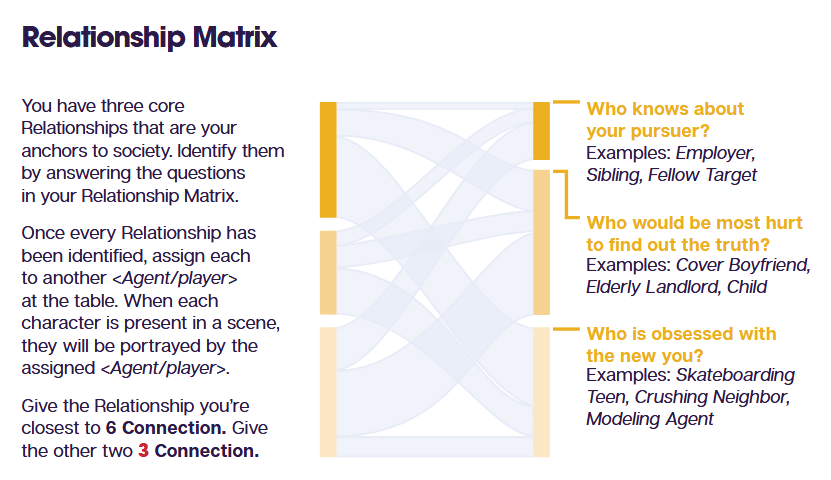
There’s ways to set things up without being an intrusion. Triangle Agency, for instance, which also has a lot more fascinating tech and this is honestly one of the less interesting parts of it so please check it out, has these, as part of character creation:

It’s a set of three relevant NPCs to whatever your mundane life is like. (In this case, your mundane life is a cover identity on the run from a checkered past. “Mundane” is relative, okay?) And control over them is explicitly handed over to the other players, rather than the GM. Those players then control those NPCs whenever they show up, which they’re supposed to do semi-consistently, and the GM has no say over it.

That’s an intrusion, right?

Well, no, is the thing!

The game itself has set this up as a convention. It’s something everyone playing is cognizant of, and has formed their understanding of the domains around being the case. Each player’s domain to write in is their own PC, and the actions they take… plus, the companion NPCs to the other players that get handed to them to control, and the actions they take. The GM’s domain is the entire world, except for the PCs and their actions… and, except for all of these recurring companion NPCs, and their actions. When a companion NPC shows up and a player starts controlling them, the GM won’t internally get upset and then remember that this isn’t their department – it’s already been established, and so, it’s not an intrusion.

Advance warning

There’s a particular sort of RPG horror story, one which I encounter much less of nowadays but do still spot here and there.

The short of it is, in essence – I’ve got a cool campaign set up to go explode the evil Renraku skyscraper or what have you, but the players have all made characters that actively don’t want to do that and are refusing to play what I’ve set out for them. They all want to run around ignoring the premise of the campaign as I pitched it. What do I do?

Now, the reason I don’t encounter this sort of thing as often nowadays – I hope, it’s quite possible the actual reason is I’ve just moved to healthier RPG spaces and I don’t see the bad stuff – is it’s now generally understood wisdom that you do in fact need to build a character to fit the premise of a campaign. If the game is being pitched as about hunting a dragon, don’t play someone who refuses to hurt dragons – or, at minimum, make it so they’ll make an exception for this one.

In other words – this is another constraint on the authorial power of a player. When they write a character, they have to write a character that fits into the story they’re in. If they don’t… the character doesn’t fit, and they can’t really play the game and continue the story, right? At best, you get the party puttering about doing something else while all the GM’s prep and interest is wasted. That’s not a healthy result, so, this becomes a solid restriction in writing.

Now, interestingly, this is a restriction on something I haven’t talked about up until now. It’s a restriction on character action, too, in that players are not supposed to narrate actions that will fundamentally take them out of the path of the game, but usually that’s a broader space it can cover. In the initial setup, when a player is writing their character into existence, that’s what’s being constrained. Their options go from everyone to “everyone except Jane Doesn’t-Like-Hunting-Dragons.” The end result of their backstory, whatever else it yields, has to be someone who will go play the game as it has been pitched to them. A constraint on the backstory step, as well as the backstory step itself, is new.

There’s another particular sort of RPG horror story, which has also fallen out of fashion. The person who shows up to a game with a veritable tome of backstory, establishing powers, world elements, and whatever else their heart desires. Someone using the backstory as a vector to establish a whole bunch of nonsense about their character and the world, because, they can write anything, now can’t they?

In other words – creating a character, and the context around that character, is an authorial affordance to the players. A much bigger one than they’d get anywhere else.

When in the midst of play, narrating a whole location as a player is a significant faux pas. (Unless the game is actively set up that way, or your GM is happy to rubberstamp almost anything – and even in those cases, it’s significant.) Narrating dangers, even moreso. Just suppose Jane Doesn’t-Like-Hunting-Dragons were to announce “suddenly vampires attack” in the middle of the GM trying to set up their complex political dragon-intrigue (I may have lost the plot a bit, but that’s fine, so did the GM). That’s not fair! Jane can’t do that! She’s stepped way beyond her domain as a player. Writing things like that is solidly the GM’s job.

But, suppose Jane came to the table with her character pitch, and in her backstory, wrote about the secret volcano-island where she was raised in secret by a group of humans hiding out from the vampires that ruled the land. Taught strength and honor and to not hunt dragons, or whatever else.

Well, that’s just cool, right? It’s an interesting tidbit of worldbuilding, and gives some context for Jane’s cultural background as a character. It gives the GM something to fit into the larger world, too. It might be a bit out-of-genre, and then you need to discuss that – but what it isn’t is an overreach. Jane totally had the right to write all that, even though she never could’ve gotten past sentence two if this was in play.

In the setup phase, then, the domains are different. Each player has the right to establish parts of the world, including locations, groups, and significant enemies to be faced in the future. They don’t control these elements past this point, but they can create them, and inject them into the wider domain of [the world and the plot of the campaign], which the GM still controls.

The GM once again maintains veto power, these are injections into their domain, but they’re expected to take a much lighter touch. “That’s cool, let’s see if we can make it work” when something doesn’t fit, rather than the fundamental affordance given to the GM and not the other players – “no”.

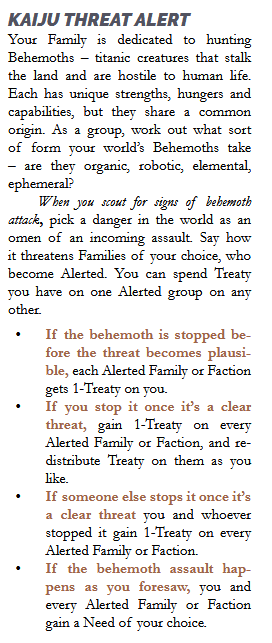
For some games, this isn’t just an implicit step. In Legacy: Life Among The Ruins, and actually even dating to the original Apocalypse World, the build choices you make when creating a character explicitly include elements they add to the world, and you’re allowed to customize the details. In a sense, this is more constrained than just getting to write anything you want into the world, but it’s also definite. The GM isn’t allowed to veto the existence of giant rampaging monsters, when you take the playbook with this move:

In fact, a lot of the options you take in character creation fill in these details in an authorial manner. Depending on the stat spread and build options you pick, you establish a history with the other players’ factions, landmarks to exist on the nearby worldmap and explore/be threatened by, and more:

These are, again, authorial powers granted by the system in a more specific way, but each player option gets these, tailored to the concept they represent. When I played Legacy, I got to play the zombie apocalypse faction from one of the expansions, and picking that option tinged the whole area and themes of the story with the genre of, [this is now in part a zombie apocalypse story]. I got to add a haunted asylum to the map. The specter of GM disapproval did still hang over all of this, but, in codifying these powers, it made it so that being a player during the setup phase of the game was, very directly, being a writer. This is the step where you can declare things to be true.

Fabula Ultima takes it one step further. The entire initial setup of the game, world, villains, and all, are done as a collective effort. Rather than backstory-elements being written within a broader context the GM establishes, essentially, everyone has room at a collaborative writing table to figure out what the world looks like, and what big bads you’re gonna be hunting down. In terms of individual authorial power, this is kind of a reduction, since collaboration is always a headache – nobody can just say something and make it so, they’re subject to vetos or reinterpretations from everyone. But, in terms of how the power is distributed to players vs the GM, the GM has no special privilege or dominion over the world – their ideas are just as vetoable as anyone else’s.

Except…

There’s an inherent followup step. Right? To all of this. A step where you transition from [setting up the game] to [playing the game], and the GM regains control over their domain. And that includes interpretive power. Everything the players get to write in at setup time become subject to GM focus at run-time. In all of the games mentioned, and beyond, whenever I write stuff into the world I’m excited with, it’s always tagged with one thought:

“I really like this, I hope it comes up.”

The setup phase gives players authorial power far greater than they’re usually allowed when in play. But, for that authorial power to actually be impactful, it has to come up in play. And that remains the domain of the GM. So, for as excited as I get about what I conceptualize, and as excited as I try to get everyone else about it? As a player, all I can really do is hope.

Mightier than the sword

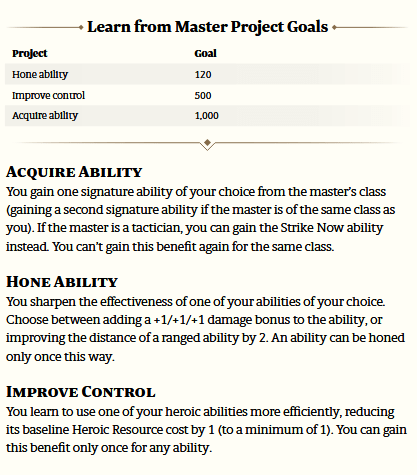
Fabula Ultima has another ingredient to its authorial power dynamics. The players have access to a metacurrency (“Fabula Points”), which, alongside being useful to boost failed rolls, has:

(The GM indirectly has an analogous metacurrency, each major bad guy has a pool of “Ultima Points” that can also be spend to boost rolls, but they don’t have this authorial utility – instead, the GM’s implicit control over their domain lets them write things for free.)

The strongest use of this, in terms of how much it lets you write, is if you’re in an unspecified context. You can introduce a whole location to the map, and, as presented, unless that location is within a wider defined context, the GM doesn’t get to veto it. That’s pretty nice! But, in any context other than that one, the GM’s veto holds. You can spend a Fabula Point to propose an idea, in other words. (It can be thought of as a formalization of the fact that you can already do that, just in social terms, by speaking to the GM as a person.)

Even so, it is a pretty significant possibility for the players to intrude on the GM’s domain. Fabula presents itself as fairly radical in democratizing the authorial power here – it’s hardly the only game to have a mechanic like this, Wilderfeast and even Exalted 3e have options to add things to the world or local context (and both are similarly constrained by GM approval), but these things do indeed let the players be writers more than games where the GM just ignores all proposals and writes everything themself. And, while Fabula, Exalted, and Wilderfeast all could totally be run by a GM who just vetoes every proposal that reaches their desk, an argument could be made about that violating the [spirit of the game], or some other such intangible failure. Whether that argument actually sways the GM is hypotheticals on hypotheticals, but rhetorically, it’s a stronger leg to stand on, at the very least.

Curiously, however – remember what I said just a moment ago? Fabula Points’ usage as a limited capacity to write is a second utility. Alongside a primary power – juicing rolls to ensure success. Making sure you win, and win as hard as you can.

Instrumentalization beckons, in other words.

The value of a Fabula Point is penned to a gold standard. It can be about +3 to a roll, more if you rolled really badly, more abstractly, [a decent shot at converting a failure to a success]. From an instrumental perspective, an expenditure of a Fabula Point on world details wants to be at least as valuable as the benefit difference between a failed roll and a successful one. Now, the calculations for this are actually made a bit complicated, since “a villain appears and attacks immediately” would be a net gain thanks to some other elements of how villains work in the system, but, in broad terms, it’s about what you’d expect. A point expenditure to introduce a convenient bridge across the chasm the GM presented as a threat? Great! Effectively an autopass for multiple rolls. A piece of set dressing or character introduction you think would be cool but don’t benefit you any? Inefficient! There’s a few cases where it’s worth it to spend a point inefficiently over not spending at all, and there’s room for splurging unless you’re really feeling the squeeze, but, again, if you’re just thinking instrumentally – authorial power becomes [resolving things more efficiently than the game mechanics allow] power. And, of course, then a GM needs to be on watch for the players making proposals that earn them too much benefit. Being locked to a gold standard goes both ways – if a Fabula Point can resolve a whole adventure, then actually spending them on rolls is a significant waste. And then things like [no fatigue] are back in the conversation.

In other words… by putting instrumental play in the pot, suddenly authorial power in the hands of the players is a lot more muddled. (Which might be one of the reason why it’s “safer” to let the players write in the setup phase.)

From a perspective of writing a story, fully instrumental play is really inefficient. Things are already bad enough that the power is divided so unevenly – the GM having to over the whole world and piecing events together into some semblance of coherence, while the players just handle the characterization for one guy. But, even when distributed more evenly, if everyone’s playing to win, it’s still a mess. Heck, see just two paragraphs ago. “Gosh, it’s a good thing there was this convenient bridge across this chasm” may be a series of events it makes sense for a player to try to write, but, is that compelling? Is that satisfying? From a perspective that doesn’t care about if the players are winning or losing, that’s pretty bad. In practical terms, it puts the players in the role of actively sabotaging the story. They want to make it go as smoothly and conveniently as possible for our heroes. If the GM isn’t working to make that thematically coherent, it won’t be, and they’ll be facing a major uphill battle to do that.

Commenting with finality on what makes a good story would be rather arrogant, even for me. But I do think it shouldn’t be that controversial if I posit that a story where the heroes win all the time as efficiently as possible wouldn’t be considered the most compelling. And, to be clear, I don’t just bring this up for the idea of compiling an RPG’s playthrough into a story after the fact – I mean in terms of experiencing the process of play on the dimension of it being something narrative-like. Finding interest in the paths the characters take and the way the world evolves. If those paths are all efficient, effective, and calculated… I don’t think that priority is entirely satisfied.

Really, this is a muddle that exists in storytelling’s priorities, even pushing against itself. So the problem is arguably fundamental.

Have you ever read a romance story?

I have. They’re a not-terribly-guilty-but-still-slightly-out-of-character pleasure of mine. There’s also quite a lot of them out there. Love is a popular topic of art, turns out! …Ish. Romance stories, a lot of the time, aren’t actually about romance, in the way that D&D is about fighting (ie it’s what happens most of the time). Rather, they’re about the process by which one gets to a romance – they’re about romance in the way that D&D is about beating whatever enemy is set to be the big finale. You’re focusing on the process to get there, and once you do, you stop, because the exciting part is over. Usually, for a romance, the process is a lot of heartbreak, misunderstandings, emotional turmoil, occasional kidnappings, that sort of thing. A lot of failure and struggle to move in the direction of the endpoint, and the tension of that is the fun part.

I’ll call this the [romance problem], and I immediately think this is a misnomer, because, I really like that sort of thing. I don’t think it’s a problem at all. But, relaying a perspective from the people in life for whom love is not just a fictional conceit, this can get pretty frustrating. Sometimes you do want to see the experience of actually having a healthy loving relationship mirrored, and focused on, and when everything presented as “a story about love” isn’t doing that, it’s a consistent letdown.

RPGs, by their nature, are shaped by the [romance problem]. They’re only able to structurally support what their structures are built to support. D&D can’t continue once you take out the last enemy, unless bam there’s a new enemy to be dealing with. Lancer doesn’t continue if you decide to quit your government job shooting at tyrants with a mech for a more peaceful life, unless that life is significantly not peaceful. A romance has to stop once the characters make nice, unless they continue to be emotionally tense and difficult, or we shift to focusing on new characters doing that. Or, unlike RPGs, they just shift to a different tone about them – but a romance story RPG would mechanically structure around the difficulties and failures to connect in a healthy relationship, and you’d be fighting against it all the way.

Now, let’s imagine a romance where the characters resolve their misunderstandings and obstacles at the first opportunity, laser-focused on making this connection work, and the world rewards them.

That… actually sounds pretty funny. But it sounds funny, you know what I mean? That’s a gag of a story. It’s lampshading what romances are like. It doesn’t actually satisfy the people who want to see a story about a healthy relationship, because it’s still in the shape of overcoming tribulations and miscommunications – but I’m not too pleased, either, ’cause where’s the drama! Where’s the characters failing because of who they are? Taken seriously, one might be able to enjoy it for what it is, but it doesn’t really satisfy the interests of what it’s presenting as.

Giving expanded authorial domains to the players ends up with stories like that, if the game has a goal and the players are being instrumental about it. In a way, that happens even without a more equitable capacity to write in the hands of the players, but it’s so much moreso. Hence, for games built for goals, writing has to be constrained playerside, like any other tool in the box. In Exalted, it’s a 1/scene roll you can try, and only have a meaningful chance at success if you invest in a skill which has that roll as its primary use. In Wilderfeast, it’s entirely happenstance if you roll luckily enough to have spare successes to burn on details, and they aren’t all that impactful. Fabula Ultima has a whole metacurrency with a different consistent use case. None of these games could actually just let the players write things unabated. If they did, they would have to remove their focus on instrumental play entirely, and they’re all designed for that. So, instead, these limited affordances exist, and the games can only hope that a vigilant GM and maybe a sense of restraint on the players’ side will keep things in bounds. We can only have the romance problem if the main characters really are struggling – the more they can just write their way out of it, the less they will.

Fluff and mirrors

This is a situation where Legacy‘s approach fares a bit better. You have options like stat arrays, specific powers from certain lifestyles or doctrines, and in a section for each playbook they list bundles of abilities that form various playstyles when combined. The game is interested in composing a coherent build for your faction, with particular strengths. And, when you do that, the options you’ve taken inherently invite your narrative context to fit in certain ways. It’s also possible to pick options for their authorial hooks and get a build from that, but, you will be mechanically disadvantaged to some degree, that’s the natural price of not focusing on instrumental logic. Legacy by its design tries to allow for both approaches, and it works, to a decent degree.

This format is how a lot of more mechanically-dense games make narrative representation work, actually. You pick abilities to cohere based on what build you want, what you want to be able to mechanically do. Then, once you’ve selected all that, you look it over, and it gives you a set of narrative hooks and concepts that affect what you write about your character. This is a way that the system pushes into the players’ domain, not just the GM’s. These powers are all lightning blasts, so let’s be a bit sparky, shall we?

There’s an adage, in some of the RPG circles I run in. “Fluff is free.”

Let’s suppose I picked out a bunch of lightning blasts. I like the nonstandard multitarget aoes and the charge mechanic, or whatever it is. They form a coherent build, and it’s a playstyle I enjoy, and the closest other options don’t meaningfully work the way this build does. Mechanically, I’m entirely satisfied.

Aesthetically, however… who wants to be a lightning mage? Don’t answer that. Let’s assume it’s not my speed. My ideal character is throwing fans of darts out from his sleeve, and it’s very cool, and maybe I commissioned some art about it. The game doesn’t even have darts as an option. I’m just using the lightning, and making its aesthetics something else.

That’s the “fluff”, and the “free”ness is that I can do that at all. That I can say, “here’s my list of powers, the baseline aesthetic for them is lightning but I want to do cool dart tricks instead” and it’s not breaking the rules any. It’s changing the element of the powers that doesn’t matter – it’s not like it changes how it plays any, if it’s lightning or darts. This way just makes me happier, on an aesthetic level. It doesn’t cost the game anything, and it makes me happy. Why not make that free?

Generally speaking, it’s an adage I stand by. It’s also coherent with what’s been established previously in this post – the domain of a player allows them to write something that is true, so long as it is constrained to being about their character and the actions they take. Even if the borders between domains are running hot and war is on the horizon, that should be fine.

Suppose, though…

Suppose my super cool dart boy gets imprisoned. Alongside the rest of the party. We flubbed a fight, or something. It happens.

And suppose that, among the various abilities picked up over the course of the campaign, I got a simple reposition power. Slide 2 spaces 1/round, ignore intervening terrain, don’t provoke reactions, open one seal. Whatever. Mechanical jargon. It doesn’t matter. What does matter is, in altering the fluff a bit for my dart boy, I decided he has some sort of cursed amulet that lets him teleport a little, and even dip his darts in curses to explain some of the attack effects I’ve picked up. Cool, right?

Well, I just said that he can teleport. We’re stuck in a cage. Can’t I just teleport my way out?

In this (and almost no other context) I’m rather conservative. I think the simple answer is, no, you can’t. It’s fluff, and it’s called that for a reason. The way you fluff your powers doesn’t matter, so it’s free, but it also doesn’t matter – you can’t squeeze utility out of it just because of the aesthetics it has. And, to be clear, I can understand why that would land poorly with some people. But, if it is the case that fluff can give that sort of tangible utility, and you still let it be free, then, well… actually, my darts were the manifestation of a power to make physical objects out of anything I imagine. So I can also conjure lockpicks that way. My ranged attack is me traveling back in time and lightly injuring their grandparents, I can totally do time travel outside of a fight too, right?

It’s the troubles of instrumentalization again. The more impactful a given piece of writing can be when put into the world, the harder it is to just let a player do it, or they’ll turn it into an effort to win. Trying to win is one of the core jobs of a player, after all. What’s the optimal fluff for a given powerset to get the most narrative utility out of it? I have no idea, but if that question is being asked, then you’re better served not letting people refluff at all (and also hoping that the default aesthetics of the powers are roughly equally matched in terms of narrative power, which is also often not the case).

And… if you look at what I just read, it’s, “if we give the players any tangible authorial power, it becomes a mess, so let’s constrain their domain even further to avoid that.”

In other words – the instrumental arrangement is why the power is so imbalanced. If the players have a goal, and they can write what they want, they speedrun the romance and skip all the tension. So a GM has to let them write around the margins, and nowhere else. For it to be free, it has to be fluff, in other words.

In the margins

As it happens, there are other marginal sections, other bits of fluff, beyond what gets normally classified as such (the aesthetic presentation of one’s character). In fact, you can kind of broaden the category significantly – any part of the world that does not tangibly impact the process of overcoming obstacles and following the mechanics of the game, notionally, should be “free” to write in. Even if a player writes into them, a trespass into the GM’s domain, that’s probably going to be allowable. (Though there’s probably qualifiers based on the ever-absurd invocations of “common sense” or the like – declaring today to be an eclipse might be seen as a player getting uppity, and thus worth a veto, even if that would have no impact on proceedings one way or another.)

Some aspect of this, I believe, comes from the format of play. In recent years, the majority of games I’ve played in have been in text – both in a usual session format, and in asynchronous posting. I find this more comfortable for a few reasons, one of which is the propensity for long-windedness I’m sure you’ve observed by now. There are upsides and downsides vs a game done verbally, and some systems are affected more by one or the other – but most relevantly to this conversation, text has it significantly easier to “slip something by,” in terms of writing.

If, in a game, I were to say, for instance, “the wind blows by,” out of context, that might feel a bit strange. Even if I do it before a short moment of dialogue, or a long one, it would be somewhat notable. Going for several sentences of description would be downright self-indulgent, as a player, and making a habit of it would never go uncommented on, even if it were accepted as an eccentricity.

If, in a game, I were to type all that, interwoven with the other dialogue and narrations of character action, it would require a lot more to become noticeable. I’ve done that. I’ve made posts, as a player, that include whole paragraphs simply describing and establishing pieces of the world, within the margins of fluffiness where they won’t cause any mechanical concerns the GM might feel compelled to litigate. The only comments I’ve gotten on them are when it gets really self-indulgent and expansive – the ceiling is much higher than an analogous situation delivered verbally.

Another form of engagement that I have found to be easier in text, and constitutes an implicit capacity to write into the world, is conspiracy. Shooting a proposal to another player, especially the GM, is awkward to do in person, and even in a voice call online, especially if it’s something you want to discuss just with the GM. As a result, those sorts of conversations don’t tend to happen so much, or, when they do, they’re between sessions – and, usually, in text formats anyway (like emails). In the text games I’ve been in, however, having both a public chatter place to discuss the game, and personal lines of communication between each player and the GM, have been very normalized. Within that normalization, alongside the other benefits of having accessible communication channels, has emerged (by which I mean, I intentionally introduced) the practice of [scene framing].

That is – pitching, to the GM or other players involved, “hey, I would be interested in X scene happening next.”

This is pretty useful for setting up specific character interactions, for deciding on where to set scenes and what people are interested in seeing, and, once the ideas start flowing, getting a whole itinerary of near-future moments to explore. It’s a technique I picked up from my time in online freeform roleplay, where communication and advance plotting of scenes and their direction was the only mechanism being used (beyond all the implicit social ones, of course). It’s very handy in a lot of ways, and it’s something I try to make use of in games when possible, but, of more pertinent interest to this post – framing a scene in advance is a form of writing. It’s, again, subject to GM veto, but, where normalized, a player going “hey, I want to have an interaction with X character, maybe in Y location” is a relatively strong capacity to establish: not only is X character accessible, they are accessible in Y location, and in the near future. And, that isn’t just fluff, that can cover some pretty significant steps forward, depending on what the goal of the characters is right now. Normalizing this is, in a meaningful way, an expansion of player capacity to write.

Now, what I don’t want to do is pitch this as a solution to what we’ve discussed above; in part due to my prejudices. I am a system-minded person, I care about what the mechanics of the game do and want to be molded around that core. There are, really, a lot of these sorts of non-game-grounded methods to redistribute the balance of authorial power. The GM just not vetoing any narration, and accepting whenever the players say “hey, wouldn’t it be cool if X?” covers that entirely, for instance. But, these are non-deterministic. The power being redistributed is done by the grace and habits of an individual GM, entirely disconnected from the system on its own merits. Something like scene framing could be formalized by a system, I’ve had thoughts in that direction in my various design works lately, but using it for a system that doesn’t do that, and presenting that as a more even distribution of power, is, at best, disingenuous. A game is, out of the box, only what the system mandates. Anything else that the players layer on top is nice, but not universal, and not necessarily [true of the game]. That’s the baseline principle of design that I hold to in my analyses, and I don’t want to be deviating from it here, even if I can recommend this as a method in broad terms. So, the question is what systems on their own merits do, in terms of distributing the capacity to write.

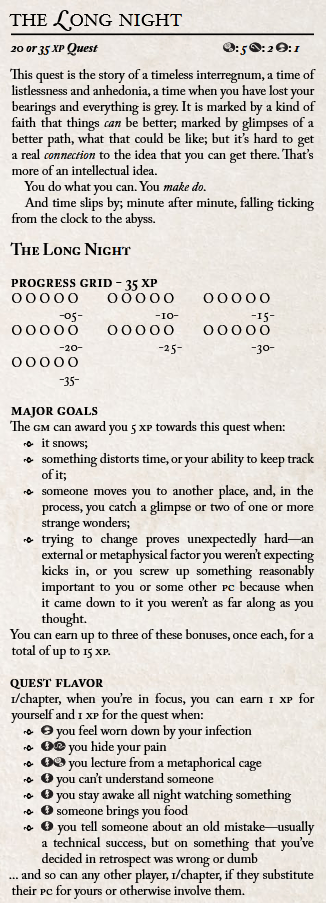
This is why things like Quests in Glitch interest me so much. (If you read the instrumentalization post when I linked it, you’ve seen these already.) Not only can the players just write their own, alongside picking from a list, each one comes packaged with explicit and implicit writing capacities both – actions that you can just declare true, and larger goals that the GM is obligated to put in your path, aligned with the thematic bent of whatever the Quest is about. (Which is sometimes bad! There’s multiple Quests about spiraling into depression in one way or another.) They’re properly-structured and mechanized methods to grant authorial power to the players, even while the game is instrumentalizable in other dimensions (it’s got a whole resource management game at the heart of it), and it weaves in similar scripting-the-future capacities to scene framing. In terms of putting authorial power in the hands of the players, it’s quite a nice format to iterate on.

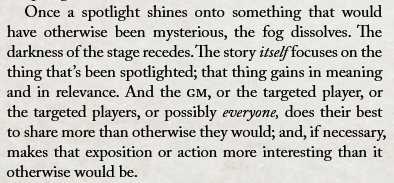
That’s not the only thing like it in Glitch. Honestly, the game is a solid starter point for systemized player authorial power within a GMed context while still having instrumental play relevant to the players. Each player comes with a budget of Spotlights per chapter, which, alongside literally regulating the spotlight between players (since everyone has to go through their budget, so if a player is lagging behind the focus moves to them to catch up), serves as a limited authorial capacity.

There are a few other uses for Spotlights, including ones that let you inflict even more authorial power when in the alternate void-dimension that you have more control over than reality (the game’s premise is complicated enough that I could make my own gushpost about the lore, so let’s just move on for the moment), but you can see the elements here. You spend your budget of Spotlights to take parts of the world and make them have more information to give you. Center them in your perception, and the importance of the story. You can take an NPC and push them into new characterization, even if the GM was going to have them be a gloomy mess for a while. (That one happened to me, as a matter of fact.) These are alongside the in-some-ways-authorial powers that the game gives its players as a matter of their diegetic capabilities. You have a lot of options to write things into the world, in Glitch. Budgeting Spotlights is part of the gameplay as much as budgeting your more active powers is, but, the game tends to give you more breathing room with them, and the GM’s interpretive power does work something like a veto – but these are, still, powers the player just has. By including these systems, Glitch expands the domain of a player in ways that even setups like Fabula Ultima‘s don’t.

A farewell to arms

Honestly, for as much as I’ve milked it, I kind of don’t like the domain analogy.

From an instrumental perspective, as we’ve covered, there’s an important utility to it. If you don’t understand the bounds of what is fair to do and what is unfair, you can’t play your best and be satisfied with a win. When those bounds are socially defined, and applying pressure to the GM will let you expand them, it muddles it even further – did I win because I did my best, or did I win because I wore down the will of my friend? Can I say I’ve done my best if I didn’t wear down the will of my friend? The GM veto and capacity for arbitration has shown up many a time in this post, even in mechanics that I’m mostly praising. In a sense, my thoughts on stunting all apply here, as well. I don’t really think there’s a way to get around that, too, if you’re keeping things within the instrumental milieu. If you have goals, and obstacles, and player tactics centered around how well they can manage those obstacles, or even only a couple of those elements – the border is going to run hot. You’ll need to navigate the diplomacy at the table, to avoid it turning into a war.

And, for as much as I enjoy instrumental play, I think that’s a shame. As a GM, I like doing invasions into the players’ space sometimes, in this analogy. I’ll tell them part of what their characters are feeling, how they would instinctually react based on what’s been established about them, and where they might want to go from there. That’s another instance of “here’s a trick that has nothing to do with the mechanics,” so, take it with a grain of salt, but it’s only something that can be done if the boundaries of narration aren’t quite so clear-cut. That requires the players to figure I’m not trying to beat them down with this – which means them not expecting me to be putting obstacles for them to have to overcome. There’s a sort of trust there that can only exist if the arrangement isn’t too instrumental, isn’t that adversarial. And I think that’s why I find implementations like Fabula‘s to not really resolve the problem for me – they’re certainly better than nothing, but they’re coexisting with an understanding of what the GM is here for and what I’m here for. If I lose that understanding, the game’s mechanics are much less useful, the whole thing is centered around a fleshed-out combat system, after all – but if I keep that understanding, whenever I write, it’s a play for power, and whenever the GM writes, it’s a setup of something I probably need to keep an eye on.

The value of fluff, of writing in the margins, is that you can do it without it being a threat. The GM can figure it won’t support a scheme, and veto it if you try to let it – and the players can let it slide without having to keep an eye on every angle, if the GM is content leaving things as aesthetics. The value of systemization, of things like Quests or a hypothetical formalized scene framing, is that it can coexist and intertwine with instrumental play, because the mechanics themselves can be built to not let the players slip by and get too powerful.

If you ditch instrumentalization entirely, then systemizing it is still helpful, because systems give structure to players – but you also need an idea of what the players are actually trying to do. And “tell an engaging story” is, in that dimension, a circular and pretty meaningless goal, which is why you’ll see things like Belonging Outside Belonging games come with more specific moods you’re trying to elicit when playing a given character or environment element. (And even those have some amount of token-optimization gameplay to them, as a rudimentary chassis to push thing forward. I think it would be somewhat difficult to find more than one or two games that are entirely free of instrumentalization.)

Ultimately, I think my conclusion is one that I’ve been orbiting in the past several posts. Trust is an illusion. Even freeform roleplay is founded on a baseline of what are the boundaries you can’t cross and the things you shouldn’t do, where the domain of the other player begins and you don’t have a right to touch unless they’re comfortable with it. And I don’t think that’s a problem, per se, I think “trust is an illusion” is an applicable lesson to the social entanglements we have even beyond RPGs, but I do think, as designers, it’s an important thing to recognize. Where we take trust, and collaboration, and authorial generosity for granted, the systems we write can’t. But they can make things explicit. They can say, “this is a power to write, you may do so”. In a way, that’s the most fundamental thing they do. The list of skills in Shadowrun defines a set of actions you can take. Some games will be more or less persnickety about how much that covers the entirety of the actions you can take, but they ensure a minimum. A player can always narrate something in line with at least this much, and the system will support it.

People rely on trust to cover the space between [what my character does] and [what exists within the broader world]. The GM has implicit dominion over the borderlands, and the players can move as far as the GM’s grace will let them, maybe.

As designers, we can do better than trust. But that starts with understanding the shape of what we’re building on. One large domain, and several tiny ones, trying to branch out.

Usually, that’s not what writer’s rooms look like. But it doesn’t have to be. This isn’t a demand that every player get equal authorial billing the whole time, especially not if you do want there to be instrumental gameplay to it. But room to expand beyond what they’ve got is a blessing for players of all stripes, and rules can support that exploration. So, they should! Everyone’s writing. The system should give them room to write. That is, in a sense, what RPGs are for.

Winning and losing in the games you can’t win

I’ve been doing some reading on GNS lately.

(Please don’t leave, I haven’t even gotten to the bad part yet.)

More specifically, I encountered this post by the irreplaceable Vincent Baker, which is a retrospective in some dimensions and a reinterpretation in others. And if you’ve never heard of GNS before, I think it can give you a biiiit of a primer about what it is. In short – it was a model of game design and play sensibilities, popular in online RPG theory throughout the aughts, mostly centered on people who favored one of the codified approaches to design and wanted to build for that. As a result, the other two (the G and the S) were a lot more ill-defined as outgroup taxa, and mostly served to rhetorically be “people doing the things we don’t like”.

As I’m sure you can imagine, this started a lot of fights. GNS is kind of synonymous with [that thing everyone yelled about forever] nowadays, and when it gets pulled back out it usually ends up being more yelling, followed by people going “sounds like we defined our terms differently” and storming off in a huff. Fun if you like miserable repetitive fights, but not worth much beyond that. We’ve got other models and new terms to yell about. (I like rambling about ghosts, for instance!)

But, if you dive through old RPG theory posts, it’s inescapable. And, really, the lens of it as being written primarily about Narrativism, the N of the three, and the other two being outgroup guesses that don’t necessarily model anything concrete, gives an interesting recontextualization to the posts that invoke it.

A history lesson, however, this is not. I’d have to do more thorough research for that, disadvantaged by the fact that I did not live through most of it, and I wouldn’t really have a point to make, beyond “hey, look at these ideas from the past, some are insightful and some are terrible.” Could that be fun? Certainly, I read these droplets of the past every so often for precisely that reason. But, it’s a bit weak as a thesis, for my tastes.

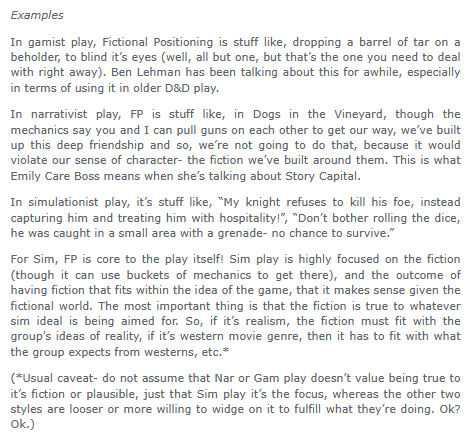
Here’s a post from about the era I’m discussing. 2008, GNS was in full swing in the zeitgeist. It’s discussing a concept, new in the terminology field, well entrenched by now – this post was one of the first clear sources on it, in fact. [Fictional positioning]. (I’ve also discussed this, indirectly, but I won’t link everything I’ve touched on here and there. I orbit a lot of topics, and if you read the last post I made, this is a direct expansion of a sidenote included in that one. It’s all recursive.)

Fictional positioning is… positioning within the fiction. Sounds rather self-explanatory, to some degree. It’s when you say, “I have the high ground,” even if there isn’t any mechanical meaning to that. It’s when you pull a gun from your holster, but the GM protests that you never established owning a gun, or a holster. It’s when you say “I walk across the room” and we assume your character has the ability to walk and exists in a room, on the side they don’t want to be. Fictional positioning is invoked when these things happen, and invoked when these things are canceled because the preconditions aren’t fulfilled. What do you mean, across the room, we’ve established there’s a hole in the ground! And you’re outside!

Obvious in retrospect, valuable to codify. Kind of goes to show how weirdly nascent this field is, that base concepts like that, which, I, for one, definitely took for granted, are dated that recent. (Almost 20 years ago is hardly recent recent, but on the scale of art? That’s very short.)

And, indeed, we see the three letters come up again. G, N, S. All framed in the context of how these three categories, which we now think of as one category and a couple of guesses, engage with it.

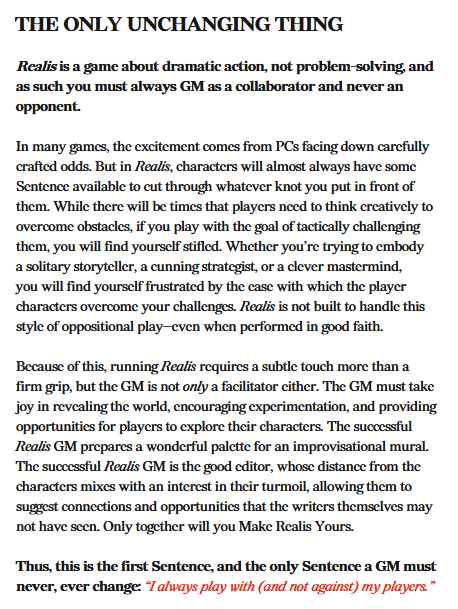
Here’s what Chinn (the author of this post) has to say:

And now, just one more mote of ado.

If you like miserable repetitive fights

Remember when I said that?

Unfortunately, I was talking about myself.

I enjoy arguments. I find them intellectually and socially satisfying. Many of the posts on this blog were born from arguments with people about RPGs and what we enjoy about them, and how those systems work. It’s a method to hone my ideas, in my experience.

It’s also socially unhealthy. Not as in for me personally, I’m quite alright, but it can poison a social context. If you’ve ever been anywhere on the internet that entrenches someone toxic and mean through argumentation, you’ll notice that the tone around the space gets worse, and generally it becomes a less pleasant context to exist in. You also tend to entrench a specific group of loud opinion-havers and people who agree with them, and further push away anyone else. This isn’t entirely the deciding factor of the course of RPG theory discourse in recent years, but it is definitely a contributing factor, and you can chart out many of the balkanized groups in terms of who is writing angry posts about whom. (I’m hardly an exception, if we’re being honest.) So it’s something I try to be cognizant of, and keep myself focused on interest in the perspectives of others, and improving the accuracy of models. Some amount of emotional bleed is always there, but an argument doesn’t have to be a fight, one would hope.

The primary cause of arguments, however, is still disagreement. And the primary cause of disagreement in RPG discussions is a difference of taste. People want different things out of RPGs, and if what I want is incompatible with what you want, and I come in with some rambling models of how to better build a system that does what I want, to you, who will necessarily lose what you want from that system in the process, because the two are mutually exclusive… well, you see how that goes.

Among the categories of people with distinct interests in RPG tastes and a similar propensity for argumentation, I’ve most commonly ended up clashing (again, not necessarily hostilely) with what I would describe as OSR people. The OSR is another digression, one with an unfortunately much more bitter history to read through – where the Narrativist movement had some dubious takes and general argumentativeness to its name, the OSR was for many years a seedbed of reactionary sentiment. Not merely as in terms of reactionary to RPG design; as in, “don’t worry, OSR stuff is no longer a gamble on if it’s racist” is a true statement I can make nowadays and only nowadays. Reading into OSR history may be enlightening as well, but, unlike the former sorts of history dives, which may be intellectually compelling, this one I definitely cannot recommend.

However. Nowadays, OSR stuff is no longer a gamble on if it’s racist. The OSR folks I discuss things with are, in fact, decidedly not racist, a quality I appreciate in the company I keep. And the OSR movement, “old school renaissance,” directly harkens back to the gameplay modes of old editions of D&D. Or, well, a nostalgic imagination of what those old gameplay modes were. Coherence in the present has come from discarding fidelity to the past in favor of clearer design. The goal of that design, and, by extension (though that reverses the causality) the play interests of the ones I’m deeming OSR people, are focused on gameplay fidelity to an imagined world, difficulty and danger that must be overcome through clever outmaneuvering within said imagined world, and a distaste for boundaries of both concept and gameplay. In a word that has moved to become somewhat synonymous with the movement – Simulationist. Our dear old S.

Now, I love boundaries of concept and gameplay. In fact, I long to be entirely bounded, and find the most satisfaction from games that properly construct a device for me to move within. I am a ghost that wants to be a mere droplet in a pipe, and never fly free again. So, you can see the core of where we clash. Discussing with the OSR people I know helped me consider my ghost model in more detail. It helped me see the various expectations put on GMs. It helped me see what it was I liked about Lancer, Panic at the Dojo, and etcetera – in contrast to what they found chafing about those games. A well-defined structure to play within, and strive to win at. A game I could play, and examine the game pieces as game pieces, and know if I was winning and how well. That is what I wanted, and what they found jarringly unrealistic. Their tastes did not align with what I would call the G in my own tastes. A Gamist I was.

This is all, of course, horrendously misapplied. I didn’t put much stock in labels from a multi-decade-old model that had been endlessly fought about, but these were the categories as they were split up, when GNS came up in discussion. (And then proceedingly, in fights.)

…Here’s a thing, though.

Remember this snippet?

This is exactly the thing I didn’t like. The thing I appreciated well-codified tacticsgames from not making me worry about. I get to a fight, the fight is balanced within its rules, I play within its rules, that’s that. It’s fun specifically for how it eschews fictional positioning as an element.

More interestingly – this is something OSR people would actively bring up to me. As what they liked, and wanted to do, and why they found games such as Panic constraining. They wanted to engage with the world, weaponize it, use it to be clever and bypass the obstacles in their way. Being deprived of that was a disappointment, and that was the appeal of OSR games, no?

And yet, it’s the G on that list, not the S, that categorizes this behavior.

Now, some amount of historical context is warranted. Most of the games I enjoy in this vein, Lancer in particular, but, really, many of them, owe their existence to D&D – specifically, the fourth edition. 4e in some ways pioneered this style of rigorously-mechanically-constrained combat design centralizing play, building on top of 3.5 already having codified combat to an unprecedented degree in comparison to prior editions. This led to it being rather maligned (in no small part thanks to an opportunistic marketing campaign by Paizo,) though, not a sales failure as I often see it reported. It would take a while for the indie scene to take to it as a pioneer, too – a post made in 2008, the same year as 4e was initially published, is to be expected for not accounting for its legacy. In fact, the GNS essays themselves were written around the turn of the millennium, and cite games like Shadowrun as Gamist affairs – because Shadowrun was one of the most mechanically-dense and optimizable options there was. Would things change if this all had been done more recently? Maybe!

But, remember. These are wastebin taxa. Gamism is written to cover [that behavior other people do that chafes with us (ie the people who prize Narrativist play)]. And that behavior is distinct from the specific game context it’s in. The behavior that was being gestured at, and not elaborated because it wasn’t in focus, was the direct commonality between me and the aforementioned OSR people.

The point of that example is that it’s using fictional positioning to try to win.

That’s what the G meant. For as much as it meant anything.

Playing to win

Most RPGs put a goal in front of you. (If you’re a non-GM player, at least.) Survive this dungeon. Steal this treasure. Rescue this dragon. Whatever it is. Sometimes, there’s a reward for it. Sometimes, there’s the opposite of a reward – you get there, and you stop playing. But the point is it’s a thing you want to do, and the experience of play is oriented towards you eventually doing it, or failing at that. Notionally, it’s probably something your characters want, so the motivations are in alignment if the players want it too. Plus, it gives an easy direction to go for all the cool challenges and interactions and whatnot. Going for the goal is playing the game.

It makes sense to try to win, then, right?

Just walking in a direction you’ve been given, metaphorically speaking, isn’t bad. I’ve had fun with that. But I mentioned challenges just now for a reason. Most of the actual tools a game might hand you as a player, or the GM as a GM, are focused on things that might stop you from achieving your goal. The goal that the gameplay is oriented towards, and your characters are motivated towards. If those challenges can’t actually stop you, then whatever you choose doesn’t really matter here, but if they can? Well, then, if you try, you get the experience of struggling to overcome a challenge, and if you don’t, you just don’t get to continue in the direction the adventure was built.

This is the logical foundation of what was prior being identified as Gamism. Naturally, since it’s human behavior, a logical foundation isn’t the only core of it. Using the manyfold model to try to summarize it, the emotional satisfaction of approaching a game like this comes mostly from fiero (the thrill of triumph) and ludus (the thrill of engaging with game mechanics directly). (In fact, the distinction I was noting between my tastes and the OSR tastes can be noted as the latter point – whether ludus fun is a priority, or if fiero is the sole focus.) And, I recognize that’s even more terminology to throw at you, so, in short, intuitive terms – winning is fun. Trying to win makes you win more, and both the trying itself and the increased number of times you win make for increased fun. If you enjoy that.

Winning is a thrill. It’s an easy kick to get, and to want to keep getting, as much as you can manage. So, the trick is, playing to win snowballs on itself. If left devoid of context, you just keep pushing more and more, figuring out new tricks and new combos to squeeze the most possible effectiveness out of a given build, the most effective way to bat your eyelashes at the GM and get them to okay your plot to cross this 10 foot chasm. You wouldn’t stop, unless there was a reason to.

But, unfortunately for this hypothetical context-absent you, they are about to die, because there is a reason. There’s an inherent maximum reward to this. Once you have a setup strong enough to always win, you don’t get any more benefit from continuing to empower yourself. You might get some of the tactile appeal of piecing cleverer builds together, if that’s your thing, but in time that fades away, too. You hit that threshold, and it becomes more trouble than it’s worth to go on. If that threshold comes too soon, you might not be satisfied by the game at all.

And that’s because the threshold of [you now win no matter what] is beyond the bounds of [interesting play]. Which means, feeding more context into the hypothetical, someone should have stopped you before then.

That puts a defined ceiling on how much room to push yourself there should be. If you can make a build that wins all the time, the GM needs to put challenges out that can match the power of that build. If you can argue a plan that the GM always has to accept, the GM has to put challenges in complicated enough that stringing several individually-perfect plans together becomes its own challenge. The worst-case scenario is they toss their hands up in frustration and punish you in particular, bypassing your efforts entirely. If they don’t do that, though… you’ve still got room to maneuver. There’s more blood to squeeze from this stone. As long as you aren’t always winning, and you haven’t conclusively hit the limit of what is possible in the system, keep trying new things, and you might tip the odds ever more slightly in your favor.

Now imagine if you’re playing next to that guy. The person following the logic of the above paragraphs. And, let’s take a more emotional appeal for a moment. Even if you don’t care as much about trying to win as they do. See how the GM had to spend so much time worrying about them, and figuring out specific counters? See how effectively they pushed you guys towards the goal, the thing that play is oriented towards? They’re in the spotlight. They have more control over what happens, and more attention from the other players. If that doesn’t make you green with envy – the next time an obstacle happens, and you’re responsible for resolving it, think about how less stressed you would be if you had the edge. This is something tuned for their nonsense capabilities, and you’re struggling to pass muster. If you fail, that might hold the whole group back, and they might get mad at you. There’s social repercussions to consider. Isn’t it better if you’re all on the same level?

This is what I’ve come to call [instrumental play]. It’s one of the first things I try, when I sit down with a game, and it’s what comes naturally to me. But, as I’m sure you can see – even in the context it’s adapted for, it has a lot of problems. It asks for an infinite treadmill out of an inherently finite system. There’s only so much better you can make yourself at a game, especially when a lot of that betterness comes from social adeptness, rather than anything mechanical. If your GM isn’t actually prepared to make challenges to match you, you will just win, and that might be fun for you for a short time, but the kick gets old, and nobody else will be enjoying it, either. If even one player isn’t on board with it, or even just on board with it to the same level, someone is gonna be unhappy. One of the most important skills for an instrumental player is learning how to rein it in. And that sucks! I hate reining myself in! I’m here to let loose and go all out and all that jazz.

This is, in essence, the behavior the G in GNS was trying to gesture at, as a “we don’t do that here.” Instrumental play has a lot of faults, if you value things other than getting to the end as efficiently as you can. Have you ever wanted to have your character get afraid and run away? Have you ever wanted to have them suffer a crisis of faith? If those happen, they might make you less capable of solving the problem you’re faced with. You’re hindering your effectiveness that way. The more instrumentalized you get, the harder that is to excuse.

That’s why it’s “instrumental.” A character is an instrument. A tool. A piece on the board, if you will. It’s a game, and winning takes effort, and the toys the game gives you are all about trying not to lose.

The catch

Here’s a question.

How do you know you’re winning?

One of the appealing qualities of instrumentalization is confidence. You know you’re doing your very best, and getting to where you’re supposed to go. You’re following the intended path of play, and that’s a good thing to do. So many complaints and horror stories about RPGs come from people refusing that, or simply not caring to, after all.

Sometimes, it’s pretty clear. You might not have a map of the whole dungeon, but whenever you find a new room, that’s progress towards seeing everything there is in this place. Eventually you do get to the end and find the princess. You just have to keep doing what you’re doing.

But not everything works like a dungeon.

What I’ve written about instrumentalization so far presupposes a clear goal to work towards. If there’s a fight, you know what you have to do to win it. If there’s a ball, you know who you need to slip the evidence to mid-dance. Etcetera. The more open-ended things are, the harder things get – because telling people ‘here’s what you need to do to win’ is not all that common. Open-endedness is often touted as a virtue of RPGs, after all.

For the most part, however, that open-endedness is an illusion. There is a goal, or, at least, an end state, the players are trying to reach. The game, and/or the GM, are expected to give little flags to signal that you’re going in the right direction, that there’s something to find this way. That’s much more common than there actually being a thing in every direction – much easier to implement, too, and if you’re the sort of person to enjoy a narrative with some focus when all is said and done, it works out better that way.

I recently had an opportunity to play the Magnus Archives RPG, running one of the modules it came with. Unfortunately, I can’t recommend it – Cypher disappoints me at the best of times, and it’s a very poor match for a mystery, of all things. But, it’s a phenomenon of adventure design that I want to talk about today, rather than that.

In short, the thrust of the adventure was an evil wasp nest that was doing evil magic that was planted by some suspicious people that we needed to investigate. Since it was an investigation, it was quite open-ended – go to places, poke around, do some skill rolls, hope you find some stuff. For the most part, freeform. We did find some stuff! Several clues, enough information to get us a sense of what was going on with the evil wasp nest, etcetera. Among those clues, we found a book. Upon reading the book, one of us immediately suffered some Stress (the game is operating somewhat in the Call Of Cthulhu milieu), and was told it involved some strange geometry and hurt to look at. Ominous! And definitely relevant to the case. We pocketed it for returning as evidence later, and didn’t read it again, on account of it was injuring us on a mechanical level, and intentionally reading more of the magic tome that does evil infectious bug things seemed like an obviously terrible idea.

As it happened, however, the adventure was designed such that a key piece of information was only accessible by reading the corruptive magic book and paying the Stress tax, three times. The detail we needed to find was about something growing within the hive, which was rather awkward, since we had already concluded the hive was growing, and, in fact, made a point of pretty soundly destroying it before we were done. The GM had to workshop that the specific element they were growing within it had managed to survive, and thus, we had only partially achieved the goal of the mission. Which we didn’t know was there, because we hadn’t read the book, because doing so was damaging us for no apparent gain.

Now, I do think there’s a fair bit to criticize about this as adventure design, which again loops into my dissatisfaction with the system. But, instead, I want to pivot to a conversation I happened to have a few days later, in another context, about Call Of Cthulhu proper.

The key argument of said conversation was – Sanity loss (and, by extension, Stress damage in this context) is a flag. It damages the player, yes, but it signals to them also – here is where something interesting is, you should pay the tax and see it.

This was both interesting and confusing to me, mostly because it had just never crossed my mind. I’m not much of a Call Of Cthulhu person, I haven’t played a lot of it, but, just as a general principle when I’m playing games, I try to avoid random losses of resources. If something demonstrates itself to be a fire, I pull my hand out and don’t put it back in unless I know it’s worth doing. It’s a resource-conservative mindset, which isn’t always instrumentally correct, but it is, usually, pretty consistent. What I hadn’t been considering was the resource cost absent the context of the game. That is, as a piece of communication from the GM to me (or the adventure module to me, or etcetera). And, if I had, I would have probably considered it as a warning. Touch the fire, get burned. Here’s something dangerous, keep going and you’re gonna keep getting hurt. This would be a stupid and inefficient thing to do. Right?

But, that’s not always the case. As evidenced by people who were COC GMs in that conversation nodding along and saying that, yes, they absolutely use Sanity taxes as a signal that players should go here. The theory was, as they explained it – players are expected to look at Sanity loss as an inevitability. Not something they should minimize, but, rather, an inherent phenomenon of walking down the track of the game. Engage with eldritch horrors, lose Sanity, insert rest of game there. As a result, not losing Sanity is a downside flag. It means that you’ve missed the path you were supposed to go on. That’s the sign of the goal, not a wall.

Except also you can avoid some Sanity loss while moving towards the goal if you’re smart about avoiding the hazardous parts, and that is the most ideal play, so you should be doing that, from an instrumental perspective.

And there’s the muddle.

See… I’m bad at picking up implications that are left unstated. That’s part of what draws me to instrumental play. It’s clear in both its motives and the context it necessitates around it. Have goal, move towards goal. It’s simple. Similarly, if a game hits me with a mechanic that I know will be bad for me if it keeps happening (Sanity loss, Stress buildup, etcetera) then I’ll know that’s a dangerous thing, something to avoid having happen again if I can help it. An invisible manner in which that is also a lure to compel me to engage more, if it’s not stated by the game’s design as a reward and it’s not stated by the GM as a norm of play… well, what happened in the Magnus Archives game is what happens. I don’t even realize that I was doing something wrong until I get to the end and am told I was expected to come to an entirely different conclusion.

Instrumental play is preconditioned on having a sense of what you’re supposed to be doing. One of the big failure points of GMed RPGs as a medium is lacking that sense. I think every game that has gone wrong for me, I can point at least in part to an absence of direction as part of the problem.

And the thing is, if the GM is the one providing that sense, it gets worse. GMs have a lot of conflicting responsibilities to their name, but among them, if you’re good at instrumentalizing yourself, they’re going to feel obliged to stop you. Can’t let you win too easily, or the whole experience breaks down. (Maybe.) This is where the thing I said before comes in – the GM has to add more and more difficult challenges in front of you, and you run the risk of them getting frustrated and actively singling you out for punishment. Would the latter be wrong of them? Yes, of course, but it would also serve to rebalance things if you’re far ahead of where the other players are at in terms of ability to engage with the game. No options are good, in a sense.

If you get on a treadmill of harder obstacles and more power, you have, in a sense, bought into an illusion. Your optimizations don’t actually make you any more efficient, since you’d be facing a weaker challenge if you hadn’t bothered. It’s an illusion the GM is spending active effort into having to maintain, too, which isn’t great. (If you’re seeing a comparison between this and certain progression systems, that’s another story, but – yeah, many of those are illusory treadmills for the same reason. Giving the player a sense of satisfaction at getting more efficient, more powerful, more instrumental; without actually having to reckon with the consequences of that.) Is that satisfying? It can be! I find this sort of treadmill to be a good way to ease off my instrumental brain, for games where it isn’t helping much. But it doesn’t do the same thing. It’s still, ultimately, smoke and mirrors.

Instrumental play, more than many approaches, highlights the PvP nature of RPGs. It sets you against what the GM has in store for you. A lot of the time, it’s a game imbalanced enough that the GM could just wave their hand and win instantly. So it can really only ever go one way, for the most part. And that means, to truly instrumentalize yourself, you have to learn to read your GM in and out. Know when this is an obstacle to overcome, when it’s a warning that you put your hand in the fire for no reason, and when it’s a flag that you’re on the right track, which just happened to come with a bit of damage for your trouble. If you don’t know, or you guess wrong, it’s easy to fail entirely, no matter how well you play.

Stress

A lot of my RPG theory is born, I think, from finding it rather stressful to interact with people.

Now, there’s a lot to unpack there, and a random blog post for the public eye is not the place to do that. But, I do think it’s relevant context, and a lens worth considering. People are stressful! Socialization is a complex tangle of rules and norms, most left unspoken and yet harshly punished if you transgress. It’s not a very well-designed system, in terms of user experience – and it’s a fundamental substrate all non-solo RPGs are built on. Understanding how that influences the shapes and structures of play is fundamental to understanding the medium.

Instrumentalization is, in part, a social gambit. If you get everyone on board, then you don’t have to worry about that anywhere near as much. Are people passively unhappy with you? Are they charmed by you, and going to go out of their way to assist you? If you’re all working for the same goal, and you’re all focused on efficiently achieving that goal, these things don’t not matter, but they do matter a whole lot less. The implications of being favored fall away, for the most part, in the face of the implications of the rules and structures of the game.

If the gambit gets declined, of course, if the group isn’t on board with instrumentalization, you are now eclipsing them ‘unfairly’ (‘unfair’ in that you are not doing so by engaging with what the group wants to be the deciding factor of player significance) and that likely itself becomes a social repercussion. Which makes for a complex negotiation phase when moving into new playgroups – though, that phenomenon is certainly not unique to instrumentalized play. That negotiation always happens, and if left unsaid, it happens in the underlying passive-aggressive social layer of approval and disapproval.

Interestingly enough, though… social anxiety or no, the stress of instrumental play doesn’t end if the gambit is accepted.

Winning is hard. (I mean, sometimes it isn’t, and the GM is primed to let you win – but in that case, instrumentalization really flounders against itself. It expects winning to be hard.) You have to be on the ball, and doing you’re best, and you’re going to make mistakes. We’re human, it’s what we do. Sometimes, even if it isn’t necessarily a mistake, you’re going to make a guess and get it wrong. Mispredict something. It’s especially difficult when what you’re playing involves predicting what the GM wants you to do, or will let you get away with. There’s many variables to juggle, and if you don’t juggle them right, you’ll fail.

The first thing I feel when I win an encounter in an RPG is relief. I’ve made it through. I can relax now. I’d wound myself up a lot there, but it’s done now.

It’s satisfying, too, don’t get me wrong. I’ll be pleased by my success, happy to bask in the reward. But the first thing that hits is relief and fatigue.

It’s tiring, being locked in. It’s stressful. And it gets more distressing when all that comes to naught – either my best wasn’t good enough, or I couldn’t bring my best, and both are bitter pills to swallow after however much time it took stressing about trying to win. Loss is a looming threat, on an emotional level, entirely because this is a thing I care about. That’s tough! Even if everyone’s on board!

I don’t think my heart could take a game that’s all instrumental, all the time. I’ve played them, and at best they’re a sometimes food for me. I’ll need time to recover, and needing time to recover after a campaign of an RPG isn’t necessarily to be expected.

What I’ve found works best, then, is segmented play. A game with modes where I’m supposed to be going all-in, and ones that serve as breaks. A release valve of putting around between fights, to keep the emotions down.

I think these kinds of breaks are valuable! Even in a broader conversation than about instrumental play at all, just, having break time in between tense modes of play is valuable for any multi-session-length RPG, for the health of the players. It’s a good design facet to keep in mind, and it’s why things like downtime mechanics that serve almost no purpose beyond as scene framing are actually quite handy to have.

However, we’ve hit another intuitive snag. One that circles back around to our example of fictional positioning, of all things.

We just had a tough fight. We’re putting around. Getting a few character moments in, maybe. There’s another encounter on the horizon, but we’re not there yet, we still need to de-stress a little. Something about a beholder.

Someone asks if they can find a barrel of tar nearby.

We are now instruments again.

It’s a sensible consideration, right? Yeah, we’re stopping to rest, but there’s another fight coming. We have time to prepare. The smart thing is to use it. It’s much more difficult to use the environment in combat-time, setting it up to our advantage is clever, etcetera. Hardly any complaints from an intuitive level, and from an instrumental level, exactly what we want.

But now, I can’t relax here. This isn’t a break, it’s another phase of the test. If I don’t figure out the most efficient use of my break time, the best way to prep us for what’s coming next, I’ve messed up. I can’t afford to be doing these side character moments that I wanted to get to even though they don’t mean anything gameplay-wise, I have stuff to do! Heck, what if there’s some sort of character bond system to focus on? If I don’t make my character interaction scenes as efficient and value-positive as I can, I’m sabotaging myself!

This forms one of the big boundaries around the sort of break I need, and definitely one I encounter the most opposition to in discussions of game design: breaks need to be unimportant. Structurally, that is. They can be meaningful to the players and the stories they’re writing, in fact, I find they’re quite valuable in games that otherwise limit the player capacity to focus on character moments and interactions, but they can’t be vectors to win. At most, I find the aforementioned downtime systems to work decently well as a compromise – in Blades In The Dark or Lancer, you pick from a list of downtime options based on the benefit they give you, and then what happens when you play them out won’t change the game. It doesn’t shift the mechanics, after that initial choice – it’s a little bubble of break time, where you can do the wrong thing, have a character self-sabotage a bit, and not have it come back to bite you. It’s nice.

It’s, I imagine, what everyone who doesn’t play like this gets to experience, when they aren’t stuck next to a player like me.

…Kind of.

I started this post by discussing GNS, and its relationship to instrumental play as a vaguely-defined “other people do this, we don’t want to, let’s make our own thing for us instead of them”. I’ve had, in various discussions, the concept brought up that this play approach is inherently perverse, and, perhaps, there’s something wrong with me for engaging with it at all. It’s the mark of an inherently toxic or to-be-avoided player, the theory apparently goes.

Now, I’m not one for pathologizing preferences, especially my own. I happen to think that I am a perfect being and everyone could stand to be more like me. But, there is one factor to all this that I’m interested in noting, and picking apart a bit.

To wit – it is a worse experience to play alongside someone instrumentalized, if you don’t enjoy that sort of thing.

Forget the social gambit consideration, and just look at the experience of play. You’re faced with a challenge. The primary way you can engage is by overcoming that challenge. The guy next to you is really good at overcoming the challenge. You would like to have the spotlight every so often.

What do you do?

You figure out a way to outcompete. You get better at overcoming challenges yourself.

Or you don’t, and the GM starts posing tougher challenges to match the next guy, and now you aren’t even getting your normal share of success. If the next guy (I shoulda just named him) were to vanish, you probably couldn’t even progress at all.

If you’re not happy with that, if you don’t care too much about that, if overcoming obstacles is just what the game happens to mechanize and not what you care about? Yeah, I’d imagine you’d be peeved at Steve over there (I named him). You wouldn’t really be wrong to, either. Your experience lost its appeal to you, and your capacity to engage with it, all because of the way he approached it. One of you needs to change, and, in the passive-aggressive social context where just talking expectations out would be a faux pas, Steve has you beat, because the game is working for his side more than yours. Pushing him out of the group would really be the best option you have, and making sure someone like him doesn’t get to join back in.

(…If it wasn’t clear, I think [the passive-aggressive social context where just talking expectations out would be a faux pas] is a terrible place to be and this method of resolving this situation would make me think poorly of everyone involved. However, getting people to talk about their expectations is hard, doubly so when people don’t understand their expectations, so I get why it happens.)

Probably one of the best ways to avoid this mess is to communicate from the designer end. To tell the players, hey, please play like this, and not like that. I don’t want you to be instruments. Or I do! In a sense, that’s what the [Narrativism as game jam] perspective Baker wrote about was taking – a series of games all made based on a communicated designer intent to have players play for what drama they could find, and not try to win over everything, or any other such goals the players might have (the S was its own thing, potentially, for instance). These are gradients, of course – I brought up Blades In The Dark earlier as an example of a game with a somewhat comfortable rhythm for instrumental play, despite it being a descendant of the Narrativist game jam, because it actually can work that way. But the request is still there.

I read Eureka recently. It’s an urban fantasy mystery game. (The full title-and-subtitle are literally Eureka – Investigative Urban Fantasy.) For a lot of the time spent reading it, I was rather unsure of what to make of it. The most important segment for me was actually nestled away in a piece of GM advice – the GM is asked rather emphatically to avoid making their own adventures, as that would be a lot of work, and instead rely on the preexisting wealth of modules for games like Call Of Cthulhu. Or, in other words, the design of Eureka can be looked at from the lens of being a game built to run Call Of Cthulhu modules, which made several things make a lot more sense to me. I definitely don’t think it’s the sort of thing I would want out of a mystery RPG, but for those intrigued by the prior few sentences, I do suggest giving it a read.

That’s not why I’m bringing it up, though.

(Do note, this is a copy of a game in development, so a few placeholders-for-images occur here and there. The text is the important part, anyway.)

These sections are placed one after another, in explaining the principles of design and expectations of play for the game. Which I do really appreciate! I’m glad that games doing this sort of thing has started to catch on. It is nice to be informed as a player and a reader what the game expects of me. And, for the most part, these sections seem clear to me. I should follow the incentives of the game and the interests of my character to preserve their survival and ability to follow through to the end of the investigation. The difficulty should be tuned high from the GM’s end, because a certain or highly likely victory is unsatisfying in comparison to a hard-fought one. From an instrumental perspective, I ought to be on board with this. Except, the first thing they ask is to discard my prior notion of winning. In fact, they go as far as to propose that I “play-to-lose”. Which seems to declare an upper bound on how hard I should be trying to solve the case, surely. Specifically, if a decision would make significant progress, but remove an interesting situation, it seems I should avoid it. But, then, what if I consider remaining while at low Composure to be a more interesting situation, and I stay in a dangerous context? My understanding is the answer would be that’s supposed to happen, but that also means the incentives the systems are producing are now pushing against the goals it sets out for me. How do I know when I’m doing too much instrumentalization, and it’s sabotaging the interest? How do I know when I should be doing more? The answer is left unclear, and it’s on me to figure out.

And, to be clear, I understand why. But this, more than anything, is what stresses me out about instrumentalization. The idea that there is a too-much. There is a ceiling, and if you go past it, you should not have. But we don’t get to tell you where the ceiling is. You have to figure it out, and if you guess wrong, you’re Steve.

In the ever-spinning gyre of RPG discourse, there’s a term from some 10 or so years ago. “Flashlight dropper.” I believe it comes from Call Of Cthulhu gameplay, even, though I’m not certain of that. A flashlight dropper is a player who, when presented with a scenario frightening to their character, says something like, “I drop my flashlight and run away”. It’s a derogatory term. The point is, this action is so obviously foolish from an instrumental perspective, not only abandoning the group but depriving yourself of a valuable tool for no reason (at least keep the flashlight when you run away!), that players who do it are disruptive to any even-slightly-instrumentalized arrangement. If you have an objective you’re trying to fulfill, that act is actively sabotaging you.

If I were playing Eureka, I would leave this intro post simultaneously thinking that the game expects me to drop flashlights, and that group defeat would be inevitable if I did. Part of the logic behind flashlight dropping is that real people would do that. Real people are stupid! If I was panicked, I might drop my flashlight before running away from a monster. Would that make for a more interesting story? I don’t know, I’d be more concerned with the monster than finding out. But if the mystery was set up as Eureka asks it to be, I’d interpret that as a significant detriment for no gain, and telling the other players that our goal is to have a fun story, so actually this was fine, would feel pretty flimsy. It’s hard to look someone in the eye and say that counts as a win.

What even is a win?

I tend to get pretty aesthetically invested in my characters.

(This is another reason why OSRs don’t quite work for me. They’re pretty strong on characters as disposable tools, as far as instrumentalization goes.)

As a result, this defines, for me, a secondary dimension of winning and losing. If I get through a situation with my character looking competent and showing off their strengths, I’m happy! If they look silly, and don’t get to play to their strengths, I log that as a failure. It’s not a win in terms of the goal the players are working towards, but it’s a win for me in specific, and it’s something I’ll stop to consider before sacrificing.

That’s one of the ways to make instrumental play compelling on other dimensions, in my experience. Force players to choose between priorities, sacrificing one goal for another, and you can get interesting results. As a player, I enjoy dilemmas like that, and they’re much less solvable. It’s not a matter of picking the right answer, it’s deciding what answer is right. They make nice breaks from the puzzle of optimization.

I’ve been chatting with someone recently who has rather similar interests of play, especially in terms of instrumentalization. But, on this point, we diverge. She’s discussed modeling her characters’ dignity, well-being, and situation in life as resources to be expended gleefully for the sake of further resolving the primary goals of play. And this produces problems! Dilemmas like I proposed in the last paragraph are no-brainers to her, and when games bake them in, the balance gets thrown entirely out of whack. It’s just not a win condition for her, so it’s free points.

A lot of dilemmas like this rely on aesthetic player interest, one way or another. Endangering an NPC only means anything if the players care about that NPC. Losing a mission only means anything if the players care about winning missions. Most commonly, the ways games have to designate things as goals and stakes are one of: [here is a thing, please bond with it] and [here is a source of more power]. The former is where things like caring if your character looks good comes in. The latter is what XP is. Why do you care about winning the mission? You want to level up, don’t you? And you want to level up because that makes it easier to win missions. It’s a cycle, or so the theory goes.

There’s also a third option, [the game doesn’t continue unless you do it]. For games with high lethality, or even games like D&D 5e that just have moderate lethality but are happy to lock you into it, that’s why winning a fight is a goal rather than just surrendering from the get-go every time. (That, and surrendering not being a codified option, but you can always intentionally beat up your own party until you go down. And that sounds ridiculous, yes – but, remember. If that gets you to move on, and it gets to the end, that’s only a defeat if you happen to care about the things lost in the process!) In practical terms, this is what things like dungeons are. If the GM plops down an adventure in front of you, and you decide not to bother, then usually this is why that’s not an option. However, usually, people don’t want to invoke this one, so it’s a bit invisible vs the other two.

[Here is a thing, please bond with it] is very unpredictable. Whether the players care or not about a given character, or if they look good, or if the kingdom is recolored purple instead of red, the system really doesn’t know. Usually, this is left to the GM to figure out. They know what the players care about, they can put that at the end of a quest, or put it at risk if they don’t face this challenge right now. This is also hard to systematize – at best, you can say “put something the players care about here” as an open slot in a defined obstacle, and the players will figure something out to go there when the time comes. You might be able to say “players are obligated to care about this person and want their wellbeing,” but I’m not sure how consistently declaring that as a system would land. It’s usually all too interpersonal and fiddly for that.

The second option, though. [Here’s a source of more power]. That has potential.

…Or, at least, it seems to.

Here’s a bit of tech from Glitch.

This is a Quest, and it’s design that I absolutely love, except for the instrumental part.

Quests are composed of two lists that feed into a progress bar of XP. Major Goals, which are big events that give you a solid chunk of XP when they happen, and Quest Flavor, which give you 2 pips (XP for yourself is allocated to any Quest of your choice), and can happen much more consistently. More specifically – you, the player, have the power to just declare that a Quest Flavor happens. They’re little pieces of authorial power that you always have access to while it’s in progress. If I were playing this Quest, I could just say, hey, someone brings me food. And they do! However that resolves. They aren’t materially significant, you don’t use Quest Flavor to overcome obstacles in your way, but they do let you shape the world around you to fit a certain tone, and, since players are allowed to write their own Quests (with GM approval), you can get pretty nuanced with the vibe they create. As narrative-shaping tools, they’re quite nice.

Writing Major Goals gives players a way to signal interest in dramatic moments they might want to have happen, then. And, more broadly, the XP track helps to make sure that you’re never stuck in the same narrative arc for too long, while still being sure it has enough time in the spotlight to really last. They’re not only scripts, they’re pacing mechanisms for certain moods to come with your character. As someone who’s been known to spend whole campaigns with characters wrestling with the same internal struggles unless actively prompted out of them, the utility as a narrative pacing mechanism is something I so rarely encounter and I quite appreciate.

But.

When you finish a Quest, you get build points proportional to the length of the Quest, and power yourself up.

The capacity to write Quests and choose your own is a massive increase in authorial power, vs a lot of RPGs I’ve seen. The premise of Glitch also tends to lend itself away from concrete aspirations, and towards “I feel aimless and have no goal in life” as a thematically relevant point to the players, and thus a feature of play. And yet, it still gets compromised by this! Whenever a Chapter is nearing a close and someone’s Quests aren’t hit yet, they have to awkwardly shuffle through all of them to meet quota, or they fall slightly behind. The falling behind doesn’t actually mean much, but I’ve seen some pretty significant build point differentials build up, and even just on a player focus level – if they have the instrumental impulses I do, it scuttles nearly the whole operation. The Quest can’t even serve as a great signifier of how much more time should be spent dwelling on this particular beat, because they’re all trying to hurry through at the same pace.

Glitch is a better experience if you forget that you’re rewarded for completing Quests, and just use them as a neat narrative pacer. They’re genuinely quite good for that. But if you’re trying to win, they end up working against themselves. In trying to pull people like me into playing along with a narrative pacer, alongside other niceties (you get mechanical rewards for disappointing people, the exact sort of win-one-way-but-lose-another dilemma I was pondering above), the game instead makes it all the harder for me to set down my victory-drive and meet it on its own merits.

I think meeting on its own merits would be fun. I’ve had a lot of fun by doing that. Glitch is a solid game. And if I constrain my instrumental impulses to only when there is a mechanical or conceptual challenge to overcome, it can even work pretty well for that. But I can’t play all of it as efficiently as I can and get what the game wants me to get out of it.

If a [satisfying experience] is the win condition, then the winning move is to not try.

This is why I don’t like XP triggers, in PbtAs and the like. They’re written to direct players towards interesting actions in pursuit of instrumental goals – to try to get a player like me to move where I’m supposed to for a [satisfying experience]. And they can be quite cleverly written for that! But they just mean I rush through a quota really fast, and come out the other side without even having gotten what the game would have wanted for me. Yeah, I hit the right notes, but that wasn’t [winning] when I did it. It was just what I was doing to get the points.

You know?

The friends we made along the way

At the heart of RPGs, as they’re commonly conceptualized, is a paradox.

An RPG is a group improv exercise. It’s a many-vs-one competitive game. It’s a chance to explore characters in complex and fantastical worlds, see what they do, watch them overcome impossible odds. It’s a roll of the dice, and sometimes you lose.

“The goal of the game is to have fun” is a platitude. It’s irritating to me whenever I see it, and it doesn’t give me any direction to aim for.

But… it’s the only goal a lot of these games could have.

Remember the hypothetical instant-surrender adventuring party. What distinguishes a loss from a win, anyway? If the fight doesn’t stop you from moving towards the end of the adventure, why would you bother with it? If it does stop you from reaching the end – well, you stop playing either way, right? There’s no material difference outside the game, the only impact is that within the game, you get either a victory result, or a defeat result. Things get narrated differently, and if you don’t meet again, that’s all it’ll ever mean. Same as any game.

The paradox at the heart of RPGs is that they want you to care, but winning is the language they speak.

It doesn’t have to be. I highlight Quests not just because I really like them, but because they’re a method of game design that puts players in a seat where winning and losing, overcoming obstacles, doesn’t make sense as a description of what they do. Other parts of the game do put them in that seat, it’s not something like Microscope by any means, but you can’t play the act of writing Quests to win, beyond writing in the aesthetic beats you want to see happen – and that’s what you’re supposed to do. The only reason you can play following a Quest to win is that you get a reward once you hit its end.

But, I’m not talking about all the wonderful RPGs doing different things out there. I’m talking about the popular conception, where what you have as a player is your character and the ways they can overcome obstacles. That’s what you get handed, and it’s the primary path you have to influence the imagined world around you. That means that influencing it to become satisfied has to be a win, and not doing so has to be a loss. Right? What else could winning and losing be?

At the core of what I’ve discovered about myself with this post is – I like having the comfort of knowing that I’m doing it right. That I’m following a process as is expected of me, and whatever the result, at least I didn’t fundamentally misunderstand things. If I lost the fight, it’s because I zigged when I should have zagged, or the dice were mean to me, not because I should have just ran. This is why I favor mechanical structures over social ones in games – systems are much easier to read. I can read the rules and know how they go, but operating a human is a matter of understanding their mood and wishes and the social dynamic and that’s all very stressful. I can’t talk to a person and try to get them to see something my way and know I’m doing it right. I can only hope.

Instrumentalization is an approach to RPGs that lets you have that comfort. Here is a goal, here are the tools you have to work for that goal, use those tools and we’ll see if you’re up to the challenge. That’s where it comes from, for me.

Framing enjoyment as the end goal frustrates me because those aren’t the tools I have. I appreciate Quests because they, directly, are a tool for framing a satisfying narrative. They give me what I need to understand “hey, I think this kind of thing would be cool” as a goal to work towards. So I appreciate design like that, too, because I can read it and the way it signals me to act, and I know that I’m doing it right by following that.

When a game like Eureka gives me detailed combat mechanics and a stress resource to manage and skills to aim for rolling, and it tells me actual win condition is to experience a compelling narrative play out, there’s a mismatch. The reason for that mismatch is, the challenge is supposed to be a prompt. We play with the rules, watch the characters succeed or fail, and, with some distance as players, view the resulting shape with some satisfaction. Ideally.

I’m approaching games with the tools I’m given. If those tools are for overcoming obstacles, I’ll be playing the overcoming obstacles game. Whatever the shape is after the fact, that’s hard to prioritize in the moment.

I suppose, in some ways, it’s overly simple psychology, but I’m a straightforward woman. I think this is the mismatch that makes instrumentalization spring up where it isn’t “supposed to”. This is why it’s an observed phenomenon, and it keeps having to be denoted as either [what we’re not doing] or [what you must do to a minimum standard]. Gamism isn’t Narrativism. We don’t like flashlight droppers.

There might be an ideal band of instrumentalization to reach. There is, actually, it’s just not in the same spot from game to game. The important thing, though, is that RPGs are usually written with the assumption that you’re aiming for something else. You want a [satisfying experience] out of the game, out of the shape of a story it produces – how much that leads you to being efficient with your gameplay, well, that’s a bit of a non-sequitur, don’t you think?

I would like for more RPGs designed where the tools they hand the players match the responsibilities the players are trying to fulfill. I think that’s a good standard of design to work from, if you can. Until then, if you’re like me, I hope this read helped you to at least organize your thoughts. “The goal is to have fun” might bother you, like it does me, but it’s something people mean when they say it, even if it’s not much of an answer.

If you’re not like me, I hope this proved an interesting case study in the play psychology of someone with a very different approach. If you got this far, I appreciate the open-mindedness.

To be honest, I hadn’t expected this post to have gotten this personal. I was hoping to have wrapped all this up in a neat little bow and conclusion, but I don’t think I really have one, in all honesty. I’ve identified the source of why many games agitate me when I play them, but, I suppose I’ll have to be content to leave it at that.

So, yeah!

The weight of the world, or, On GMing

Have you ever GMed before?

…This is a blog post, I can’t hear your answer. I don’t know why you bothered.

To some degree, the GM is just a role like any other. Plenty of games have clearly defined roles of several types, several have no delineation and keep all players as equal, some have rotating roles, most keep them locked after initial assignment. The dynamic of one GM and many non-GM players is just one enduring arrangement among several, and it’d be an error many pieces fall into to claim that’s always how RPGs work.

But, that is what I want to talk about today.

I have GMed before. I’m doing it right now, in fact. Not right this minute, but, as in, there is a game I’m running in progress at the time of writing. It’s a fun experience! To anyone reading this who’s never tried it, I highly recommend giving it a whirl. There’s an odd stigma in places about it, but, it’s very unearned. GMing isn’t all that harder than being a player of any other sort, and, really, it’s a lot of fun getting to control a whole world instead of just one character.

There’s a meme, of sorts. Mostly in D&D spaces, but I’ve seen it in RPG spaces overall. The “forever GM”. The complaint is, one player always has to be the GM since everyone else they play with refuses to try it out. It’s a meme I find rather frustrating, for a few reasons. It’s not true to my experience at all, everyone I’ve played with has also been a GM for various games, for one. For another, it’s a self-fulfilling concept. The whole arrangement is predicated on GMing as an unfun chore, and, once it builds up that reputation, it makes people less inclined to want to try it out, meaning they keep pressuring the one person most willing to do it. I can’t count how many times I’ve seen someone interested in a new game, but decide immediately that running it is too hard because they just assume that GMing is too difficult, and so, they just don’t play the game at all. Let me tell you, just as a personal tip, all of my capacity to acquire consistent play groups and try out the GMed games I enjoy was by GMing myself for people who were also inclined to run their own things, and getting them excited about what I was running. I’ve gotten to play games I thought I maybe never would, by running them, and then one of the people I ran for ran it as well! It’s a much healthier arrangement than all the complaints would have you believe!

And, really. There aren’t that many more responsibilities the GM has than any other player. It’s not as much work as people act. Here, I can list them all out now, it’s really not much:

A GM is a narrator and tone-setter. The GM’s job is to set the mood of the places, events, and people that come up in play. Giving them all identity is important, but the real meaningful part is selling a tone with them. Boring or repetitive occurrences will fade out of the players’ thinking!

A lot of the skill for this comes from paying close attention to your players. What kinds of themes engage them? What parts of the premise of the game excite them? You’re the one trying to tie this all together into a coherent narrative, or at least something that feels that way. Be a writer!

Alongside that, a GM is a world simulator. They’re controlling everyone and everything that isn’t the PCs, after all. (Maybe there’s a few special side characters the players get to control. But besides that.) The GM has to make that all come together and make sense. Where is everyone? What are they doing? Who are the major power players, what do they want, and how are they making it happen? When the GM poses a scenario for the players to deal with, it has to make sense. When something happens, the players need an answer for how and why. When the players want to try something unexpected, the GM has to know what the results might be.

Together, those two roles define the primary responsibility of a GM – to present situations to the players. Hypothetically, an RPG occupies a world as detailed as the real one. Ideally, the GM’s head contains that world. However, in practice, you have to present specific chunks of it. Contexts to exist in, enemies to defeat, conceptual challenges to their ideals, etcetera. These scenarios have to make sense as an emergent part of the world, and they have to thematically fit into the growing narrative of play. Together, that’s GMing!

They also have to make those situations mean something. If there’s no challenge, the players will glide through it and not really think about it. As a result, a GM has to be a tactician and an opponent. You have to be prepared to beat your players down, to be blunt. Most obviously, this is true in games with combat as a focus – you’re gonna control a whole set of enemies, and they have to match the entire rest of the table, or it’s gonna get boring. But, even outside of games like that! Are you setting the difficulties they’re rolling against? Are you handing them an obstacle progress bar they have to work to get over? You need to be making sure you’re giving the other players a run for their money. A GM who doesn’t know how to outthink their players and put obstacles they’ll struggle with is a GM people aren’t going to enjoy, much, unless they’re really uninterested in the game part of the game. (And if they aren’t interested, that’s a problem in its own right.)

But, then again, a GM can’t play too hardball. For the most part, your players are supposed to be winning. Remember the narrator role! You’re here to weave things together into a coherent story. How many stories do you know that have their protagonists lose all the time? How many actually serious stories do you know like that? Plus, the players have to be satisfied with their time. And remember how much power you have – you control the entire rest of the world. If you used that, you could absolutely just make them lose by arbitrary decision. That means, when you control the world realistically and with thematic appropriateness, you have to actively not do anything that would mess with the players too badly. You can react to what they do, but they don’t have the same power. You’re not here to win. A GM is a jobber and a heel – you look bad and lose so the players look good.

And on that note, it’s important that you make them look good. The players and their characters are the stars of the show. So keep the spotlight there! If too many of the important actions in the story are made by characters the players have nothing to do with, or, worse, that the players want to stop but aren’t allowed to, that won’t feel great. If too much time is spent with NPCs talking to each other and being in focus, then the players are essentially just there while you tell them a story, and that doesn’t give them much autonomy at all. They might enjoy it, but they aren’t really playing so much as just going along with things. The NPCs should exist in relation to the players, and be there to bounce off of them. Make them challenge, make them disagree, of course, but don’t make them outshine, and don’t make them have nothing to say. The PCs are the primary characters – the job of the GM is to control all the secondary characters that frame and exist around them. You’re there to be a foil and a secondary support.

Which, of course, ties into the earlier goals. Those secondary characters need to thematically play off the interesting aspects of the PCs to tell a coherent narrative, and they need to be internally realized enough that their actions are a coherent part of the world. No having people do things just because it’s convenient – you’re here to make this feel real. (But it can’t be so real that the PCs don’t feel special.)

But, remember. You have to keep them on your toes. Support them, keep them in the spotlight, yes, but don’t let them feel certain in how it all works. As a GM, you’re a plotter and a deceiver – you can’t ever show your full hand. The players are going to get cocky since they know they’re the center of attention. They’re going to get confident, since the challenges you present to them are supposed to be overcome. If they spend all that time confident and smooth, it’ll get boring. Throw them some curveballs! You need to have a plan for what’s going on, and the players shouldn’t be able to see that plan until they’re through with it.

So, if they guess what you have in store, maybe add a bit more? Oh, but that might be unfair. The ideal is that your plan catches them by surprise, and then they work to adapt and overcome it, and nobody has to pull any punches. If that doesn’t happen, you’ll get varying opinions on how much you should change things up or how much you’re allowed to change things up – whatever happens, you’re the one who needs to make it work. If the players figure out who’s behind the plot to bomb the senate and install a monarchy, and then they stop it, and nothing surprising happened… well, you’ve failed, kind of, right?

Of course, the players have to be interested enough to theorize. They have to care and wonder about what they don’t know, or there’s no point in you plotting it out. If they just tune out all the politics of it, you’ll need to make it pressure them into action, so they do worry about it. They rely on the local democratic systems to form a community supply of resources for dungeon-delving, or something, and now they have less equipment next mission due to bitter sentiment. But don’t force them too much, that’s railroading. Your plan has to be able to go off without a hitch, and the players have to be able to never learn it ever happened, and they have to be able to find out everything about it and stop it well in advance. But, none of those should happen. You see what I mean?

In short, you’re the wall maintaining the fog of war. The players don’t get to see the whole world, and you have to be sure the bits they can’t see matter to them. Otherwise, why would they try to find them out?

And that’s it. Those are, broadly, the core skills and goals that go into running an RPG out of the box. Practice all of those, and you’ll be right where you need to be.

…Now, that said. Running a game out of the box isn’t the be-all end-all of what a GM does.

Sometimes games are bad. Sometimes games are mostly good, but have a few bad bits. Sometimes games are good, but have a few bits that don’t work specifically for the tastes of the people you’re playing with, even if, in the abstract, they serve a purpose. Or, a lot of the time, the game is actively relying on you to fill in blanks, make rulings where the rules don’t cover. It’s rare that a system will claim to cover everything relevant to play. Resolving the rest is where you come in. As a GM, you’re a game designer in your own right. You need to fix rules that don’t work for your group, add new rules that do work when things come up the game can’t cover, rebalance when certain options prove too strong or weak, and keep on the ball with the system enough that you catch these things before they get too bad.

But, you know, also bear in mind your other responsibilities, and the limits they put on what you do here before it’s unfair. If a player has a powerful tool that lets them beat challenges, and you nerf it, and then the players lose… remember that you’re also the one posing the challenges to them. You’re the one trying to beat them (but not actually beat them too hard). If the players get frustrated, because the person trying to stop them has the power to remove their tools, that’s fair, right? It’s easier to buff a player whose options are weak than to do the other way around, when you get down to it. Though, of course, don’t over-buff, you still have to put the pressure on them.

And, on the other side of the arrangement, the game isn’t all you’re running. An RPG is a social event, and that means organizing people. As a GM, you have a certain level of social power over the other players in this context, so you’re the best person to set schedules, handle absences, that sort of thing. You also get to decide who plays and who doesn’t, which matters if conflicts come up. You’re going to need to be good at conflict resolution, and at expressing your authority without alienating people. It’s an extra layer of social work, essentially, but it’s not too bad if you’re experienced dealing with and defusing uncomfortable social dynamics. If you aren’t, a lot of problems emerge, so, best to be prepared, just in case. If a player is a problem, you need to be ready to intervene, or everyone’s gonna suffer. Even if they’re your friend.

Ultimately, though, there’s one goal each of these roles serves. One point to GMing. You’re an entertainer. You’re here to ensure that everyone has fun. If that means bypassing or ignoring one of the aforementioned roles, that’s how it goes. Some tables don’t actually want a serious challenge, and that means you shouldn’t be that for them – and that, if the game would present that by default, you have to put on the secondary game designer cap and tune it down to be easier for them. If that means an extended character drama complete with silly voices that’s mostly just freeform and doesn’t touch on the system at all, that means that’s where the job of the GM is. If the players aren’t having fun, something is wrong, and you’re the person who’s there to fix that. All the roles I’ve mentioned above are just elements of how to keep the experience fun for the players.

That’s all! See? That’s not so bad, is it?

…Isn’t it?

So, here’s the thing. Initially, I did want this post to be what I outlined in the intro. A call to action that more people give GMing a try, because it’s a fun time and presenting it as a terrible fate sucks for everyone. I stand by that, still! I think it’s good for people to get the experience, and it’s a great way to gather new groups and play new games you otherwise might not get to.

But, you know…

I just outlined a lot of work, right?

A lot of contradictory work, to boot. These roles are filled with conflicts of interest. You have to balance enough to challenge the players, but not beat them outright because you have the power to just change the rules, but if that balanced challenge would be dishonest to the world you’re playing in it’s bad to do that, but maybe that means the world is wrong and the game takes precedence? It’s all muddled together, and kind of a mess.

The thing is, for most games, all of these are responsibilities of the GM to some degree, but not evenly. Games that claim to discard game balance won’t discard it entirely because the result is nonfunctional in play, but they will give an answer to the question of, hang on, which should I prioritize? Games with clear win-loss stakes that don’t just slam the play to a halt (like unmanaged PC death, for example) shift the GM away from the responsibility of making it so that the players win. They don’t lose it entirely, but they get a decent way there.

Plus, you’re not going to get people to agree on the importance of these goals, either. I imagine almost everyone reading this had a balking reaction to at least one of the ones I presented, and, to be entirely honest, so would I. Some of these goals I think are just bad, or undesirable, or, at minimum, not for my tastes. But they’re all goals that I’ve seen people express, or act on, in the process of GMing. They’re all present as semi-consistent expectations. They are all, for some subset of the audience, things they expect a GM to do. If you’ve spent any length of time GMing, I imagine you either know how to do the things I’ve listed, or pointedly don’t do them when you run, with the particular mix of the two depending on your tastes.

And… that’s kind of strange, right? Looking at all this. A long list of contradictory goals, a massive amount of mental bandwith eaten up by them, and a large amount of stress to juggle when you’re trying to ensure that you haven’t imbalanced your priorities too much for the players to have any fun. It’s a strange position to be in, and, when it’s all laid out like that, it makes perfect sense why it gets talked about like it’s such a dire fate.

Like, of course people are tired of being put in a role with a mile-long list of contradictory responsibilities. Right? I find it a lot harder to hold that against people than I did when I started workshopping this post. And there’s more dimensions of work, which I haven’t even touched on. These are all your responsibilities in play – but what about outside of it? Planning encounters (and drawing maps for them, so many maps) if your game has fights, building a mystery if your game has mysteries, writing a whole cast of characters in advance, organizing the game in the first place… there’s a lot of work beyond the game, too. And that all very much compounds on itself.

Plus, you barely even get to play the game!

The game and its play

One of the points I harp on every so often in this blog is, the GM is a player role. They’re a player like any other. And, from that, you might go – right, so, they’re playing the game. And, that is true! But it’s also not.

[Play] isn’t just one thing, you see.

You sit there and you talk with your friends. That’s part of the fun, and you certainly get to do that. You all share talk on an imagined world, and you get to throw your piece into the pot to make it what it is. That’s also part of the fun, and, it forms a meta-layer of play in its own right, which you’re also playing. (The goal of this meta-game is to get your particular vision of the world and what you want it to be like to have as most traction as possible. In a sense, the GM authority gives you an edge in this game – but in another sense not! Though, I digress.) But, I mean the lower layer of play. The mechanics. The part where you take a bunch of mechanical toys and you link them together to try to make a shape where you win. The puzzle of gameplay, the thing the players do all the time.

You might have some of the toys, but you’re not playing like they’re playing. You don’t get the game.

You don’t get the win condition, in particular.

RPGs get talked about, a lot, as though they’re games you don’t win. And that’s kind of true, but not actually. More specifically, it’s more like a segmented series of games with discrete win/loss conditions that you move through as you go. Here’s a fight you need to win or lose. Here’s a vault you need to break into and get this thing out. Etcetera. The shape is different from a board game where you have your final victory in mind from minute one, but, having a goal and working towards it is one of the most common activities in RPGs – especially ones that lean heavily on a GM role. The GM is very convenient for this, in fact! They get to play the opposition.

Which should be a counterargument. Right? The players play on one side, the GM plays on the other, whichever side plays better wins. It’s competitive solo-vs-team, the GM absolutely plays with the mechanics like the players do. What am I on about?

And if you’re like me, that actually is the position you take in response to this argument. That’s where I’m at, at the very least as an idealized mode of play. That’s how I’ve played and ran games (ones that can work with it as an approach, at least), and I’d argue I was playing, then.

But, statistically speaking, you probably aren’t me. And I would expect that that isn’t your response, either.

I wrote about this before. (Among other things.) The prevailing sentiment in RPG spaces would object to a GM playing like that at all, and directly declare, hey, you’re not supposed to be opposing the players. That’s adversarial, or something to that effect. When you do play against the players, you’re presenting obstacles to challenge them, but they should overcome them. If you actually defeat them, you’ve screwed up.

Now, sometimes, players catch flak for the same thing. They might get judged if they try to win too much, called a powergamer or selfish or what have you. But there’s, comparatively, a lot more wiggleroom. One of the privileges of being a player and not a GM is the right to try your hardest. And, really, that’s the [play] as I’m discussing it here – having a goal, doing everything in your power to make that goal happen, and, whether you win or lose, having the satisfaction of being pushed and really making an effort.

And, how much that matters is going to depend on the person in question. I know some people who don’t care at all about that experience, and it’d make no difference. I know some games that don’t put meaningful pressure on anyone to try to overcome them. But, for the games that do, and for the players that do… usually, the players get that experience, and the GM gets the job of ensuring the players have that experience, rather than actually getting it for their own.

The GM’s got a different goal, see. A meta-goal. Hiding right in the implications of the last one on the list. The GM is there to ensure every player has fun, and that’s what they’re optimizing for. And that means…

Well, it means a lot of stressful and confusing social maneuvering, and figuring out the particular tastes of every player involved. (That thing I said about some players not caring about being pushed and forced to try to win from their challenges, and other players really caring about that? You have to spot that, and cater to both.) But, more relevantly, that means it’s a goal! The GM does have something to aim for, and win or lose at, after all. They’re playing a social game, while everyone else is playing a puzzle game.

The trouble with that, of course, is that everyone is playing the social game.

How to win at RPGs

People don’t really come to RPGs to overcome obstacles.

That’s, a lot of the time, the gameplay. And it’s fun to do! [People] doesn’t cover everyone, in the above sentence. It only sort of covers me. If you drop a game in front of me, tell me about the fights I’ll have to win and the puzzles I’ll have to solve, I can be satisfied with that. If I read through a rulebook to see what it’s about, and the rules are all about exactly that, then, yeah, you should come to the table prepared to focus on beating some sort of challenge.

But if you’ve read, like, any RPG before, and how their introductions frame themselves, you’ll know that’s not it. Hell, if you’ve just asked someone to explain RPGs as a medium to you before, you’ll know that’s not it. It’s not what people sell you on.

RPGs are collaborative storytelling and improv exercises and opportunities to indulge in playing a character, and all that jazz.

These aren’t activities people conceptualize as having winners and losers. And, for good reason – improv where you’re trying to have your way the whole time and not let the other guy do anything to contradict that, sucks. It’s a bad experience for the both of you, and also just rude to do. On the same token, however, even if your partner isn’t trying to push things away from what you want, if things never go in a direction you enjoy, and you don’t try to pull them towards that, at the end of it you won’t have gotten any satisfaction out of the deal. And, probably, you’ll make them feel bad, if they wanted you to have fun as well. (Which, ideally, they do.)

So, the ideal state is somewhere between those two. Everyone is getting some amount of what they find fun to play as an improv story, and nobody’s getting boxed out because of it. That’s what idealized freeform roleplay feels like, among other things.

That’s what winning at RPGs is. (Kind of. It’s actually slightly better practice to err in favor of satisfying yourself a bit more than other people, because you know your interests better – and really, all of this is going to be messy unless you’re openly discussing things as a group and willing to shift gears if someone is uncomfortable, but that’s its own beast.) That’s a goal that everyone is working with when playing, including the GM.

This goal is, at times, directly contradictory with the goals of the game itself. What if you, personally, would find the flow of the story more interesting if you lost this fight? Should you try to lose on purpose? Is that against the spirit of the game? Is that rude to your fellow players? The answers to those questions are contextual on what the game wants you to prioritize, and the answer can be pretty hard to tease out if it isn’t open about it. Even worse, if your fellow players have different answers than you do about what’s kosher and what isn’t. (And if they do, then, they’re unsatisfied and upset with you – which means you haven’t won the social game after all!) It’s kind of a mess, and navigating that mess is one of the reasons RPGs have a diversity of different priorities to their design. You can make games that privilege the mechanical play over player satisfaction, games that contextualize their mechanics as props to be arranged to produce that player satisfaction, games that focus on different sorts of satisfying shapes of narrative as what they produce, etcetera. It’s neat! And a massive headache, unless everyone’s on the same page.

Which brings us back to GMing, ’cause the GM is assigned with ensuring that everyone wins this social game. That means unless everyone is satisfied, and on the same page of how this game will satisfy them, the GM is on the hook to fix it. The trick for getting what you want in an RPG, for “winning” as I’m talking about it here, is left as, don’t worry, the GM will ensure it. Or else.

One of the inspirations for this post was reading through the quickstart of Realis. Realis is an interesting game. Essentially, the gameplay is informed by having a list of declaratively true statements about yourself and the world, and, if your actions are in line with one of those true statements, you just succeed. For instance, “I am a master of swordfighting” as a sentence lets you narrate yourself beating someone in a swordfight, and unless they have a statement of their own, you win.

It’s neat! I enjoy tech like this, I’ve appreciated it in Nobilis and I appreciate it here. And, here, too, there are adjudication rules for when statements clash. Each statement has a numerical power level, which increases over time as specificity also increases. It makes for an interesting balancing act – “I am a master of swordfighting when wielding my trusted blade” is a more powerful statement than “I am a master of swordfighting”, but it takes more work to engage. Similarly, it’s the duty of the GM to define the statements the enemies are working with, including their power rating. Without that, any statement would be just as true, so, incentivizing specificity means the GM needs to be putting solid numerical pressure on them. In fact, they only grow in power and specificity by experiencing failure at the hands of a stronger enemy statement. Mechanically, posing statements that are stronger than the players’ is the main point of interaction the GM has.

Anyway, here’s a snippet from Realis.

This is, I think, a fair thing for the game to say. I’m always in favor of games communicating how they want you to play them. But, on the same token, it’s asking GMs to not use the one mechanical form of engagement they primarily have. Or, at least – to only use it for the purpose of the social game. Posing sentences for the players to overpower or have to outmaneuver isn’t gameplay, in the sense of a challenge two sides have to overcome one another through, it’s props for the production of satisfaction.

That’s the trick to it. That’s what’s going on when people expect victory while playing D&D. That’s what is expected of how a GM engages with their mechanics, a lot of the time. Not playing a game, but arranging props for other people to feel good as they play around.

And… I have complicated feelings about that.

Murkiness

There’s a lot of GMing advice out there, much of it contradictory with itself. You can find advice on how to run a meaningfully difficult combat encounter and advice on how to make enemies make realistic mistakes and flee when they hit half health so the players don’t face difficulty that feels too much like a game. You can find advice on how to prep scenarios in advance so the players have things to engage with; advice on how to never prep anything because that’s violating the spirit of player freedom and truth to an emergent world; and advice on how to prep things in such a way that the players don’t notice, so they still believe in their freedom and the emergent world even if that isn’t really there. You can scroll to the first section of this post again. And there’ll always be more of it, and all of it is pulling in contradictory directions.

That’s because games want different things from their GMs. Realis up there wants you to be focused on the social layer of appealing to the players’ sensibilities, in particular appealing to their sensibilities of what an exciting narrative might be. Any number of OSR games out there will tell you to hold to realism of the world as a highest principle, and then never quite state that you should play the social game to be sure you appeal to whatever the players think realism is like, because their immersion is necessary for them to keep playing. And… heck. I’m a big proponent of games standing on their own merits, but, the quintessential bit of GM advice that always grinds my teeth in? [It’s fine to ignore the rules or get them wrong, as long as people have fun]? It’s true, right? Even just from a pragmatic angle, the people you interact with being socially unhappy just affects you more than not following the rules does. In the long run, adhering to a system gives more consistency to the experience of playing, but, when you’re a human being, a social primate, and not me on the internet yelling about elfgames, that’s a very distant priority. This is a social affair, and that means placating people and managing expectations to keep things smooth.

That’s the murkiness of GMing. It’s the murkiness of RPGs as a whole, but, a lot of the arrangement is set up to resolve that murkiness by pushing it onto the GM to navigate.

The role of the GM is, in many ways, a scapegoat. You can blame them if the system is bad, because they should’ve fixed it. You can blame them if the social dynamics don’t work out, because they should’ve moderated it. You can blame them even if you do everything you’re supposed to, and they do the same, and everything went exactly as it should; but you didn’t feel satisfied at the end.

And… I can’t in good conscience come on my blog and go “hey, being a scapegoat gets a bad rap, you should try it,” right?

So, then, approaching GMing starts from figuring out how to not be that.

Those priorities I listed at the beginning? Most games don’t ask all of them of you. Some of them do. You don’t have to listen.

Some of these priorities you’ll find easy. Some of them you’ll find hard. I’m good at charting out thematic events to hit the players with, and worse at holding a simulation of a world in my head. More importantly, some of them you won’t find fun. It’s worth experimenting running different kinds of games to see, but, start with what excites you. With only the responsibilities you would want to do.

Most importantly? Always ditch the last one. Having one person responsible for everyone being happy is a cursed position to be in, and, it’s got conflicts of interest with every other piece of authority you’ll have. That’s the one that makes you a scapegoat, more than anything.

Once you’ve got the set of what you’re up for trying, be open about that. Be clear about what the play will and won’t engage with. You’re not here to make meaningfully difficult fights, but you can make them feel in line with the world as it’s been presented? Cool! There’s players who will jive with that, and players who won’t. If they know that in advance, everyone will be a lot happier from the get-go.

And… yeah. Yeah, that does mean that some of your friends won’t want to play what you’re running. A friend group tends to cover a broad spectrum of RPG play interests, usually incompatible. And that’s okay. It’ll be a better social experience this way. (And, even if you value the game as a consistent friend group activity more than any of this – being open that they won’t get what they want if they play is still the best answer.) People deep in the RPG trenches tend to cluster around enjoying certain sorts of play as a direct result of this. It’s easier to play with people who like the same kind of play you do.

All that’s pretty hard for a newcomer to GMing, or a newcomer to GMing in an ideally-less-exploitative manner, and you’re gonna slip up here and there. Some of these concepts may sound fun, but not be something you can pull off in execution. I’ve been there myself. The important thing is to learn your limits, be able to adapt, and explain as such to your players.

To a lot of players, the GM is a black box do-anything machine.

Probably the biggest asset a GM can have is players that understand just how much that’s not the case.

After all that, I still recommend giving GMing a whirl. It’s a lot of fun, when it’s going well. Not fun in the way being a player is fun, they’re not even close to the same experience… but even so, it’s fun in its own way. There’s value in that experience, too.

(And, to the designers in the audience – all this is a short introduction to my real agenda, why I think the GM role is deprecated and contradictory tech and a more distributed or systematized structure for running games is well worth investing time in. Check out Emberwind‘s enemy AI, or, any one of several Belonging Outside Belonging games. There’s so much cool GMless tech out there.)

(But, I digress.)

So… yeah!

Stunting, fictional positioning, and the tyranny of human intuition

There’s a mechanic that I hate, whenever I see it.

It goes something like this:

“When a player narrates their action in a cool or exciting way, they gain [insert bonus].” Or, even worse, if it’s paired with: “If they narrate their action in a repetitive or uninteresting way, they lose [insert penalty].”

Now, on its face, there’s nothing too objectionable about this. The incentives are very simple. We take something desirable for gameplay, having exciting narration and framing for actions, and tempt the players to go out of their way to indulge in it, because a mechanical reward is offered, and, we assume, the players want mechanical rewards. Simple enough.

However, you might already see some of the issues with it. For one, what is it that makes a certain piece of narration ‘cool’? How do we know if something is exciting, and, more specifically, exciting enough to warrant a reward? What happens if everything a player says is really cool, and they just get more power than the other players because of this? Do we have to raise the bar for that person specifically, to balance it out? What if someone’s shy? Wait, do the developers expect me to give this bonus a lot, or am I breaking the numbers if I do?

Usually, the answers start with “the GM has to adjudicate that,” and that means they end somewhere pretty messy. The impulse for this, too, is simple to understand. Suppose the other players adjudicate it amongst themselves. One of the things RPGs tend to take as given is that the players are angling for their characters to materially succeed, sometimes to the level of failure actively grinding play to a halt. That means the players have a vested interest in going “oh yeah that was definitely cool,” because they stand to gain from it. Now, that’s framed dishonestly, and obviously, most players aren’t going to be weaseling like that. But. What if they’re on the fence? What if, because of this, they decide to err on the side of getting what they want? Or, if they’re a conscientious sort, consider the opposite. Something they think might be cool, but, for fear of not thinking they’re taking advantage of things, they decide it’s not. In that declaration, they’re actively signaling less interest in the play than they’re actually having! That’s bad!

So, putting it onto the GM makes some sense. They have much less of a conflict of interest, or, rather, it comes bundled into the preexisting conflicts of interest of the GM role (which is a doozy of a topic all on its own) – the GM wants to meaningfully challenge the players, but still support their efforts to be cool and succeed, in theory. So, “you don’t get this free bonus at all times, but you do when you do something exciting and neat for the game” sounds well in line.

However. This doesn’t actually remove these concerns. The open question of, how much is too much, is still very much in play. What if the GM has high standards for what’s cool, and so the players don’t get the bonus dice the game’s math assumes they’ll have? Or, in that same scenario – what if the GM thinks to themself, “I’ve been giving this bonus die out a lot, that’s probably not right, I should raise my standards”? I’ve started thinking about [yes fatigue] and [no fatigue] as phenomena of GMing, where, when the game calls on you to say yes to a given player proposal enough times (or, to say no), GMs will end up standardizing to a more even adjudication just because they get tired of it. This is a prime example of where both can come up. If the GM needs to be asked if a given narration counts as cool enough, then, even if the game wants them to say no except for, say, once an adventure… that’s unlikely to actually be the pace they hit.

Now, obviously, I’m an advocate of communicating things. “You should get this bonus at most once an adventure” is a thing you can just say. You can lay it down as a rule, even! But I think that’s rarely something mechanics like this do, because they’re intended to be inconsistent and stochastic. A cool moment is unpredictable and unpaced, and thus, unbalanced. But, even if you discard balance concerns entirely, in my experience, the actual players at the table won’t discard those concerns, and that worrying will compound the buildup of yes fatigue and no fatigue.

And that’s not the only concept of social fairness at play here. What do you do if one player is just, better at narrating moments the group finds cool than others? If you shift standards for them to avoid unbalancing the game, that’s got a very real risk of feeling discouraging for them. But if you don’t, that’s the game specifically rewarding one player over the others for their performative ability – starting a competition it’s really not great for the social dynamic to have. And if a player is notably bad at it, or even just shy, that gets significantly worse. If they don’t get any mechanical benefit because they can’t pull it off, not only does that feel bad for them, having weaker mechanical control means they have even less control over the spotlight, pushing them into the background even more. If they do get the benefit anyway, then not only is the entire concept revealed to be silly and pointless (since, now it’s not celebrating things the table finds cool at all), it also prompts the other players to feel like they’re wasting their time for trying to make cooler-than-usual beats. If you have both a notably good-at-this player and a notably bad-at-this one at the same table, all of these effects compound. And, really, since the pitch of mechanics like these is “this way, you get more cool moments,” the ways it actively stymies people who might be awkward about that but want to try and get better are the most damning criticisms I could give of the concept.

So, yeah! That’s stunting, and I do not like it. Whenever a designer thinks to introduce it to their game, I highly recommend they consider the perverse social dynamics I outlined above and if they actually want any of that in their experience of play. (Maybe, if it’s a game about unhealthy social expectations, that can fit! But probably not.) Short showing today, but this was mostly just a personal grumble. You can all go home now.

The predictable twist

Yeah, you know I couldn’t leave it at that.

Consider, if you will, a different mechanic, with a similar shape. A player can get bonus dice, or an XP reward, or, any other [insert bonus] idea we might have had from stunting, when they take an action, if they can describe how that action makes sense. How it works, you know? Why is this time that you’ve tried to stab your opponent plausibly more effective than the last one? Riff something about chinks in the armor, whatever suits your fancy.

On the surface, that sounds very different. But in practice, I’ll argue – read everything I wrote in the previous several paragraphs. That also applies here! If a player is uniquely comfortable or uncomfortable with narrating little quirks of the world they interact with, or, say, familiar enough with how electrical engineering to bolster their Elec. Eng. roll (in this hypothetical system, skills have a strict 10 character limit to their names), then, you have the same imbalanced dynamics. If the GM gets tired of giving the bonus every time, or worried the game is getting too easy because of how frequently it comes up, that’s yes fatigue. It’s a different player skill being tested, a little, though both do end up having a core ingredient of [how well can you convince the GM to give you what you want] – but the dynamics haven’t changed. The shape of what that mechanic does, is still the same.

So, arbitrarily-adjudicated bonuses. I don’t like ’em. If you give a consistent pace to them, maybe a resource to spend as a bonus pool, that works for sure, but making it contingent on one player’s judgement of another player’s performance, that’s questionable. Make sense?

Let’s consider another scenario.

A player has a set of skills, which they roll as a dice pool on a challenge. Among their skills, they have Stalk at 2 and Slaughter at 7. (All of the skills start with S, which sounded cute to the designer but in practice is confusing for the table.) That player is currently attempting to sneak up behind and assassinate an NPC, an action that could ostensibly fall under either skill. It’s the GM’s job to declare which skill applies, based on what the player narrates they’re doing, and how.

In other words, the player has 5 bonus dice on the line based on how well they describe their actions to suit one of two overlapping skills, and both they and the GM know that.

See where I’m going with this?

Now, the thing I just described, very intentionally, looks like what a lot of RPGs do for skill systems. In fact, this example is pretty much taken wholesale from Blades In The Dark (which does not do the S thing, the skill names and numbers have been changed to protect the guilty), with one notable exception. Blades affords the players the decision of what skills are valid for a given test – ie, to analogize earlier, letting the players declare how good their stunt was. However, the GM then has their own parameters of difficulty to apply to the test – meaning, a GM could make the Slaughter roll harder and the Stalk roll easier, within those parameters. This might make the Stalk roll a better bet, despite the smaller value! But it also might not. And, even then. If it does make the Stalk roll the better choice, that’s the GM saying “no, you can’t do that stunt for a bonus” by any other name, right?

Now, let’s go one more layer.

A player declares that their character does something. No roll, no mechanics necessary, just, this is a thing that happens. The analogizable reward to the prior levels of stunting is, the thing happens. Most prominently, the thing they’re doing solves a problem or accomplishes a goal.

To that end, they explain to the GM why they think this should work. You see, nuclear reactors always have emergency shutdown buttons that can flood the irradiated material with antimatter nega-radiation to render it inert. Maybe they even cite some real-world science about that! Nega-radiation is a thing, you know. Look it up.

The GM can either accept it, or veto it, or maybe they call for a check of some sort, and we’re back on the previous layer.

In other words, a significant reward for the flow of play is shaped by the GM’s judgement of the description of the acting player. How well it lines up with [what makes sense] and [what should happen]. And, of course, if they do too much of that, the GM gets tired of saying yes, and when another player proves really timid and unable to do this much, that means they trail behind in how much they can contribute to and play the game.

This is what I called in the title the “tyranny of human intuition”, and, that might seem like an odd thing to call it, when I’ve been talking about social pressures first and foremost. And the reason for that is – I don’t actually believe in human intuition. At least, not in the context of tabletop roleplaying games.

There’s a concept that gets taken roughly as given, in my experience, in discussions of RPGs and what they do. That of the [shared world-conception]. That is, all the players, GM included, will, over the course of play, come to an understanding of the world the game is set in, and how it works. That understanding is the same to every player that possesses it, such that everyone can have an intuitive understanding of what would happen if a given action was taken in a given context. Sometimes I see this framed as the most important aspect of an RPG, even, with mechanics as a subservient tool for the purpose of creating this. (For some more detailed exploration of a few concepts ancillary to this, my ghost engine post goes into some detail there.)

Now, I don’t think this is entirely wrong. But I do think it’s somewhat wrong. Specifically in that, while people can share broad ideas with roughly similar shapes, the nature of human interpretation and understanding means perfect translation of thought between beings is impossible. There’s a reason communication is an art form. (Several, actually. Writing, conversation, arguably all art forms are in part communication.) And with an RPG, an actively social activity…

If you think you understand how something will resolve, but the GM is suffering from yes fatigue and declares it won’t work because you’ve done too much, your understanding was wrong. Any meaningful understanding of the world, then, inherently has to involve an understanding of the boundaries and habits of every other player at the table. The GM, especially, a lot of games I see give an outsized amount of adjudication power to that role specifically, but even if we take that as given. If we know the GM is prone to no fatigue, and will say yes more often to people who rack up a bunch of nos, and we know a specific player struggles to narrate things in a persuasive manner, we know that player will, potentially, be able to do things that other players couldn’t get away with, out of an impulse to throw them a bone. (And if we know the GM isn’t prone to no fatigue, we know that player very well might not be able to accomplish things other more well-spoken players could.) If we don’t understand that, we don’t have an accurate understanding of how the fictional world works and interacts with us, but if we do understand that, we’re acknowledging that the world-conception is inconsistent and influenced by social factors.

The [tyranny of human intuition], then, is putting these adjudications on the shoulder of a player role, GM or otherwise, with the baseline expectation that it’s founded on this [shared world-conception]. It’s relying on [what makes sense] or [what feels right], and thus, as influenced by social bleed… on some level, it reduces to the dynamic of stunting.

This is a common ingredient in many RPGs. I won’t say all of them, I know some definitions of RPG would take it as a necessity, but my stance on that is a hardline “nuh-uh”. (It’s always important to elevate the discourse.) And, to be clear, when I said at the beginning that stunting was a mechanic I hate, with each layer of that exploration, some of that hate dissipated. I don’t hate games that have adjudicated skill checks. (Well, I do hate some games that have those, but not because of the skill checks.) I don’t hate games that let things happen based on what [makes sense]. But I do think, on some level, a lot of the perverse social dynamics radiate outwards through the layers. And that’s something to keep in mind! The more you lean on this intuitive adjudication, the more no fatigue, yes fatigue, and the persuasive difference between individual players become pillars of how play shakes out. Lean on that too much, and tables with more of a disparity might very well have problems.

It’s something to consider some more, at least. Among other things, these dynamics get taken for granted so much that you get stunting, their worst form, quite consistently. Stunting’s an old mechanic! Games I otherwise kind of like have it! And because these factors aren’t really considered as potential risks, or things to be built around where possible, it comes up again and again. And that, I hate.

So, yeah!