
Have you ever GMed before?
…This is a blog post, I can’t hear your answer. I don’t know why you bothered.
To some degree, the GM is just a role like any other. Plenty of games have clearly defined roles of several types, several have no delineation and keep all players as equal, some have rotating roles, most keep them locked after initial assignment. The dynamic of one GM and many non-GM players is just one enduring arrangement among several, and it’d be an error many pieces fall into to claim that’s always how RPGs work.
But, that is what I want to talk about today.
I have GMed before. I’m doing it right now, in fact. Not right this minute, but, as in, there is a game I’m running in progress at the time of writing. It’s a fun experience! To anyone reading this who’s never tried it, I highly recommend giving it a whirl. There’s an odd stigma in places about it, but, it’s very unearned. GMing isn’t all that harder than being a player of any other sort, and, really, it’s a lot of fun getting to control a whole world instead of just one character.
There’s a meme, of sorts. Mostly in D&D spaces, but I’ve seen it in RPG spaces overall. The “forever GM”. The complaint is, one player always has to be the GM since everyone else they play with refuses to try it out. It’s a meme I find rather frustrating, for a few reasons. It’s not true to my experience at all, everyone I’ve played with has also been a GM for various games, for one. For another, it’s a self-fulfilling concept. The whole arrangement is predicated on GMing as an unfun chore, and, once it builds up that reputation, it makes people less inclined to want to try it out, meaning they keep pressuring the one person most willing to do it. I can’t count how many times I’ve seen someone interested in a new game, but decide immediately that running it is too hard because they just assume that GMing is too difficult, and so, they just don’t play the game at all. Let me tell you, just as a personal tip, all of my capacity to acquire consistent play groups and try out the GMed games I enjoy was by GMing myself for people who were also inclined to run their own things, and getting them excited about what I was running. I’ve gotten to play games I thought I maybe never would, by running them, and then one of the people I ran for ran it as well! It’s a much healthier arrangement than all the complaints would have you believe!
And, really. There aren’t that many more responsibilities the GM has than any other player. It’s not as much work as people act. Here, I can list them all out now, it’s really not much:
A GM is a narrator and tone-setter. The GM’s job is to set the mood of the places, events, and people that come up in play. Giving them all identity is important, but the real meaningful part is selling a tone with them. Boring or repetitive occurrences will fade out of the players’ thinking!
A lot of the skill for this comes from paying close attention to your players. What kinds of themes engage them? What parts of the premise of the game excite them? You’re the one trying to tie this all together into a coherent narrative, or at least something that feels that way. Be a writer!
Alongside that, a GM is a world simulator. They’re controlling everyone and everything that isn’t the PCs, after all. (Maybe there’s a few special side characters the players get to control. But besides that.) The GM has to make that all come together and make sense. Where is everyone? What are they doing? Who are the major power players, what do they want, and how are they making it happen? When the GM poses a scenario for the players to deal with, it has to make sense. When something happens, the players need an answer for how and why. When the players want to try something unexpected, the GM has to know what the results might be.
Together, those two roles define the primary responsibility of a GM – to present situations to the players. Hypothetically, an RPG occupies a world as detailed as the real one. Ideally, the GM’s head contains that world. However, in practice, you have to present specific chunks of it. Contexts to exist in, enemies to defeat, conceptual challenges to their ideals, etcetera. These scenarios have to make sense as an emergent part of the world, and they have to thematically fit into the growing narrative of play. Together, that’s GMing!
They also have to make those situations mean something. If there’s no challenge, the players will glide through it and not really think about it. As a result, a GM has to be a tactician and an opponent. You have to be prepared to beat your players down, to be blunt. Most obviously, this is true in games with combat as a focus – you’re gonna control a whole set of enemies, and they have to match the entire rest of the table, or it’s gonna get boring. But, even outside of games like that! Are you setting the difficulties they’re rolling against? Are you handing them an obstacle progress bar they have to work to get over? You need to be making sure you’re giving the other players a run for their money. A GM who doesn’t know how to outthink their players and put obstacles they’ll struggle with is a GM people aren’t going to enjoy, much, unless they’re really uninterested in the game part of the game. (And if they aren’t interested, that’s a problem in its own right.)
But, then again, a GM can’t play too hardball. For the most part, your players are supposed to be winning. Remember the narrator role! You’re here to weave things together into a coherent story. How many stories do you know that have their protagonists lose all the time? How many actually serious stories do you know like that? Plus, the players have to be satisfied with their time. And remember how much power you have – you control the entire rest of the world. If you used that, you could absolutely just make them lose by arbitrary decision. That means, when you control the world realistically and with thematic appropriateness, you have to actively not do anything that would mess with the players too badly. You can react to what they do, but they don’t have the same power. You’re not here to win. A GM is a jobber and a heel – you look bad and lose so the players look good.
And on that note, it’s important that you make them look good. The players and their characters are the stars of the show. So keep the spotlight there! If too many of the important actions in the story are made by characters the players have nothing to do with, or, worse, that the players want to stop but aren’t allowed to, that won’t feel great. If too much time is spent with NPCs talking to each other and being in focus, then the players are essentially just there while you tell them a story, and that doesn’t give them much autonomy at all. They might enjoy it, but they aren’t really playing so much as just going along with things. The NPCs should exist in relation to the players, and be there to bounce off of them. Make them challenge, make them disagree, of course, but don’t make them outshine, and don’t make them have nothing to say. The PCs are the primary characters – the job of the GM is to control all the secondary characters that frame and exist around them. You’re there to be a foil and a secondary support.
Which, of course, ties into the earlier goals. Those secondary characters need to thematically play off the interesting aspects of the PCs to tell a coherent narrative, and they need to be internally realized enough that their actions are a coherent part of the world. No having people do things just because it’s convenient – you’re here to make this feel real. (But it can’t be so real that the PCs don’t feel special.)
But, remember. You have to keep them on your toes. Support them, keep them in the spotlight, yes, but don’t let them feel certain in how it all works. As a GM, you’re a plotter and a deceiver – you can’t ever show your full hand. The players are going to get cocky since they know they’re the center of attention. They’re going to get confident, since the challenges you present to them are supposed to be overcome. If they spend all that time confident and smooth, it’ll get boring. Throw them some curveballs! You need to have a plan for what’s going on, and the players shouldn’t be able to see that plan until they’re through with it.
So, if they guess what you have in store, maybe add a bit more? Oh, but that might be unfair. The ideal is that your plan catches them by surprise, and then they work to adapt and overcome it, and nobody has to pull any punches. If that doesn’t happen, you’ll get varying opinions on how much you should change things up or how much you’re allowed to change things up – whatever happens, you’re the one who needs to make it work. If the players figure out who’s behind the plot to bomb the senate and install a monarchy, and then they stop it, and nothing surprising happened… well, you’ve failed, kind of, right?
Of course, the players have to be interested enough to theorize. They have to care and wonder about what they don’t know, or there’s no point in you plotting it out. If they just tune out all the politics of it, you’ll need to make it pressure them into action, so they do worry about it. They rely on the local democratic systems to form a community supply of resources for dungeon-delving, or something, and now they have less equipment next mission due to bitter sentiment. But don’t force them too much, that’s railroading. Your plan has to be able to go off without a hitch, and the players have to be able to never learn it ever happened, and they have to be able to find out everything about it and stop it well in advance. But, none of those should happen. You see what I mean?
In short, you’re the wall maintaining the fog of war. The players don’t get to see the whole world, and you have to be sure the bits they can’t see matter to them. Otherwise, why would they try to find them out?
And that’s it. Those are, broadly, the core skills and goals that go into running an RPG out of the box. Practice all of those, and you’ll be right where you need to be.
…Now, that said. Running a game out of the box isn’t the be-all end-all of what a GM does.
Sometimes games are bad. Sometimes games are mostly good, but have a few bad bits. Sometimes games are good, but have a few bits that don’t work specifically for the tastes of the people you’re playing with, even if, in the abstract, they serve a purpose. Or, a lot of the time, the game is actively relying on you to fill in blanks, make rulings where the rules don’t cover. It’s rare that a system will claim to cover everything relevant to play. Resolving the rest is where you come in. As a GM, you’re a game designer in your own right. You need to fix rules that don’t work for your group, add new rules that do work when things come up the game can’t cover, rebalance when certain options prove too strong or weak, and keep on the ball with the system enough that you catch these things before they get too bad.
But, you know, also bear in mind your other responsibilities, and the limits they put on what you do here before it’s unfair. If a player has a powerful tool that lets them beat challenges, and you nerf it, and then the players lose… remember that you’re also the one posing the challenges to them. You’re the one trying to beat them (but not actually beat them too hard). If the players get frustrated, because the person trying to stop them has the power to remove their tools, that’s fair, right? It’s easier to buff a player whose options are weak than to do the other way around, when you get down to it. Though, of course, don’t over-buff, you still have to put the pressure on them.
And, on the other side of the arrangement, the game isn’t all you’re running. An RPG is a social event, and that means organizing people. As a GM, you have a certain level of social power over the other players in this context, so you’re the best person to set schedules, handle absences, that sort of thing. You also get to decide who plays and who doesn’t, which matters if conflicts come up. You’re going to need to be good at conflict resolution, and at expressing your authority without alienating people. It’s an extra layer of social work, essentially, but it’s not too bad if you’re experienced dealing with and defusing uncomfortable social dynamics. If you aren’t, a lot of problems emerge, so, best to be prepared, just in case. If a player is a problem, you need to be ready to intervene, or everyone’s gonna suffer. Even if they’re your friend.
Ultimately, though, there’s one goal each of these roles serves. One point to GMing. You’re an entertainer. You’re here to ensure that everyone has fun. If that means bypassing or ignoring one of the aforementioned roles, that’s how it goes. Some tables don’t actually want a serious challenge, and that means you shouldn’t be that for them – and that, if the game would present that by default, you have to put on the secondary game designer cap and tune it down to be easier for them. If that means an extended character drama complete with silly voices that’s mostly just freeform and doesn’t touch on the system at all, that means that’s where the job of the GM is. If the players aren’t having fun, something is wrong, and you’re the person who’s there to fix that. All the roles I’ve mentioned above are just elements of how to keep the experience fun for the players.
That’s all! See? That’s not so bad, is it?
…Isn’t it?
So, here’s the thing. Initially, I did want this post to be what I outlined in the intro. A call to action that more people give GMing a try, because it’s a fun time and presenting it as a terrible fate sucks for everyone. I stand by that, still! I think it’s good for people to get the experience, and it’s a great way to gather new groups and play new games you otherwise might not get to.
But, you know…
I just outlined a lot of work, right?
A lot of contradictory work, to boot. These roles are filled with conflicts of interest. You have to balance enough to challenge the players, but not beat them outright because you have the power to just change the rules, but if that balanced challenge would be dishonest to the world you’re playing in it’s bad to do that, but maybe that means the world is wrong and the game takes precedence? It’s all muddled together, and kind of a mess.
The thing is, for most games, all of these are responsibilities of the GM to some degree, but not evenly. Games that claim to discard game balance won’t discard it entirely because the result is nonfunctional in play, but they will give an answer to the question of, hang on, which should I prioritize? Games with clear win-loss stakes that don’t just slam the play to a halt (like unmanaged PC death, for example) shift the GM away from the responsibility of making it so that the players win. They don’t lose it entirely, but they get a decent way there.
Plus, you’re not going to get people to agree on the importance of these goals, either. I imagine almost everyone reading this had a balking reaction to at least one of the ones I presented, and, to be entirely honest, so would I. Some of these goals I think are just bad, or undesirable, or, at minimum, not for my tastes. But they’re all goals that I’ve seen people express, or act on, in the process of GMing. They’re all present as semi-consistent expectations. They are all, for some subset of the audience, things they expect a GM to do. If you’ve spent any length of time GMing, I imagine you either know how to do the things I’ve listed, or pointedly don’t do them when you run, with the particular mix of the two depending on your tastes.
And… that’s kind of strange, right? Looking at all this. A long list of contradictory goals, a massive amount of mental bandwith eaten up by them, and a large amount of stress to juggle when you’re trying to ensure that you haven’t imbalanced your priorities too much for the players to have any fun. It’s a strange position to be in, and, when it’s all laid out like that, it makes perfect sense why it gets talked about like it’s such a dire fate.
Like, of course people are tired of being put in a role with a mile-long list of contradictory responsibilities. Right? I find it a lot harder to hold that against people than I did when I started workshopping this post. And there’s more dimensions of work, which I haven’t even touched on. These are all your responsibilities in play – but what about outside of it? Planning encounters (and drawing maps for them, so many maps) if your game has fights, building a mystery if your game has mysteries, writing a whole cast of characters in advance, organizing the game in the first place… there’s a lot of work beyond the game, too. And that all very much compounds on itself.
Plus, you barely even get to play the game!
The game and its play
One of the points I harp on every so often in this blog is, the GM is a player role. They’re a player like any other. And, from that, you might go – right, so, they’re playing the game. And, that is true! But it’s also not.
[Play] isn’t just one thing, you see.
You sit there and you talk with your friends. That’s part of the fun, and you certainly get to do that. You all share talk on an imagined world, and you get to throw your piece into the pot to make it what it is. That’s also part of the fun, and, it forms a meta-layer of play in its own right, which you’re also playing. (The goal of this meta-game is to get your particular vision of the world and what you want it to be like to have as most traction as possible. In a sense, the GM authority gives you an edge in this game – but in another sense not! Though, I digress.) But, I mean the lower layer of play. The mechanics. The part where you take a bunch of mechanical toys and you link them together to try to make a shape where you win. The puzzle of gameplay, the thing the players do all the time.
You might have some of the toys, but you’re not playing like they’re playing. You don’t get the game.
You don’t get the win condition, in particular.
RPGs get talked about, a lot, as though they’re games you don’t win. And that’s kind of true, but not actually. More specifically, it’s more like a segmented series of games with discrete win/loss conditions that you move through as you go. Here’s a fight you need to win or lose. Here’s a vault you need to break into and get this thing out. Etcetera. The shape is different from a board game where you have your final victory in mind from minute one, but, having a goal and working towards it is one of the most common activities in RPGs – especially ones that lean heavily on a GM role. The GM is very convenient for this, in fact! They get to play the opposition.
Which should be a counterargument. Right? The players play on one side, the GM plays on the other, whichever side plays better wins. It’s competitive solo-vs-team, the GM absolutely plays with the mechanics like the players do. What am I on about?
And if you’re like me, that actually is the position you take in response to this argument. That’s where I’m at, at the very least as an idealized mode of play. That’s how I’ve played and ran games (ones that can work with it as an approach, at least), and I’d argue I was playing, then.
But, statistically speaking, you probably aren’t me. And I would expect that that isn’t your response, either.
I wrote about this before. (Among other things.) The prevailing sentiment in RPG spaces would object to a GM playing like that at all, and directly declare, hey, you’re not supposed to be opposing the players. That’s adversarial, or something to that effect. When you do play against the players, you’re presenting obstacles to challenge them, but they should overcome them. If you actually defeat them, you’ve screwed up.
Now, sometimes, players catch flak for the same thing. They might get judged if they try to win too much, called a powergamer or selfish or what have you. But there’s, comparatively, a lot more wiggleroom. One of the privileges of being a player and not a GM is the right to try your hardest. And, really, that’s the [play] as I’m discussing it here – having a goal, doing everything in your power to make that goal happen, and, whether you win or lose, having the satisfaction of being pushed and really making an effort.
And, how much that matters is going to depend on the person in question. I know some people who don’t care at all about that experience, and it’d make no difference. I know some games that don’t put meaningful pressure on anyone to try to overcome them. But, for the games that do, and for the players that do… usually, the players get that experience, and the GM gets the job of ensuring the players have that experience, rather than actually getting it for their own.
The GM’s got a different goal, see. A meta-goal. Hiding right in the implications of the last one on the list. The GM is there to ensure every player has fun, and that’s what they’re optimizing for. And that means…
Well, it means a lot of stressful and confusing social maneuvering, and figuring out the particular tastes of every player involved. (That thing I said about some players not caring about being pushed and forced to try to win from their challenges, and other players really caring about that? You have to spot that, and cater to both.) But, more relevantly, that means it’s a goal! The GM does have something to aim for, and win or lose at, after all. They’re playing a social game, while everyone else is playing a puzzle game.
The trouble with that, of course, is that everyone is playing the social game.
How to win at RPGs
People don’t really come to RPGs to overcome obstacles.
That’s, a lot of the time, the gameplay. And it’s fun to do! [People] doesn’t cover everyone, in the above sentence. It only sort of covers me. If you drop a game in front of me, tell me about the fights I’ll have to win and the puzzles I’ll have to solve, I can be satisfied with that. If I read through a rulebook to see what it’s about, and the rules are all about exactly that, then, yeah, you should come to the table prepared to focus on beating some sort of challenge.
But if you’ve read, like, any RPG before, and how their introductions frame themselves, you’ll know that’s not it. Hell, if you’ve just asked someone to explain RPGs as a medium to you before, you’ll know that’s not it. It’s not what people sell you on.
RPGs are collaborative storytelling and improv exercises and opportunities to indulge in playing a character, and all that jazz.
These aren’t activities people conceptualize as having winners and losers. And, for good reason – improv where you’re trying to have your way the whole time and not let the other guy do anything to contradict that, sucks. It’s a bad experience for the both of you, and also just rude to do. On the same token, however, even if your partner isn’t trying to push things away from what you want, if things never go in a direction you enjoy, and you don’t try to pull them towards that, at the end of it you won’t have gotten any satisfaction out of the deal. And, probably, you’ll make them feel bad, if they wanted you to have fun as well. (Which, ideally, they do.)
So, the ideal state is somewhere between those two. Everyone is getting some amount of what they find fun to play as an improv story, and nobody’s getting boxed out because of it. That’s what idealized freeform roleplay feels like, among other things.
That’s what winning at RPGs is. (Kind of. It’s actually slightly better practice to err in favor of satisfying yourself a bit more than other people, because you know your interests better – and really, all of this is going to be messy unless you’re openly discussing things as a group and willing to shift gears if someone is uncomfortable, but that’s its own beast.) That’s a goal that everyone is working with when playing, including the GM.
This goal is, at times, directly contradictory with the goals of the game itself. What if you, personally, would find the flow of the story more interesting if you lost this fight? Should you try to lose on purpose? Is that against the spirit of the game? Is that rude to your fellow players? The answers to those questions are contextual on what the game wants you to prioritize, and the answer can be pretty hard to tease out if it isn’t open about it. Even worse, if your fellow players have different answers than you do about what’s kosher and what isn’t. (And if they do, then, they’re unsatisfied and upset with you – which means you haven’t won the social game after all!) It’s kind of a mess, and navigating that mess is one of the reasons RPGs have a diversity of different priorities to their design. You can make games that privilege the mechanical play over player satisfaction, games that contextualize their mechanics as props to be arranged to produce that player satisfaction, games that focus on different sorts of satisfying shapes of narrative as what they produce, etcetera. It’s neat! And a massive headache, unless everyone’s on the same page.
Which brings us back to GMing, ’cause the GM is assigned with ensuring that everyone wins this social game. That means unless everyone is satisfied, and on the same page of how this game will satisfy them, the GM is on the hook to fix it. The trick for getting what you want in an RPG, for “winning” as I’m talking about it here, is left as, don’t worry, the GM will ensure it. Or else.
One of the inspirations for this post was reading through the quickstart of Realis. Realis is an interesting game. Essentially, the gameplay is informed by having a list of declaratively true statements about yourself and the world, and, if your actions are in line with one of those true statements, you just succeed. For instance, “I am a master of swordfighting” as a sentence lets you narrate yourself beating someone in a swordfight, and unless they have a statement of their own, you win.
It’s neat! I enjoy tech like this, I’ve appreciated it in Nobilis and I appreciate it here. And, here, too, there are adjudication rules for when statements clash. Each statement has a numerical power level, which increases over time as specificity also increases. It makes for an interesting balancing act – “I am a master of swordfighting when wielding my trusted blade” is a more powerful statement than “I am a master of swordfighting”, but it takes more work to engage. Similarly, it’s the duty of the GM to define the statements the enemies are working with, including their power rating. Without that, any statement would be just as true, so, incentivizing specificity means the GM needs to be putting solid numerical pressure on them. In fact, they only grow in power and specificity by experiencing failure at the hands of a stronger enemy statement. Mechanically, posing statements that are stronger than the players’ is the main point of interaction the GM has.
Anyway, here’s a snippet from Realis.
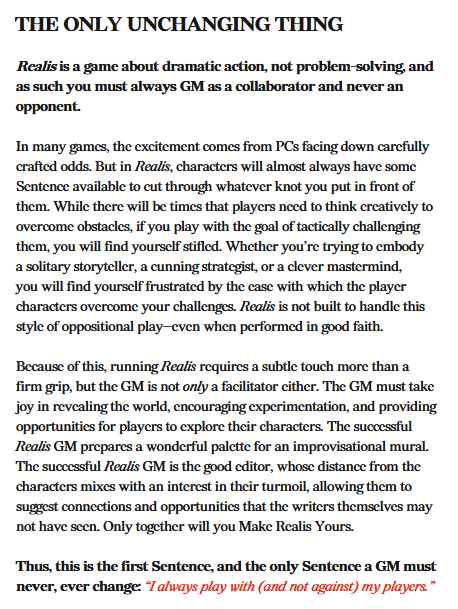
This is, I think, a fair thing for the game to say. I’m always in favor of games communicating how they want you to play them. But, on the same token, it’s asking GMs to not use the one mechanical form of engagement they primarily have. Or, at least – to only use it for the purpose of the social game. Posing sentences for the players to overpower or have to outmaneuver isn’t gameplay, in the sense of a challenge two sides have to overcome one another through, it’s props for the production of satisfaction.
That’s the trick to it. That’s what’s going on when people expect victory while playing D&D. That’s what is expected of how a GM engages with their mechanics, a lot of the time. Not playing a game, but arranging props for other people to feel good as they play around.
And… I have complicated feelings about that.
Murkiness
There’s a lot of GMing advice out there, much of it contradictory with itself. You can find advice on how to run a meaningfully difficult combat encounter and advice on how to make enemies make realistic mistakes and flee when they hit half health so the players don’t face difficulty that feels too much like a game. You can find advice on how to prep scenarios in advance so the players have things to engage with; advice on how to never prep anything because that’s violating the spirit of player freedom and truth to an emergent world; and advice on how to prep things in such a way that the players don’t notice, so they still believe in their freedom and the emergent world even if that isn’t really there. You can scroll to the first section of this post again. And there’ll always be more of it, and all of it is pulling in contradictory directions.
That’s because games want different things from their GMs. Realis up there wants you to be focused on the social layer of appealing to the players’ sensibilities, in particular appealing to their sensibilities of what an exciting narrative might be. Any number of OSR games out there will tell you to hold to realism of the world as a highest principle, and then never quite state that you should play the social game to be sure you appeal to whatever the players think realism is like, because their immersion is necessary for them to keep playing. And… heck. I’m a big proponent of games standing on their own merits, but, the quintessential bit of GM advice that always grinds my teeth in? [It’s fine to ignore the rules or get them wrong, as long as people have fun]? It’s true, right? Even just from a pragmatic angle, the people you interact with being socially unhappy just affects you more than not following the rules does. In the long run, adhering to a system gives more consistency to the experience of playing, but, when you’re a human being, a social primate, and not me on the internet yelling about elfgames, that’s a very distant priority. This is a social affair, and that means placating people and managing expectations to keep things smooth.
That’s the murkiness of GMing. It’s the murkiness of RPGs as a whole, but, a lot of the arrangement is set up to resolve that murkiness by pushing it onto the GM to navigate.
The role of the GM is, in many ways, a scapegoat. You can blame them if the system is bad, because they should’ve fixed it. You can blame them if the social dynamics don’t work out, because they should’ve moderated it. You can blame them even if you do everything you’re supposed to, and they do the same, and everything went exactly as it should; but you didn’t feel satisfied at the end.
And… I can’t in good conscience come on my blog and go “hey, being a scapegoat gets a bad rap, you should try it,” right?
So, then, approaching GMing starts from figuring out how to not be that.
Those priorities I listed at the beginning? Most games don’t ask all of them of you. Some of them do. You don’t have to listen.
Some of these priorities you’ll find easy. Some of them you’ll find hard. I’m good at charting out thematic events to hit the players with, and worse at holding a simulation of a world in my head. More importantly, some of them you won’t find fun. It’s worth experimenting running different kinds of games to see, but, start with what excites you. With only the responsibilities you would want to do.
Most importantly? Always ditch the last one. Having one person responsible for everyone being happy is a cursed position to be in, and, it’s got conflicts of interest with every other piece of authority you’ll have. That’s the one that makes you a scapegoat, more than anything.
Once you’ve got the set of what you’re up for trying, be open about that. Be clear about what the play will and won’t engage with. You’re not here to make meaningfully difficult fights, but you can make them feel in line with the world as it’s been presented? Cool! There’s players who will jive with that, and players who won’t. If they know that in advance, everyone will be a lot happier from the get-go.
And… yeah. Yeah, that does mean that some of your friends won’t want to play what you’re running. A friend group tends to cover a broad spectrum of RPG play interests, usually incompatible. And that’s okay. It’ll be a better social experience this way. (And, even if you value the game as a consistent friend group activity more than any of this – being open that they won’t get what they want if they play is still the best answer.) People deep in the RPG trenches tend to cluster around enjoying certain sorts of play as a direct result of this. It’s easier to play with people who like the same kind of play you do.
All that’s pretty hard for a newcomer to GMing, or a newcomer to GMing in an ideally-less-exploitative manner, and you’re gonna slip up here and there. Some of these concepts may sound fun, but not be something you can pull off in execution. I’ve been there myself. The important thing is to learn your limits, be able to adapt, and explain as such to your players.
To a lot of players, the GM is a black box do-anything machine.
Probably the biggest asset a GM can have is players that understand just how much that’s not the case.
After all that, I still recommend giving GMing a whirl. It’s a lot of fun, when it’s going well. Not fun in the way being a player is fun, they’re not even close to the same experience… but even so, it’s fun in its own way. There’s value in that experience, too.
(And, to the designers in the audience – all this is a short introduction to my real agenda, why I think the GM role is deprecated and contradictory tech and a more distributed or systematized structure for running games is well worth investing time in. Check out Emberwind‘s enemy AI, or, any one of several Belonging Outside Belonging games. There’s so much cool GMless tech out there.)
(But, I digress.)
So… yeah!

