
I like to make a point of trying new things. I find it’s very easy to feel like I’ve gotten stuck in a rut, and to not have a sense of how to get out of it, or even if there’s anything better out there in the first place. As life advice, I find this to be a relatively useful guiding principle. As a result, I try to apply it to RPGs whenever I can. If a new game interests me, I should try it out.
Usually, however, RPGs are a commitment. You need to gather a group of people, find out a time that works for all of you, make sure you’re all on the same page, and agree to stick with it until you’ve all seen your fill. For some people, there’s an additional hurdle of convincing people to be willing to play a given game at all. It’s tough!
Since this is something I actively seek out, I’ve fostered contexts where it’s easier for me. Groups of people that are already interested in trying out new games, that have a designated time they can play at (maybe even filling in the breaks between a larger campaign they play at the same time), and that I generally know I can play well with. Now, there’s something to be said for [playing with new people] as a form of trying new things, one this format lacks, but, it’s still a useful start.
Even with this, it’s relatively rare that a whole new campaign gets pitched. When it does, that’s usually because the prospective GM already knows the game and wants to introduce new people to it – I’ve been in that seat twice, for instance. When it’s just everyone agreeing that they’re interested in seeing a given system in action, they tend to propose something smaller. A oneshot.
Notionally, ‘oneshot’ is supposed to mean a single session of gameplay. Practically, it rarely does. When the goal is to see a game in action, it needs to be long enough to cover a full cycle of gameplay. For a game like Lancer, for instance, you can probably run one fight in a session – but the game’s attrition over the course of a mission means you’ll need to do three or four fights to see the full experience. As a result, the usual expectation is that a ‘oneshot’ in this context will be weekly sessions for around a month, maybe longer, until we hit a logical stopping point. Which is pretty notable!
But it’s still, fundamentally, short. It’s a short, focused experience.
Most recently, we did a premade dungeon in the RRD game Hollows. Since it’s a mind-palace-dungeon-delve context, the breadth of a ‘oneshot’ was one dungeon, with several fights and some navigation to get through it.
It was relatively impressive! Considering this was coming off the backs of the tragically-disappointing Hellpiercers, and before that Wilderfeast (which was fine enough, but it also had combat in a battle egg centered around a single large boss monster each fight, so it made gameplay comparisons quite easy), we had many comments to be had about the gameplay, and ended things excited and happy to have spent our time this way. I picked up a few thoughts on combat rhythm design from the experience, even. By all rights, it was a satisfying time for all.
(Obviously, I left with some complaints. I suspect it is in my nature. But I can still recommend Hollows‘ combat as an excellent case study!)
I have a slightly embarrassing hobby, vis a vis the RPGs I am in the thick of. When I am in bed, readying myself to fall asleep (sleep does not come quickly to me, it hasn’t for a while), I like to imagine potential future interactions between characters. (Perhaps the fact that I find this slightly embarrassing reflects on myself more than anything, as I write this out I realize it sounds positively mundane.) Almost always, I don’t accurately predict how any given interaction would go. However, it does give me some satisfaction, to imagine how a character would interact with others. How they would respond to a given scenario. How the next planned moment might go between them. It’s simple imaginative fun – essentially telling a fractured story to myself, or, in another sense, mentally playing with dolls.
I do not do this with my characters for oneshots. It only emerges in longerstanding campaigns, where characters are more established and have room to interact. In a oneshot, the characters just don’t have room to compel me the same way.
Naturally, I have exacerbated this phenomenon through my own apathy. When I am interested in playing a game, I will produce enough of a character as necessary to play the game and that will be that. My name in the Hollows oneshot was “Todo” because I had left the name field TODO and never bothered to finish it. It was a running gag that my character was coincidentally offscreen and any action was hastily cut away when it ran the risk of involving them, so as to justify me as a player not particularly wanting to spend much time describing my actions. By all rights, any ability to care about my character was smothered in its crib.
The true sourcing is the other way around. I held an apathy towards my character because I already knew that, in oneshots, I don’t have the same room to truly get attached to a character. It’s a self-fulfilling prophecy at this point, but it did start somewhere. And because of that, when I say I came away from Hollows satisfied with my experience, it doesn’t include satisfaction of this sort.
[Satisfaction of this sort] is what I want to pick at today. What am I actually describing here? I suspect it’s the core ingredient to bridging the gap between the mindset I use to approach roleplaying and the many people I’ve talked to who balk at my level of instrumental focus. And, for that alone, even before the ways it can cover the gaps in some of the models I’ve presented on this blog before, I think it’s worth interrogating.
Look good while doing it
At their core, I think my interests can be expressed very simply. “I want my characters to be able to express themselves, to show off their psychology through the prompts thrown their way, and to look good while doing it.” When I can take an action and say “my character is doing this, because of such and such part of their internal philosophy or way of thinking,” this part of my desire is satisfied.
…Which runs directly contrary to a lot of my tastes in other dimensions. There, we get some problems immediately. What if my character would naturally do something that, say, betrays the team? Ruins the chances of success at a mission? Steps outside the expected bounds of gameplay?
My answer, of course, is that they shouldn’t do that. (This is, already, a psychological divergence point where people who share my tastes may move elsewhere – but, that, I think I have discussed at length in my post on instrumental play.) And so, when I sit down to write a character, I start by constraining myself to the sort of person who I think would remain ‘in bounds’. Whenever I find myself brushing against that, I impose as a rule upon myself – my character does the instrumentally justified thing. Then, I ask myself why they would do that. This tends to mutate their psychology a bit, and I can see it being a chafing point for someone else who works a bit like me, but, it works for me.
So, I can revise this. “I want my character to naturally be someone who would act within the bounds of expected gameplay, and to express who they are and the shape of their psychology in terms of how they respond to the prompts that the gameplay offers them, and to look good while doing it.”
Why, then, don’t oneshots do the trick for me? Sure, they go by at a brisk pace, but there’s still room within them for character moments. Often, oneshot design is focused on giving some challenges the players will need to reckon with and make choices on, so this aspect should be well-satisfied, no?
That reveals the next dimension of it – I find that characters are psychologically iterative, and slowly reveal themselves over time. I’m used to prolonged roleplay and storytelling, and the short format means characters don’t have much room to grow. I tend to gravitate towards somewhat static characters in extended play, too, so that doesn’t sound right – but, what I find is that they are usually slow to change but still meaningfully learn from their reactions. So, that gives me:
“I want my character to naturally be someone who would act within the bounds of expected gameplay, and to express who they are and the shape of their psychology in terms of how they respond to the prompts that the gameplay offers them, and to change in turn due to the responses they provide and how they reveal new things and offer challenges to said psychology.”
“…And to look good while doing it.”
What’s that last bit doing there? It doesn’t really seem to fit in.
Well, for one, I’m an arrogant and vain person. I take my pride as a point of pride. Being seen as cool and successful appeals to me, and that extends to my characters, when they serve as an expression of my mechanical competency and my skill as a writer.
But that doesn’t really have anything to do with the rest of it, right? It doesn’t connect to character psychology or reveal anything about them, nor does it prompt the character in new directions. It’s a request of how the character is seen – or, at least, how they’re framed.
The easy conclusion is that, indeed, that doesn’t have anything to do with the rest of my tastes here. I like getting to reflect and elaborate character psychology through play, and I also like looking cool. But, I don’t actually think that’s quite it. See, it’s not as if looking good on its own satisfies me. Nor is it that I can’t enjoy the opportunity to explore character psychologies unless the characters look good doing it. But it is there on my list of desires, because, if I can get both, it means more.
That’s very imprecise. What I mean is – a character being cast in a certain level of grace, intensity, or other such light, indicates something about how we are expected to look at that character. The rest of my interests in this space of character-satisfaction are, when you pick them apart, oriented in the same direction. Demonstrating and exploring character psychology is a matter of showing off. It takes a character’s way of thinking and presents it as an object of interest, something worth spending time contemplating over the course of play. If my natural goal, then, is to bring character psychology into focus, then the matter of framing is an effort to reinforce that – to say that it’s relevant to have it be in focus.
It’s a rather rote visual language. When something is cast in a good light, it’s harder to dismiss out of hand. If someone says something, or does something, and they appear competent and effective through it – that lends weight to what they did, no? It makes it harder to just write off.
…In reality, I suspect this is more a brainworm than something that’s truly the case. There’s many ways to present something as meaningful, including while still challenging it. To make matters worse, my general inclination is to write characters with dubious and destructive outlooks. That’s setting myself up for a narrative context where their initial outlook should be challenged and cast in a criticizable light. My habits are working against themselves here – but it’s interesting to note the habit, nonetheless.
“I want my character to naturally be someone who would act within the bounds of expected gameplay, and to express who they are and the shape of their psychology in terms of how they respond to the prompts that the gameplay offers them, and to change in turn due to the responses they provide and how they reveal new things and offer challenges to said psychology, and to have their perspective and psychology framed as something worth exploring, and potentially legitimizing.”
There we go! This summarizes my personal characterization goal when I sit down to play an RPG lengthy enough that I expect to be able to get such characterization in some focus.
But, if we are conflating [looking good] with [having the importance of their psychology legitimized], there’s a problem we’ve invited in. Something being legitimized as important to focus on doesn’t necessarily mean it has to be framed as good, or even effective – only that it’s worth looking at. You can get the same effect, in fact, by going in the exact opposite direction.
Damsel strats
…are probably something I need to define.
‘Damsel strats’ is the term I use to describe efforts to put a character in an intentionally perilous or uncomfortable situation, often for the sake of the same sort of character-psychology-exploration I’ve expressed my interest in. ‘Damsel’ is, of course, being used as shorthand for ‘damsel in distress’ (despite the ‘in distress’ part being the actually relevant part, the genders don’t tend to matter much). ‘Strat’ being short for strategy, a bit of gamer lingo to frame it as an approach to success.
Which presents a skewed idea of what [success] is, then. After all, in most games with broadly instrumental goals (ie, things you want to accomplish and obstacles you need to overcome), getting into trouble is primarily a hazard the game throws at you and you try to avoid. In that sort of context, consistently succumbing to perils is pretty straightforwardly a failstate – and doing it on purpose goes as far as throwing, and thus becomes actively impolite to your teammates (the other players). So, what kind of ‘strategy’ is this?
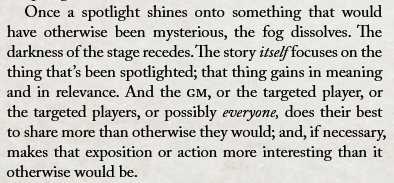
Well, there’s a reason I brought this up when I did. It’s a matter of pulling the spotlight – claiming focus on, and thus legitimacy for, your character’s plight and their reactions to it. The character is placed in a dilemma and shown as struggling for the same reason I aim to have my characters shown to be dangerous and effective. It lends credence to the way that this character thinks, and the reasoning behind their actions, as implicitly worthy of notice. Why did this character make the choices that brought them into this mess? How do they respond to it? What parts of their dilemma do they struggle against, what do they refuse to acknowledge is a problem? These are interesting questions, and the scenario necessarily pushes the viewer towards asking them.
So, from my definition of character-satisfaction as I seek it, damsel strats should work for me, right?
Well, yes, they do, actually! I do enjoy tossing my characters into a conundrum or two. My tastes drift more towards looking cool because then I don’t worry about actually sabotaging the party, but, it’s an option. I have been known to lead characters to internal breakdowns due to following dubious logic, and that interests me for a similar reason. So, in that sense, it’s not a failure of broadened definition – the notion of being a [legitimate focus] has helped see more of what I like about moments like this.
…Why ‘strat’, though?
Or rather – why would you need to strategize to pull the spotlight? Why is legitimacy a prize to be schemed after?
The fact of the matter is, metaphorical screentime is a limited quantity. There’s a lot happening in an RPG, and every player has a character that can get explored in detail. (More than that, if they’re the GM – usually, that player is responsible for churning out a whole bunch of interesting characters!) The more time that gets spent on your guy, the less room there is for others – and if everything is distributed out, then the actual gameplay is going to get crowded out. All of these elements are jockeying for position, and trying to get the most out of the time they have. The strategy part of the damsel strats is that they ensure your character is in an important position, one that needs resolving – the middle of a problem. Even if they don’t get time to themselves, they at least get time where the focus is.
There, we have why this isn’t a goal I willfully pursue. Why, despite it being core to how I enjoy RPGs, in contrast to board or video games (save for interactive fiction, which often scratches the itch quite well), I focus my attention on following the gameplay foremost and letting the character beats fall where they may.
Ultimately, it’s selfish.
(It doesn’t necessarily have to be, in that it’s perfectly possible to find satisfaction in seeing other characters explored. I don’t, even when I GM I’m most compelled by the people I write, but, it’s a possible approach.)
If I were to throw myself wholeheartedly into exploring my character above all else, I could get pretty far. I am good at taking up space, and have a natural penchant for monologues. But, that would be me taking up space for my own individual interests during what is ostensibly a shared activity. Seeking to maximize that would sabotage the entire social structure, and, there are no contexts I’m in where I both think I could get away with it and care so little about the people involved that I would be willing to do that to them. The healthier version of the goal, then, is claiming as much space as possible without tipping over into upsetting or inhibiting other players – and that is notionally doable, but only by someone with an excellent sense of social dynamics and the comforts of everyone involved, and core to my interests in RPGs is to not have to spend all my time worrying about that. Any social arrangement that mandates I constantly question how I am appearing to those around me will not fulfill me.
This is, in part, a retort to what was planned to be the thesis of this post, before I realized I was wrong about myself. The notion was that this resolves the hole in my discussion of instrumental play. There, I laid out a model of RPG gameplay, roughly reflecting my own, where there exist goals to be pursued, and the players are primarily concerned with efficiently achieving those goals. The primary hole in this model is that goals are rarely defined for RPGs, in relation to other games. Sometimes, often in my preferences, the GM will present an objective for the players to work towards. Very often, however, this is not the case. I have claimed to have played instrumentally even in contexts where I was not given an objective – so, then, what was I pursuing?
But, of course, expressing my character’s interiority cannot be the answer. If that had been my goal, I would have spent a lot of time socially jockeying for as much screentime as possible – or, more likely, growing gloomy at the thought of having to do that social jockeying. Neither of those things happened.
Instead, something rather elegant happens. The character psychology produces a goal. From how they think comes answers to the questions “what do they aspire to do” and “how would they act in this situation” – and those answers provide long-term goals, which can then be instrumentally pursued! Not only does that patch the hole for games that don’t come with their own goal, it also provides a consistent drip-feed of legitimacy. Every time I ask myself what my end goal is, I remember, oh, it’s this, because of how my character thinks.
This… isn’t very satisfying to me, because it’s something I already know. It also isn’t very satisfying to me because I much prefer to have a goal and a path externally provided than to have to make my own. But, it does, I think, bundle everything here up relatively well. It’s a way to bridge character-focused preferences with instrumental preferences, and I know people for whom that is the ticket to make a given game work for them. It can work for me, too.
But I have to get my kicks in somehow, so – let’s analyze some arrangements that very much don’t work for me.
Tuning out
I’m very attached to my characters.
The model I’ve discussed here likely makes that quite clear. Its primary interest, after all, is exploring and expressing their nuances. It requires time and attention-over-time both, and it ends up yielding results at a very slow pace. (It should be noted this pace is on some level aberrantly slow – I’ve discussed to some who have expressed a level of frustration at how slow I’m inclined to make my characters change. But, even for people who share my tastes but work faster, the result tends to be a timescale measured in real-world months for meaningful change.) Sticking with a character for a while, getting really into their head – that’s a requirement, one that’s essentially been taken for granted.
As a result, if I play a game and there’s plausible PC death rules right here, I’m going to change my tune.
I’m nearing the end of a Trespasser campaign, one that’s been running for some months now. It’s not a bad game, especially after a recent update addressed many gameplay issues we had come up over the course of our time – but it decidedly presents itself as a risky and at times brutal experience. It plays into the instrumental ethos of a dungeon crawl, and some concerted effort towards PC mortality, especially at the early levels. (Much of the threat seems to have faded away as we’ve progressed.) As a gameplay experience, I’ve found it satisfying. But, it’s the same story as the Hollows oneshot. Characterwise, I gesture just enough and then move on. It doesn’t fulfill that interest for me.
This isn’t for lack of potential. Over the course of the campaign, my character has been dabbling with the same fell magics that define the final boss, expressed some very dubious and imperious opinions on the world, made a pact with a demon – there is a lot to work with, there, if I really wanted to get into their psychology. But, I don’t. After all, they’re just some bad luck away from potentially dying – objectively implausible, since they’re a backline attacker with excellent avoidance tools, but present enough that internally I just do not want to bother getting invested. Doing so would be a gamble with my own emotions, and I do not like gambles.
This is a case where instrumental factors and characterization-focus factors are working against one another. The death of a PC is there as a threat to make it so that dungeon crawls come with significant risks, and you can find your fighting force significantly reduced during an adventure. But, because it’s there, I can’t focus on what is (for me) a secondary priority, so I eschew it.
The other way around, in my experience, is more of a problem for me. When highlighting characters in detail requires sabotaging the instrumental gameplay, I am more likely to just give up on the game entirely. I recently read Underside, a game with some very interesting elements to its character creation, and a fusion of the FitD and PbtA design pedigrees (that is, Blades in the Dark– and Apocalypse World-like) that seemed intriguingly done. However, the text requests and emphasizes at many turns that, as a player, one should be seeking to make destructive and impulsive choices as much as possible. The game has a tension clock for hostility between PCs, with triggers based on arguments and disagreements it definitely seems to want players to seek out. And yet, the actual rules for that are just “the disagreement reaches a boiling point – resolve it in some way before you move on.” Most of the mechanics are focused on the party, as a group, working to resolve problems and being a gritty superhero team and the like. The shape of the game in and of itself is straightforwardly teamwork-oriented and instrumental, but the requested gameplay wants you to sacrifice that for the sake of the character satisfaction. As a result, I’m pretty confident that if I were to play Underside I would be doing it wrong. And, if I were playing with people who were doing it right, I would be very consistently frustrated at their failure to help with the problems in front of us.
Games like that don’t work for me because instrumental satisfaction is a higher priority than character-reflection satisfaction for me. This is another significant deviation point. For someone with those priorities flipped, even though they share my interests, their RPG tastes would end up different. I imagine, to someone like that, something like Underside would be palatable but not ideal, and something like Trespasser would yield a response of “I could not play this properly” – a direct inversion of where I stand.
I think the interesting thing with arrangements like Underside is how the instrumental gameplay is still core to the experience. Someone who doesn’t care at all about whether they succeed or fail is probably not going to appreciate all the focus on the vagaries of superhero endeavors, except as a framing device and source of prompts for revealing character details. I suspect, in large part, that’s the utility of premises like that, for people uninterested in instrumental gameplay – the objectives and challenges provide prompts for their characters to react to, and those prompts are why they engage with the game in the first place.
Funnily enough, even this has an emergent problem, with the very audience it’s trying to court. Many games try, to some degree or another, to push players like me towards more self-destructive or dramatic choices. And by that, I don’t actually mean targeting instrumental players. I mean players who seek to cast their characters in a good light.
In Blades in the Dark, you get an XP if you make a roll in desperate circumstances. In Nobilis, whenever a Bond (a rule that defines your existence) cause you to get into trouble, you regenerate some MP. Even Underside rewards you for filling the party tension clock, after the confrontation resolves. These sorts of mechanics are there to push the logic towards getting into trouble, since that gives you a material benefit as a consolation prize (one that might be worth more than the loss). And, for me, they do sort of work!
But what about the damsels in attendance?
Mechanics like this are a matter of cost/benefit analysis. They’re also a matter of flagging – because you’re rewarded for getting into a mess, you know that’s something it’s okay to do. If you were already going to do that, and if your character getting into trouble satisfies you… now it’s a benefit/benefit analysis. You get the focus on your character’s psychology when in a difficult situation, and you get a mechanical bennie. Rather than turning throwing into a difficult decision, it turns a desirable option into a no-brainer.
Now, no game is going to fit everyone’s tastes. But it’s interesting to see how, even for games that just use instrumental gameplay as a shaping mechanism and source for prompting, there’s a need to design to mitigate the instrumental impulse, and that can sabotage the interests of people with a character focus. A lot of the time, it seems like there’s an expectation that people won’t pursue damsel strats, even if they do enjoy that sort of thing – that, like me, they’ll aim for looking good, and any moments where they look bad and still get focus are a happy accident.
There’s a lot of that going around, in this space of things. Things are relied on being happy accidents. In a sense, the instrumental shape of a game like Underside starts with that entirely – the [game goal] of successful superheroics is tacitly irrelevant, and making actual character choices just sort of emerges from that. These things are conceptual goals, but limited in how structured they are.
I recently read C. Thi Nguyen’s Games and the Art of Agency, an excellent paper that preceded the book Games: Agency as Art (which I intend to read sometime soon). It’s quite a good read, I suspect I could have gotten a good post or two out of just rehashing and reconsidering the points it raises. One snippet, however, really stuck with me. For some relevant context – [striving play] is a term they define to represent something similar to what I call instrumental play, but where the goal is not to win – instead, the goal is to experience the satisfaction of trying to win. (This is a mindset that I can relate to, to some degree, and might seek to differentiate from instrumental play in future.)
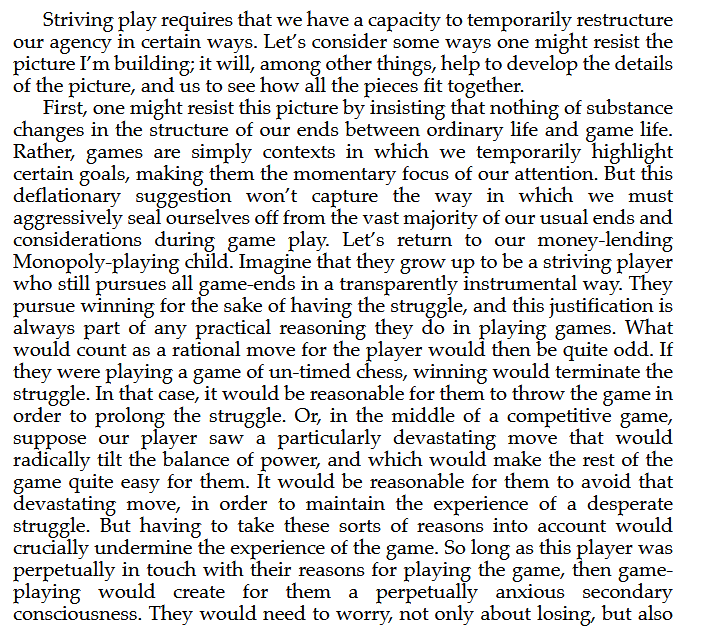
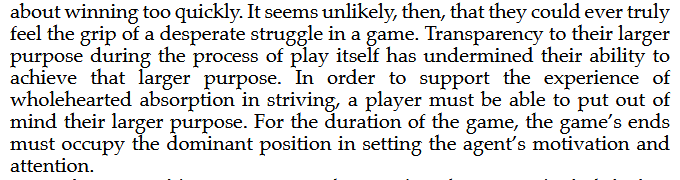
The first time I read this snippet, I had a little giggle. What Nguyen is describing as a pitfall that games dodge is a phenomenon I’ve spent several diatribes complaining about as something that RPGs in particular do indeed force people to do – most often, the GM. The GM is generally expected to be trying to mount a challenge against the other players, but willfully hold back from actually defeating the players, even when they have a chance for it. This theoretical example of muddled incentives that clearly sabotages the capacity to enjoy the experience of a game, is exactly the muddled incentives I’ve complained about that inhibit a GM from being able to engage with games as games! Smug mode.
Preening aside, however, I think the observation is very useful. If you keep in mind your core goal, and try to optimize for it, unless that goal is directly optimizable instrumentalization, that can lead to a play pattern that muddles things significantly. That’s where the selfish social jockeying I mentioned earlier comes in – if you sit down to maximize how much time your character psychology has in the spotlight, you have a stressful zero-sum game on your hands. The natural thing to do is to… not optimize that. Not too much. That’s what I do, even. This extends to multiple goals.
Striving play, the satisfaction of doing your best, is another sort of happy-accident mechanism. It’s an experience you can get from a game, and you can work towards to some degree, but things get messy if you aim for it in the same way you aim for a win. The same logic is what I apply to character expression, and what games like Underside are applying to victory itself. It’s nice if things go well and you look cool and you make things work, maybe (actually Underside‘s text in particular seems to expect you to actively dislike it if things go well when they could go wrong), but that’s not the point. The instrumental gameplay isn’t there to be approached as an instrumental goal, or even something to strive for. It’s just there as a framing device and a series of emergent prompts. It’s there to poke at you.
Pokes, prompts, and interpersonality
I’m a pretty reactive player.
What I mean by that is, I tend to rely relatively heavily on external pressures to push me in interesting directions. If left to my own devices in an RPG, I usually don’t have much of an idea of what I’m supposed to do. That’s another reason I appreciate properly instrumental gameplay, since that gives me direction inherently. But what it doesn’t give me, necessarily – or rather, what it only produces as a happy accident – is prompting.
Prompts are the [interesting] part of an [interesting direction]. They’re something that compels you to engage with it, and get an interesting result. In terms of the character-satisfaction we’re looking at here, it’s something that a given character can express an interesting reaction to. It’s… you know, it’s a prompt.
When I discard all my thoughts of instrumentality, all my interest in RPGs as pvp endeavors and mechanical systems to engage with, prompts are a big part of what’s left for me. They’re the things I can react to, and, thus, they’re the primary export from the GM. The GM’s job, alongside antagonist and everything else, is to provide prompts and poke at the players to induce interesting reactions and reveal parts of their characters.
[Poking], here, is a more active form of prompting. Rather than presenting a scenario and letting players react as little as they want, a poke nudges a player and calls on them to react in some way, or at least ask how they specifically feel. It’s a pretty useful GMing tool, and also a player tool, honestly. Especially if you’re playing with people who also enjoy this sort of character-psychology engagement, asking them about it is probably gonna please them! It means they get more of they want without having to worry about optimizing for it, after all.
But, of course, here’s where I get back on my soapbox. Why are we relying on an overworked GM to handle all of this, or asking players to actively cede screentime to their rivals for the stage? Why am I having to port engagement concepts from freeform roleplay into the medium that should have more tools to work with?
And the answer, of course, is that we aren’t. Or rather, we do often let the GM have to do a lot of it, but it’s not all left to the humans. Systems are there to poke at the PCs, and force them to react and reveal a bit of themself.
This is the non-instrumental perspective I’ve tapped into. “What do you do” when provided with a list of possible actions is, when it’s not an optimization game of identifying the most correct choice, like a personality quiz for your character. When there isn’t a definite list of actions, it’s a moment of getting to be kind of like a writer. Here’s a blank page, tell me what words belong on it. Engaging with the game is the game poking at you, while the GM shows you prompts.
This, of course, doesn’t work if you are tapped into the instrumental mindset. I am, and I tend to prefer games that are robust enough to survive that. So, that doesn’t really work for me. It is useful to realize, though.
The next layer of poking within an instrumental context, then, is “how do you do it.” Which brings us back to Hollows, of all things. That game actively mandates that every action be narrated, describing one’s physical positioning and the brutality of the violence and such like. It’s thematically important to the game’s commentary. But it’s also difficult, and, for us, does the opposite of engage. For me in particular, it’s extra tiring to split my focus, and I’m rarely much for physical narration. In essence, the problem here is that it’s a [boring poke] – I’m being asked a question I don’t have a good answer to. I stab it with a sword, but somewhere else this time? There isn’t much room to reflect characterization in the ways I find compelling, so it loses its impact. Similarly, “how do you pick this lock” in a dungeon-crawler would leave me floundering. Asking for a description of a social roll might give more room for “how do you do it” to do much for me, but then I’ll get suspicious that you’re planning to penalize me if I say the wrong thing, and now we’re back in the instrumental sphere.
I think I’ve found the best pokes emerging from the system come from the implicit, “how do you react to the consequences?” This has the same [boring poke] hazard when the consequences are in the vein of “gosh, I am down 13 hit points out of 97,” but, that brings me to the secret sauce here – specific systematized pokes. Here’s what losing HP looks like in Apocalypse World, alongside the damage itself:

This whole move is set up to make it so that you’ll be hit with a prompt to react to, a change to the fight. This is interesting from an instrumental standpoint, in fact AW is rather impressive for being designed so that doing your best to achieve your ends yields interesting gameplay while still being highly GM-interpretive (something many of its successors could have done with), but it’s also interesting from a standpoint of reflecting a character. How do they react if they lose track of someone they’re keeping an eye on? Well, that tells us something about how much they value maintaining responsibility over maintaining momentum, for instance. Apocalypse World can, in somewhat reductive terms, be looked at as an effort to make it so that a relatively classic skill roll system is improved in terms of the quality and potential of the [pokes] it offers, all of the category “how do you react to X?” And, for that, it’s quite impressive!
That all said, however… in my experience, the juiciest pokes have always been character interactions. Even when the system does a good job of providing interesting pokes to its players, I’ve found they land the best when delivered from characters in the world challenging or reacting to them. I suspect this is in part a taste thing. I find fictional interpersonal drama very compelling. But, it’s been a very consistent phenomenon, in my experience, and not just for me.
I suspect the reason for that is, it’s a two-way street. Both sides are baring and challenging their psychology, and thus, both are in focus. If how a character reacts to a stimulus is worth legitimizing and putting focus on, then two characters reacting back and forth warrants a lot of attention. And, actually, that brings me back to the mention of selfishness in character expression – this is how you hijack that! This is how you can actually optimize for character performance and not feel too bad (as long as you aren’t so committed that you refuse to accept a no when other players express their own pressures). If a moment of the spotlight is between you and someone else, NPC or PC, then even if you get more than your fair share, it’s possible for everyone else to get more than that, too. This is, secretly, another reason why I’m inclined towards hostile or dubiously-intentioned characters – it’s a damsel strat of my own. By being a character who is challengeable on their ideals, I’m likely to get some challenges, which gives me screentime – and those challenges are likely to be compelling, which satisfies me more! Is this a backwards justification for a taste preference I already had? In part, yes, undoubtedly, but it’s also been a pressure to reinforce my habits. It’s a strategy that works. At the time of writing, a weekly Glitch game I’m in has been on a short break, and when it comes back I have a very juicy confrontation with another PC which started up just as the last session ended. Having that looming over me has satisfied me a lot. It’s a context where I get to really shine!
Closing remarks
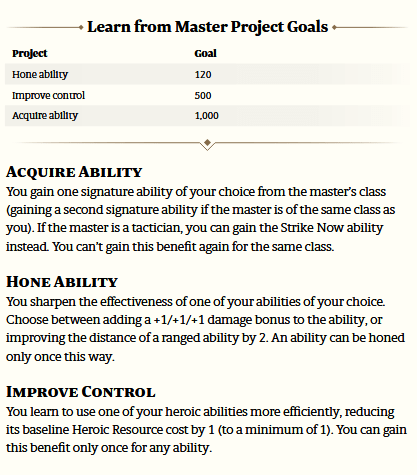
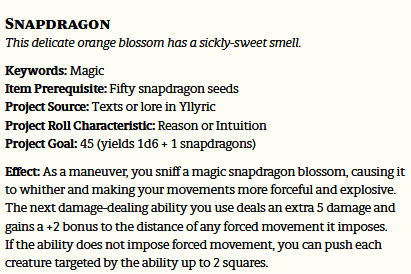
Recently, I made a post about Draw Steel. It’s essentially just about Draw Steel, and only really a specific facet of a specific subsystem of it. I do draw some wider conclusions, but they aren’t the focus. I made that post because something relatively innocuous had been bothering me for a week, and despite discussing it with multiple people, I had to formalize it to see what conclusions I could glean, to answer why it was bothering me so much.
This post is much the same way. Apparently, I’m in a bothered mood. But I think I was rather more successful in reaching conclusions this time. As I began this post, I expected to reach the conclusion that Underside‘s usage of an instrumental gameplay format was holding it back, and if the game truly wanted to commit to character drama and self-sabotage, it would be better served with a gameplay format that did not materially punish such things. That way, it could be a game I could genuinely approach on its own merits, rather than one where my natural approach is fundamentally antithetical despite otherwise being in its target audience. I do still think that wouldn’t be a wrong conclusion, but, it’s more “this game should change to suit my needs” rather than a fully legitimate criticism.
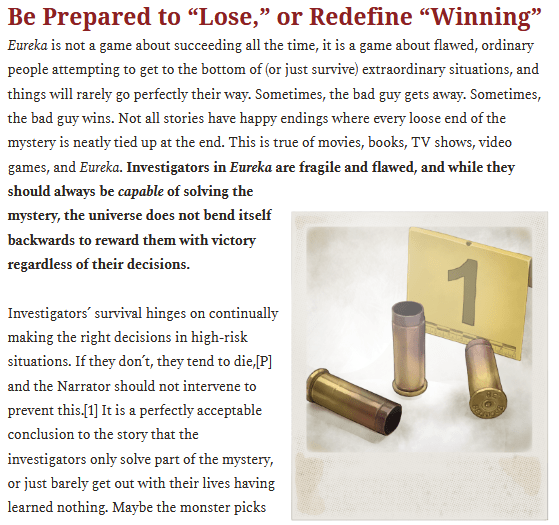
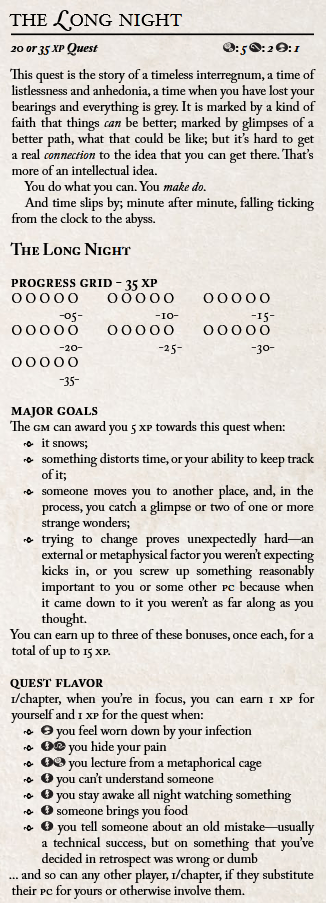
“This gameplay model is instrumental, but it intends to use it as a source of prompts and pokes for the characters, and otherwise is to be discarded as needed” is a coherent statement, even if I don’t really like it. It’s an answer to the conundrum of how exactly I was supposed to “play to lose” as Eureka asked me to. It’s a not-inaccurate model of Glitch, though that showcases how much more effectively it can work if you have a secondary structure to guide and prompt gameplay (its Quests, which I have sung many praises and some complaints about already). And, ultimately, as long as a game can clearly communicate that that’s what it’s doing, there probably isn’t much valid reason to complain. Underside and Eureka befuddled me because they did communicate clearly, and I appreciate that. Now, I think I can understand what they were trying to say.
Even so, I don’t think it’s the best possible approach. If anything, it can very easily hold things back. I’ve found a much easier time slipping into pvp character melodrama in Monsterhearts than Masks, despite both being PbtAs with comparable social-manipulation tech and solid move design – all because Masks has you on a team working together to fight crime, and Monsterhearts definitely does not. I’ve found, as mentioned, that structures like Glitch‘s Quests can provide excellent direction even without an instrumental premise to pursue, and those can provide directions that instrumental gameplay can’t – Glitch is an excellent game for enacting damsel strats, when you have multiple options for a Quest that represents having a breakdown. From the Firebrands design pedigree, you can write scene rules that provide very specific prompts to characters, and then the meta-prompt of players selecting scenes they think would suit them. From my freeform roleplay days – sometimes a lack of direction can be a virtue in and of itself! All of these options have worked better for me, and I imagine would work better for anyone else with a similar attachment to instrumental play.
Depending on how I feel, I might give Underside a try. I wasn’t planning to when I started this post, but I think I’ve come to understand it more.
(Of course, if I do, I’m sure I’ll have complaints. It’s not a game built for someone like me.)
(Even if I aspire to try new things – sometimes, that’s okay.)













 Ru's Roleplay Rants