Smoke, mirrors, and satisfaction

I don’t like dying very much.

(For clarity, this is a post about RPGs. My thoughts regarding death in real life are a matter for another time.)

I get attached to characters easily, and, often, some of the most fun I have in games involves slowly exploring the nuances of their personality and what riles them up. It’s what I enjoy, and, naturally, if that comes to a sudden and abrupt end, that’s upsetting and inconvenient in equal measure. It makes me less likely to bother getting invested in whatever I play next, and it disrupts any ongoing plans and plotlines centered on that character. It’s just not my cup of tea.

This is, in my experience, a pretty common opinion. (It’s also, I think, a big source of culture clash between different interest spaces in RPGs, because what it isn’t is a universal opinion – but, I’ll get to that in a moment.) And, it’s most definitely a solvable problem, both on the system end itself and on modifying the system table-side. Even just making death an opt-in risk goes a long way to resolving this conundrum, let alone anything more nuanced.

But that’s not what I’m here to talk about today.

There’s a game called Lancer that I really like, which I’ve brought up as an example here a few times. It’s a combat-focused mech RPG, and, in the course of that combat, the character you’ve spent all this time on can randomly and unexpectedly die.

Kind of.

The combat is, usually, giant robots fighting other giant robots. Enemies can be more varied, there’s rules for tanks and infantry squads and giant monsters and ectetera, but, that’s what the players are. And, for the most part, their character is the squishy pilot inside of that mech. That pilot is immune to all damage, can’t even be targeted, until their mech is destroyed and they need to bail out. Once that point hits, which is usually an adventure’s worth of attrition, the pilot can run around the map doing attacks for a bit of damage so the player is engaged a little. If that pilot goes down to 0 HP, they are downed and can’t play anymore – and then, they roll a d6 and only have a 1 in 6 chance of actually dying. And, for the most part, shooting a pilot just isn’t worth it vs shooting a mech, since mechs can contribute to the fight way more – this usually only happens if the GM does it on purpose or a big flamethrower blast clips the pilot or something.

So, that’s a lot of layers to get through before that actually happens. But it can happen. Technically.

I’ve seen it happen once, in all the time I played Lancer. To me, in fact! At the very final boss of the campaign, the last mission. We’d all gotten battered hard, my mech got wrecked on account of me making a few reckless plays, and then my pilot got caught in an area-blast effect, and I got unlucky with the d6 roll and died. A combination of misplays on my part, difficult enemy tools to deal with, and a few moments of bad luck in a row.

We actually lost that fight. We all died in the narrative aftermath, but I was the only one who died mid-fight like that. Our GM had prepared for that possibility, and had an epilogue prepped for the eventuality that we just beef it like we did, but, they were pretty anxious throughout it. They said they felt bad that this was how it went. This was the final boss, the big capstone of the whole campaign, the wrapping up of everything we’d set up. We were supposed to win.

That’s not supposed to happen

I have a policy, or, really, a guiding principle of design. If something isn’t in question, don’t make it a question. If you don’t want a certain outcome to take place, don’t make it a possibility. If the game can’t handle the impact on character arcs and narrative expectations of a PC dying, don’t make luck have a chance to kill them off. For instance.

I stand by this. I think, in broad terms, it’s just baseline good advice for game design, and a lot of the problems I encounter in games are borne from that issue. (People get a bit too attached to the idea that anything can happen, I think.) But… is it actually true, for Lancer, that character death isn’t “supposed” to happen like that?

Well, to ask the question another way. If it is supposed to happen, why is it so unlikely? Why is there a specific writeup for how you can just clone your character for next mission with a minor personality shift rolled from a chart and that’s it? And, heck. Why are there tightly-balanced enemy designs, and pages on pages of how to design difficult fight objectives that might be won or lost, if, in the big final boss capstone of the whole campaign, we’re just “supposed to win”? What is any of this for?

Today I’d like to pick apart “supposed to”, desire, illusion, and fear.

To start with, let’s get the obvious and (in my opinion) meanest interpretation out of the way. Lancer has random chances of characters dying because it’s unrealistic to expect that that wouldn’t happen. Because, if a dismounted meat person gets shot by a mech, they might die, intuitively. That’s probably something you would expect to happen.

I say this is the meanest interpretation because I have a very dim view of it as a logic for design. RPGs are not systems of logical intuition. They are not engines of realism. They do not craft a world that is entirely coherent, because an entirely coherent world is an infinitely complicated structure. What they do is approximate that, and use those approximations to compose a coherent and enjoyable (for whatever “enjoyable” means) experience for the people engaging with it, and then, under the principles of design, are expected to tune that approximation to better suit the experience and needs of the user. If a game designs itself in a way that “makes sense” but is worse for the player experience, I consider that design a failure.

However. To argue against myself a little. The player experience does include their own irrational foibles. And one of those consistently is a sense of [makes sense]. (It varies from player to player and audience to audience, of course – but it recurs in multiple humans, at least.) So if a game does something that clashes with their intuitive expectations, then a subset of players will have their experience diminished, will be pulled out of the experience, even if those intuitive expectations produce a worse and less-well-crafted play experience. Learning to discard things like intuition is an active skill when engaging with RPGs, one I myself needed to learn in my own time with the medium. For players who have not practiced that skill, or do not wish to, this is an obstacle.

The next obvious angle, I think, is to interrogate our givens. Maybe characters are supposed to die every so often. Which, again, brings out the rarity question, but, that does maybe have an answer. You’re only going to be out and about as a pilot at the very end of the mission, for the most part, since Lancer is an attritional game. And even then, it’s pretty unlikely that happens. So, it’s on the table, but rare enough that it won’t happen more than once or twice during a campaign – without having to make an explicit “once this happens, it cannot happen for the rest of the campaign” type rule that people would try to take advantage of.

But, like I said. Most of my time with Lancer, full campaigns or otherwise, it never happened at all. The odds are too slim if that’s the idea.

But then, on the subject of taking advantage of the rules. I said that you can only have your pilot in play once your mech is destroyed. But that’s actually not the case. You can just dismount and run around the map, and if you’ve invested in an AI to control your mech, you can control both it and your pilot at the same time. That’s some extra damage output, from the small contribution your pilot would give. It’s, potentially, something that everyone would toss on for the free extra bits, if it weren’t for the risk. Right? So it serves as a deterrent!

Except, because of the aforementioned cloning thing, it kind of doesn’t? You could just have your pilot die each mission and have your AI run the mech, as incongruous as that would be. So, other deterrents exist. Your talents, a big part of your build, don’t work if you have your AI piloting your mech instead. There is a way to circumvent that, but it itself costs several talent points. Frankly speaking, the extra plinks of damage from the pilot just aren’t worth the cost, with or without the risk of death. The only builds that really play on this do so with an extra talent on top that lets their pilot do free heat clears, a rare commodity in the resource economy of the system. But that talent also makes your pilot have a shield that makes them immune to damage and pops them back in the cockpit when shot, safe and sound. So the risk still isn’t a meaningful deterrent.

So, what’s going on here?

I think the answer is a bit complicated. Contradictory, in fact, which is why it’s a bit hard to tease out one answer from the above summaries that feels like it gets everything. So, instead, I want to put a pin in that, and shift tracks to something else that’s been bothering me in all this.

That final boss fight. We were ‘supposed to win’ it.

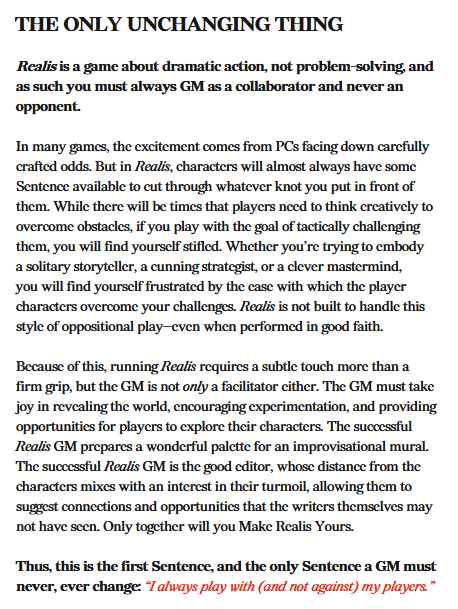
Lancer is a game about fighting. Those fights are pretty difficult. There’s a pretty solid system in the game for giving those fights objectives that aren’t just [kill all the enemies], usually tuned so that when such an objective is in play you can’t kill all the enemies, you just have to hold them off from the zone you’re trying to capture for six rounds, or such like. The game wants its fights to be hard to win, and for you to be prepared to lose and the story to deal with the consequences of that.

This group knew that. We’d been totally prepped for defeat in many pivotal fights, with stakes clearly established if we failed our objective. Which is good! That’s the best approach to take with these things. It’s what the game needs to make it so the fights itself aren’t just smoke and mirrors. It made the game as a whole a lot more satisfying, to win and to struggle through both.

But then we hit the final boss, and, that, we were supposed to win.

See, a boss fight is kind of a paradox, in terms of the motives behind it. You want it to be a big dramatic setpiece, with pivotal implications for the characters involved, since it’s capping off a whole arc, or potentially several. You also want it to be a struggle, so as to avoid invalidating those dramatics with a cakewalk. But. If it’s decently difficult, there’s a meaningful shot our heroes lose. If they lose, there needs to be some direction to go from there that still serves the dramatic wrapping-up-the-arc purpose, in an at least semi-satisfying manner. Sometimes that makes for a good hook for the troubles of a future arc, but, if it’s a final boss? The end of the whole going? That means you’re all going out on a losing note all of a sudden, and if the villain’s plotting something dastardly… do you just let that follow through? The world was destroyed, that’s a shame, hope you enjoyed the game?

There’s a lot of possible answers to these questions. Some satisfying, some less so, many entirely table-taste-dependent on how much of an issue they are. But, I think the easiest one is pretty apparent. Throw the fight. Give a good spectacle, pull in character arc references as needed, but make it so the final boss doesn’t actually get a real shot at it. You know, make it so the players are supposed to win. It kinda just lines up better with how we expect stories to go, a lot of the time, and, usually, for players invested in the arcs of the narrative, how they want it to go.

I tend to get pretty invested in mechanical struggle, myself. I like winning, I’ll admit it. I’d rather win than lose. But, honestly, given the choice between a difficult fight and a free win, I’d rather have the former, even with significant stakes for loss. The thought of the victory just being handed to me feels iffy. But… I didn’t notice, really, until we actually lost. I didn’t think, “gee, is the GM throwing?” even at points when, maybe, they were. (Which makes the loss a bit more embarrassing, but shhhhh.) From my end, as a player, it looked the same as any fight where loss was on the line.

Here’s a question, then, in that vein.

Does everyone like to lose?

…Well, that’s an extremely loaded question, actually, which I need to deconstruct a little myself first. So, bad job, me. See, I don’t like to lose. I’m rather averse to it if I can help it, and frustrated if I can’t help it. But, I just said that when I’m faced with a challenge, I want it to be on the table. And, honestly, even that needs qualifiers. I quite like games that are built on failure per se not being an option. I just got my beta copy of Kedamono Opera, which I should talk about sometime, and its whole tech is based around automatically overcoming the challenges before you, but you roll to determine what other tragedies are foretold in the process and how difficult it is to get through. I find that neat! I don’t mind that at all. But the game’s upfront about it. If I’m playing a game that says, hey, here’s a challenge, it’s up to you to play well so you win and don’t lose, I expect that to be true. If a fight is a struggle to win, there ought to be a timeline where I don’t, and it’s on me actually paying attention and playing well to ensure that doesn’t happen.

That’s what I’m asking. Do you think everyone is like that?

‘Cause, I don’t.

I’ve played games with people who always reacted to loss with frustration. Not in the way one gets frustrated at bad dice luck, or having misplayed, or thinking your fellow players misplayed, or etcetera – not frustration at the process, frustration at the result. I’ve played alongside people who have said, in the same cadence as before, “I was supposed to win.”

Now, in most competitive games, I think people would have a rather dim view of that comment. I imagine words like “salt” or “toxicity” are springing to mind. But, I’m not here to cast aspersions, because I’ve found that with RPGs, a lot of the time, the expectations are very different. I imagine some subset of the readers are currently balking that I analogized a GMed RPG to a “competitive game”. There’s an idea in the zeitgeist, in players and GMs both, that it’s specifically not that. That challenges are a performance to explore how people overcome them, but not if. You’re supposed to win.

But you can already see the problem, right? Or, there’s several steps that could be the problem.

The key string of words, in my eyes, is:

“I’ve played games with people who.”

This is me speaking from personal experience. It’s not only speaking from personal experience, I’ve talked to other people who’ve observed this, I’ve talked to other people who have been this person themselves, I’ve read a whole bunch of dubious RPG advice predicated on the concept.

But why, when I’ve laid out my tastes, have I been playing games with people like this?

The solution is obvious, right? Some games are built with losing as an active aspect of play, some aren’t. Those games will require a different design paradigm to be interesting. When I’m playing for the struggle to win, I should play a game in the former category, and if I’m playing alongside people who don’t, I should be playing something in the latter, or they’ll be unhappy. If losing is on the table, it should be something that’s supposed to happen. If a player isn’t here for that, why are they here, with me, in a game like that?

And I think the answer is… they aren’t. We’re playing the same game, yes, and that game is built with structural expectations, but they aren’t coming here based on the expectations of the game itself. They’re coming here with their expectation of [how these things are supposed to go]. The game tells them they can lose, and they say, yeah, but I’m supposed to win.

So, again. The solution is simple, right? These people who aren’t me are just thinking wrong, and need to change their ways in accordance with my brilliant vision. Ship it, I’m so smart, I love it when a thesis comes together in a way that lets me change nothing about how I think.

Except…

I’ve laid this out to people. (In slightly less rude terms, I hope.) I’ve talked to them about this, and what they might want. I’ve proposed games that aren’t built around playing to win and accepting defeat as a primary mechanism of play. Games where you are, structurally, preordained to win.

And the most common response I get is some variant of, that’s not interesting. That’s cheating. Where’s the fun in that?

Now, I don’t want to answer those responses. I think they’re very answerable, though it’ll depend a lot how compelling any one answer is to a given person. Instead, I want to posit an idea of why this is the common reaction.

To wit: There’s a disconnect between [what’s supposed to happen] and [what a game is supposed to include]. The game, as its own object, has expectations put upon it. When I proposed that a game should only contain things that are supposed to happen, in that moment, my logic diverged.

That sounds familiar, from our earlier discussion of character death. Why can a pilot die in Lancer, but practically speaking that’s just not going to happen? Because, while it’s not supposed to happen, the game, as its own object, is [supposed to have it]. If Lancer had its pilots roaming around, but no way for them to die, some section of the audience would say “hey, that’s not right”, even though that section wouldn’t want that to actually happen. (The game has some affordances to make it so even if it does happen, it doesn’t, as I mentioned before – you just make a clone with the same personality at no cost and move on.) And so, as an appeal to that audience, the mechanics are included, just made unlikely enough that they don’t matter.

Simple enough, even if I don’t agree with the logic designwise.

Except… (again…)

What if you’re someone who does want that to happen?

You know, I frame all this like I do because I don’t particularly enjoy character death as a randomized possibility. But, I’m not everyone. I know that’s a whole contingent of RPG players. And there’s games built with that as a baseline, and games without that.

A player like that could read Lancer’s pilot rules, right? There’s no law saying players of certain tastes can’t read certain games.

What then?

Well, some of them might be confident enough in their guesswork when reading the game to go, got it, there’s enough steps in the way that this probably won’t happen. But I don’t think they all would. I don’t think that’d be a fair expectation to put on them, given the game’s new to them in this hypothetical. There’ll be some prospective Lancer players who go in, comfortable and interested in PC death, and think the rules support that.

If they’re a player, isn’t that going to be a bit of a problem for their expectations?

If they’re a GM, what if that becomes a push in their eyes to nudge the gameplay towards circumstances where that does happen? And where does that leave the players at that table, who maybe aren’t interested in that?

You see what I mean, right? These are all reads of the game that people come away with. I’d be happy to argue that mine is the most valid read, that people just shouldn’t get other impressions of what the game supports like that, but, they have, and they will. I’ve talked to all of these people. My question is, why is this happening, and what does that mean?

Don’t we know what we’re doing?

RPGs are built on communication. They’re social activities. A lot of the time, they’re only social activities – you just talk back and forth until you hit somewhere the game has opinions on. Understanding what you want, and what other people want, is core to the experience.

But it’s not automatic to the experience. If you’ve ever had to read a section on safety tools when flipping through a rulebook, you already know that. Humans aren’t psychic, and they’re all operating on different baseline expectations. And some of those baselines are often seen as [so obvious they don’t need to be said].

If you were to ask me, on a lazy day, on a day where I’m not really bothering to think about this post, about that? I would absolutely classify “PC death is intrusive and bad for a game, it should be avoided” as that. I’d just, figure that’s how it is for everyone. And I’m not the only one there. I have been trying very hard to dance around the D&D in the room, but, I recently happened on someone talking about the game, and they very casually talked about character death as an active intrusion, and, worse, a sign of a bad GM. That a good GM would actively rein in and change mechanics on the fly to ensure it doesn’t happen. That wasn’t even the argument, it was the lead-in to what their actual argument was – it was a given.

But, it’s not given, is it? It’s not as if someone could read D&D, where hitting 0 HP puts you right on the fast-track to losing your character, and deterministically conclude the game doesn’t actually mean that. Just taken on its face, I’d feel obliged to say the people who think that death is expected are right! I mean, it’s right there in the rules! But now they’re running the game wrong, because they came to a different unspoken expectation than I did?

That sounds like a social trap, and I don’t like those. It’s an expectation of coming to a certain conclusion, in defiance of what’s put in front of you on the surface, and a social punishment if you don’t come to that conclusion.

Buuuuuut, I am not here to gripe about the cultural mores surrounding D&D. (Directly. Everything I’m saying here does apply to that context, but it’s not specifically about that.) Instead, I want to loop back to one of the things I posited earlier, in regards to a new question:

Why don’t we just speak these expectations?

Why wouldn’t a game just go out and say that PCs aren’t going to be dying from these fights? Why would a player set a social trap of expectation instead of just say it?

(There are more complicated social factors regarding the latter question. Players are in an odd position, and many are timid. But the former? Games don’t have anxiety, they’re just words on a page. They’re fine!)

Or, to put it another way.

Why would a player who doesn’t want this as a part of their game, say it’s [cheating] for a game to work like that?

I think the answer is – players are liars.

Yeah, no kidding, I just lined out a mismatch between expectations and stated interest. But I don’t mean that. I think a lot of players are lying to themselves, and more specifically expect games to do the same.

(And, I don’t think that’s a bad thing! Frustrating to design around, maybe, but I want to be clear – lying is morally neutral, in my framework, for this.)

See, the answer to “why don’t people just say what they expect out of a social context” is that that’s hard and people often don’t know how to do that. And, trust me, I find that frustrating too! Navigating interpersonal stuff would be a lot more convenient if people could just hand you a business card outlining what sorts of interactions appeal to them or frustrate them. But that isn’t how people work, entirely, and it’s not how they expect to work. Without sitting down and dissecting their own tastes, it’s not contradictory at all to say both “I expect a game to have provisions for characters dying” and “I actively do not enjoy it when my characters die”. Those are just two impulses that emerge from a given player’s thinking, and that’s all they have to navigate with.

The onus is on the game, or, often, even worse, on the GM role, to resolve this. To turn a set of impulses back into a structure that suits everyone, while, and this is the important part, still appealing to all of those impulses in how it presents itself. Because [I do not enjoy PC death] is structurally more important, the game has to be built around that – but it has to claim to be built with both in mind, or one of those impulses will cry foul! The game is expected to lie to them, to claim it covers every base they could ask for, and then actually only do what they structurally want!

Now, I might have been a bit misleading before. Saying I “don’t think this is a bad thing” isn’t strictly speaking true. I think this whole arrangement is frustrating to navigate, often leads to a lot of stress put on whichever player is put in the GM role, and my smug neuroatypical-on-the-internet take is that clearly people should just get a hobby of dissecting their own psychology and enumerating their structural desires, and we can return to that business card idea. But, that’s dumb. People aren’t going to do that, and it’d be nonsense to expect that everyone would. So, this is something that RPGs have to work around when presenting themself.

It’s also something that we have to work around when writing RPGs. Because, while I like to put people in boxes, game designers are, in fact, a subcategory of player. And I think it would be foolish to say that examples like this are included exclusively in opposition to the designers’ wishes, the designer filtering out which of their own wishes are lies they want to tell is something worth recognizing. Character death isn’t even the only one of these in Lancer – there’s a mechanic I really hate in there, primarily for how intrusive and yet nothing it is, regarding the game’s AIs having a risk of going rogue upon getting shot too much, and it’s a very similar story. Extremely unlikely to ever come up, it’s a literal 1 in 20 chance upon taking serious damage, but directly reflective of a conceptual facet of how AIs work in this world. They’re big naturally-occurring machine intelligences that have to be calibrated to think in a human framework, and that calibration can be knocked loose, and this is a reflection of that idea. The mechanic itself, frankly speaking, contributes nothing and makes the game worse for its presence. But! Its existence is a thing the players will read and go, “oh, this is an important part of the setup, this is A Thing That Can Happen”. It’s a flag. It’s a lie.

So, mechanics can be there to provide signals to readers about what’s conceptually possible, even though the mechanics themselves practically aren’t going to come up. Using a part of the device as though it were an extra layer of paint. And because players are primed to read mechanics that way, sometimes you get people fundamentally disagreeing on what [the actually important parts] are, and that way trouble lies. My obvious conclusion is – think about this more as something to communicate, and that way you’ll be able to separate people who read character death in Lancer as expected, people who read it as possible but unexpected, and, me. Those boxes would probably have a better time playing Lancer with one another, than someone grumping about this like me, right?

A digression of discourse

Have you ever heard of “fudging”?

It’s a rather contentious topic. “Fudging” is the act of specifically changing the result of a dice roll (or other randomization method) to a different outcome that is considered more interesting, desirable, or [supposed to happen]. (You can probably see where I’m going with this.) Notably, fudging is usually only considered for GM-role players in particular. Non-GM players doing the same thing are usually said to be “cheating”.

I’ve seen a lot of stances on the concept, often hardline. Fudging is never acceptable. Fudging is only acceptable if you’ve informed the players in advance that you do so. Fudging is only acceptable if you skew the outcomes in favor of the players. Fudging is a necessary component of GMing and refusing to do so makes you a bad player. Etcetera etcetera. I have my own thoughts on the matter, I cannot resist a bitter argument between unchanging viewpoints, but, I’ll spare you that today. Instead, I want to look at the notion in the context of what I’ve examined above, and see what the contention of fudging might be able to imply about broader concepts of what is [supposed to happen].

At its core, the drive to fudge something is the same drive as to apologize to the players after they lose a fight. The game produced an outcome, and the players, or, specifically the GM, declared that outcome wrong. The philosophical underpinning of fudging, from that lens, is that it’s better to do what’s supposed to happen than to do what the game tells you, even if that makes part of the game an artifice. In that sense, say, changing the rules of Lancer so that pilots don’t have a risk of death when being downed (something I regularly do) is not unlike fudging in concept.

However, then there’s the deception angle. One of the common complaints I see regarding fudging is that it’s lying to the players. They are told they can succeed or fail, based on GM-facing mechanisms, but then if the GM chooses to turn a failure into a success, or vice versa, there was never any chance at all. If the GM told the players that this effort was just going to succeed, or so this contingent claims, it wouldn’t be as much of a problem. The core of the issue is when the players are being lied to.

Now, there’s an easy way to tie this digression back in. Some set of players of RPGs expect to be lied to, some really dislike the thought, this produces problems when those sets are poured into the same pool. It’s a simple conclusion, and, I do think, a true one. But, see, it’s not quite that simple. I’ve seen people in both categories. People who raise this specific complaint about fudging, but then actively prefer a setup like Lancer‘s to out-and-out not including death as a stake.

That perspective implies a difference in the type of [deception] it is. And, when I’ve asked about it, the most common answer I’ve gotten is hesitance to call what the game is doing deception at all, followed by, after my trademark stubbornness and charisma, a begrudging acceptance of that with the qualifier that it’s “more fair” when the game does it. That, if this is the standard of deception I’m using, most of what an RPG does is deception.

I recently wrote a bit about stunting, a mechanic I don’t particularly like, and I expanded my thoughts into the archetypical skill roll from a bunch of different systems and how they share several of the same problems. Naturally, I think I did a great job. But I’ve been mulling over a lot of what I thought about since then, stunts and the like are a topic I have a lot of thoughts on, and, I’ve started to wonder if, in the context of this post, I’m the problem.

That is – if stunts are only a problem if you think about them.

For those of you who don’t want to go read a whole different blog post for context, which, fair enough: stunting, in the broader definition I examined, is [if the GM or the players as a whole enjoy your narration, you are mechanically rewarded]. With that having several emergent social problems when people try to game it, or make it fair. If you try to succeed at a game like that, the primary winning strategy is to appeal to your friends in a cynical repetitive way to maximize how many reactions they give you. The incentives get perverse in many dimensions.

But what if you… don’t?

If you don’t, then, you kind of just have it come up when people narrate something cool. Some people will get it more than others, some will try a bit harder at narrating, and… this still does have social problems, several of the complaints I wrote about in that post still apply, but, also, many of them matter a lot less. The mechanic works better if people just take it at face value.

And, hey, that brings me back around to the first anecdote I shared.

I like Lancer. I especially like it’s combat, that’s the brunt of what it’s about. We faced several fights, boss and otherwise, over the course of that campaign. Many of them were close shaves, and I had a lot of fun with them.

If I had been thinking, in those moments, ‘oh but I’m supposed to win’, would I have enjoyed myself as much?

I’m honestly not sure.

I think, what I would have enjoyed the most is that actually not being the case. Knowing that losing was expected would make me feel less like I’d failed as a player if we actually did hit that point (vs just slipping up on a tactical level), and it would make the victory feel more genuine. But if the big capstone fights had to be like that, as a concession to the concept of a boss battle with high stakes? Maybe I’d be happier if I just didn’t think about it.

I did get my mech destroyed before, in that campaign. Multiple times, I played a reckless frontline bruiser type. And then I was running around as my pilot, attacking enemies for light damage and trying to stay out of harm’s way. It was tough! And it felt all the more tense because the risk of death was there. Even though it wasn’t, really. Even if I got downed, it was supremely unlikely. It was an illusion, but because I bought into it, it affected my experience.

I think that’s what I’m getting at.

I like thinking about the structures of game design. It’s a hobby, it’s a passion, it’s what this blog is for. And, I think for designers, it’s very important, and for players, it’s valuable to think about what a game is doing and why. If I’m playing a game, I want to dissect it. And then I’ll want to play in accordance with what it most wants out of me.

The thing I’ve realized in pondering all this is that a lot of players don’t do that. I don’t just mean that not everyone thinks about RPG design as much as I do, anyone could have told you that. I mean that I think there’s a specific joy in being willfully ignorant. In playing a game where you can’t meaningfully lose, and being told that you can by the system itself, and believing that lie.

I don’t think I want to do that, too much. Like I’ve said. I like thinking through systems, and I like it when games are honest about what’s supposed to happen in them. This whole story started with what goes wrong when you buy into a lie like that, and it lets you down. I believe that an honest game is a better game.

But, at minimum? This is going to be how a lot of people will approach anything you write. On a meta-level, they probably expect lies where there might not be them. Being clear about, no, I mean it, this one actually matters, is, probably more difficult a challenge than it might seem! It’s like trying to indicate you’re not being sarcastic. Everything you try will be just as commonly used in sarcasm.

But it’s worth it, I think. To try to be clear about that.

And maybe, sometimes a game will work better if you just lie about things a bit.

Like I mentioned before, I recently backed the Kickstarter for the translation of Kedamono Opera, a fascinating game with some tech I quite appreciate. I’d be happy to gush about it sometime, but I want to leave on a bit of GM advice that I think represents a fascinating example of how to use this exact sort of deception.

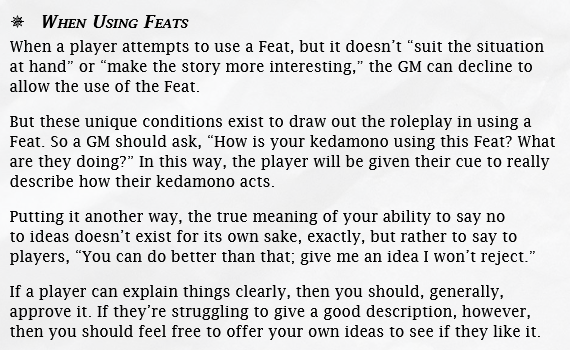
Every player is a monster with vibe-defined powers, like, say, spinning a magically-sturdy spiderweb trap. The use cases are vague, and left to the player to pitch and the GM to approve or veto. A similar arrangement to the stunting post from before. To the players, that’s what it is. To the GM, however, it frames their veto power like this. Not as a refusal, but a nudge. The point isn’t to say no. It’s to say, “give me some more to work with,” and if the player backs down, the GM is actively expected to intercede to give ideas of their own to make it work.

Facing the players, these powers are limited in use to what makes sense. The GM knows, however, that they can actually be used anywhere – the veto power is there to try to push the narration to feel more plausible, even in outlandish cases.

In other words, the player-facing mechanic isn’t as constraining as it claims. And because it’s smoke and mirrors, you get the conceptual benefit of a stunting mechanic, without the social limits being anywhere as strong.

That, I think, has a lot of interesting potential!

Stunting, fictional positioning, and the tyranny of human intuition

There’s a mechanic that I hate, whenever I see it.

It goes something like this:

“When a player narrates their action in a cool or exciting way, they gain [insert bonus].” Or, even worse, if it’s paired with: “If they narrate their action in a repetitive or uninteresting way, they lose [insert penalty].”

Now, on its face, there’s nothing too objectionable about this. The incentives are very simple. We take something desirable for gameplay, having exciting narration and framing for actions, and tempt the players to go out of their way to indulge in it, because a mechanical reward is offered, and, we assume, the players want mechanical rewards. Simple enough.

However, you might already see some of the issues with it. For one, what is it that makes a certain piece of narration ‘cool’? How do we know if something is exciting, and, more specifically, exciting enough to warrant a reward? What happens if everything a player says is really cool, and they just get more power than the other players because of this? Do we have to raise the bar for that person specifically, to balance it out? What if someone’s shy? Wait, do the developers expect me to give this bonus a lot, or am I breaking the numbers if I do?

Usually, the answers start with “the GM has to adjudicate that,” and that means they end somewhere pretty messy. The impulse for this, too, is simple to understand. Suppose the other players adjudicate it amongst themselves. One of the things RPGs tend to take as given is that the players are angling for their characters to materially succeed, sometimes to the level of failure actively grinding play to a halt. That means the players have a vested interest in going “oh yeah that was definitely cool,” because they stand to gain from it. Now, that’s framed dishonestly, and obviously, most players aren’t going to be weaseling like that. But. What if they’re on the fence? What if, because of this, they decide to err on the side of getting what they want? Or, if they’re a conscientious sort, consider the opposite. Something they think might be cool, but, for fear of not thinking they’re taking advantage of things, they decide it’s not. In that declaration, they’re actively signaling less interest in the play than they actually have! That’s bad!

So, putting it onto the GM makes some sense. They have much less of a conflict of interest, or, rather, it comes bundled into the preexisting conflicts of interest of the GM role (which is a doozy of a topic all on its own) – the GM wants to meaningfully challenge the players, but still support their efforts to be cool and succeed, in theory. So, “you don’t get this free bonus at all times, but you do when you do something exciting and neat for the game” sounds well in line.

However. This doesn’t actually remove these concerns. The open question of, how much is too much, is still very much in play. What if the GM has high standards for what’s cool, and so the players don’t get the bonus dice the game’s math assumes they’ll have? Or, in that same scenario – what if the GM thinks to themself, “I’ve been giving this bonus die out a lot, that’s probably not right, I should raise my standards”? I’ve started thinking about [yes fatigue] and [no fatigue] as phenomena of GMing, where, when the game calls on you to say yes to a given player proposal enough times (or, to say no), GMs will end up standardizing to a more even adjudication just because they get tired of it. This is a prime example of where both can come up. If the GM needs to be asked if a given narration counts as cool enough, then, even if the game wants them to say no except for, say, once an adventure… that’s unlikely to actually be the pace they hit.

Now, obviously, I’m an advocate of communicating things. “You should get this bonus at most once an adventure” is a thing you can just say. You can lay it down as a rule, even! But I think that’s rarely something mechanics like this do, because they’re intended to be inconsistent and stochastic. A cool moment is unpredictable and unpaced, and thus, unbalanced. But, even if you discard balance concerns entirely, in my experience, the actual players at the table won’t discard those concerns, and that worrying will compound the buildup of yes fatigue and no fatigue.

And that’s not the only concept of social fairness at play here. What do you do if one player is just, better at narrating moments the group finds cool than others? If you shift standards for them to avoid unbalancing the game, that’s got a very real risk of feeling discouraging for them. But if you don’t, that’s the game specifically rewarding one player over the others for their performative ability – starting a competition it’s really not great for the social dynamic to have. And if a player is notably bad at it, or even just shy, that gets significantly worse. If they don’t get any mechanical benefit because they can’t pull it off, not only does that feel bad for them, having weaker mechanical control means they have even less control over the spotlight, pushing them into the background even more. If they do get the benefit anyway, then not only is the entire concept revealed to be silly and pointless (since, now it’s not celebrating things the table finds cool at all), it also prompts the other players to feel like they’re wasting their time for trying to make cooler-than-usual beats. If you have both a notably good-at-this player and a notably bad-at-this one at the same table, all of these effects compound. And, really, since the pitch of mechanics like these is “this way, you get more cool moments,” the ways it actively stymies people who might be awkward about that but want to try and get better are the most damning criticisms I could give of the concept.

So, yeah! That’s stunting, and I do not like it. Whenever a designer thinks to introduce it to their game, I highly recommend they consider the perverse social dynamics I outlined above and if they actually want any of that in their experience of play. (Maybe, if it’s a game about unhealthy social expectations, that can fit! But probably not.) Short showing today, but this was mostly just a personal grumble. You can all go home now.

The predictable twist

Yeah, you know I couldn’t leave it at that.

Consider, if you will, a different mechanic, with a similar shape. A player can get bonus dice, or an XP reward, or, any other [insert bonus] idea we might have had from stunting, when they take an action, if they can describe how that action makes sense. How it works, you know? Why is this time that you’ve tried to stab your opponent plausibly more effective than the last one? Riff something about chinks in the armor, whatever suits your fancy.

On the surface, that sounds very different. But in practice, I’ll argue – read everything I wrote in the previous several paragraphs. That also applies here! If a player is uniquely comfortable or uncomfortable with narrating little quirks of the world they interact with, or, say, familiar enough with how electrical engineering to bolster their Elec. Eng. roll (in this hypothetical system, skills have a strict 10 character limit to their names), then, you have the same imbalanced dynamics. If the GM gets tired of giving the bonus every time, or worried the game is getting too easy because of how frequently it comes up, that’s yes fatigue. It’s a different player skill being tested, a little, though both do end up having a core ingredient of [how well can you convince the GM to give you what you want] – but the dynamics haven’t changed. The shape of what that mechanic does, is still the same.

So, arbitrarily-adjudicated bonuses. I don’t like ’em. If you give a consistent pace to them, maybe a resource to spend as a bonus pool, that works for sure, but making it contingent on one player’s judgement of another player’s performance, that’s questionable. Make sense?

Let’s consider another scenario.

A player has a set of skills, which they roll as a dice pool on a challenge. Among their skills, they have Stalk at 2 and Slaughter at 7. (All of the skills start with S, which sounded cute to the designer but in practice is confusing for the table.) That player is currently attempting to sneak up behind and assassinate an NPC, an action that could ostensibly fall under either skill. It’s the GM’s job to declare which skill applies, based on what the player narrates they’re doing, and how.

In other words, the player has 5 bonus dice on the line based on how well they describe their actions to suit one of two overlapping skills, and both they and the GM know that.

See where I’m going with this?

Now, the thing I just described, very intentionally, looks like what a lot of RPGs do for skill systems. In fact, this example is pretty much taken wholesale from Blades In The Dark (which does not do the S thing, the skill names and numbers have been changed to protect the guilty), with one notable exception. Blades affords the players the decision of what skills are valid for a given test – ie, to analogize earlier, letting the players declare how good their stunt was. However, the GM then has their own parameters of difficulty to apply to the test – meaning, a GM could make the Slaughter roll harder and the Stalk roll easier, within those parameters. This might make the Stalk roll a better bet, despite the smaller value! But it also might not. And, even then. If it does make the Stalk roll the better choice, that’s the GM saying “no, you can’t do that stunt for a bonus” by any other name, right?

Now, let’s go one more layer.

A player declares that their character does something. No roll, no mechanics necessary, just, this is a thing that happens. The analogizable reward to the prior levels of stunting is, the thing happens. Most prominently, the thing they’re doing solves a problem or accomplishes a goal.

To that end, they explain to the GM why they think this should work. You see, nuclear reactors always have emergency shutdown buttons that can flood the irradiated material with antimatter nega-radiation to render it inert. Maybe they even cite some real-world science about that! Nega-radiation is a thing, you know. Look it up.

The GM can either accept it, or veto it, or maybe they call for a check of some sort, and we’re back on the previous layer.

In other words, a significant reward for the flow of play is shaped by the GM’s judgement of the description of the acting player. How well it lines up with [what makes sense] and [what should happen]. And, of course, if they do too much of that, the GM gets tired of saying yes, and when another player proves really timid and unable to do this much, that means they trail behind in how much they can contribute to and play the game.

This is what I called in the title the “tyranny of human intuition”, and, that might seem like an odd thing to call it, when I’ve been talking about social pressures first and foremost. And the reason for that is – I don’t actually believe in human intuition. At least, not in the context of tabletop roleplaying games.

There’s a concept that gets taken roughly as given, in my experience, in discussions of RPGs and what they do. That of the [shared world-conception]. That is, all the players, GM included, will, over the course of play, come to an understanding of the world the game is set in, and how it works. That understanding is the same to every player that possesses it, such that everyone can have an intuitive understanding of what would happen if a given action was taken in a given context. Sometimes I see this framed as the most important aspect of an RPG, even, with mechanics as a subservient tool for the purpose of creating this. (For some more detailed exploration of a few concepts ancillary to this, my ghost engine post goes into some detail there.)

Now, I don’t think this is entirely wrong. But I do think it’s somewhat wrong. Specifically in that, while people can share broad ideas with roughly similar shapes, the nature of human interpretation and understanding means perfect translation of thought between beings is impossible. There’s a reason communication is an art form. (Several, actually. Writing, conversation, arguably all art forms are in part communication.) And with an RPG, an actively social activity…

If you think you understand how something will resolve, but the GM is suffering from yes fatigue and declares it won’t work because you’ve done too much, your understanding was wrong. Any meaningful understanding of the world, then, inherently has to involve an understanding of the boundaries and habits of every other player at the table. The GM, especially, a lot of games I see give an outsized amount of adjudication power to that role specifically, but even if we take that as given. If we know the GM is prone to no fatigue, and will say yes more often to people who rack up a bunch of nos, and we know a specific player struggles to narrate things in a persuasive manner, we know that player will, potentially, be able to do things that other players couldn’t get away with, out of an impulse to throw them a bone. (And if we know the GM isn’t prone to no fatigue, we know that player very well might not be able to accomplish things other more well-spoken players could.) If we don’t understand that, we don’t have an accurate understanding of how the fictional world works and interacts with us, but if we do understand that, we’re acknowledging that the world-conception is inconsistent and influenced by social factors.

The [tyranny of human intuition], then, is putting these adjudications on the shoulder of a player role, GM or otherwise, with the baseline expectation that it’s founded on this [shared world-conception]. It’s relying on [what makes sense] or [what feels right], and thus, as influenced by social bleed… on some level, it reduces to the dynamic of stunting.

This is a common ingredient in many RPGs. I won’t say all of them, I know some definitions of RPG would take it as a necessity, but my stance on that is a hardline “nuh-uh”. (It’s always important to elevate the discourse.) And, to be clear, when I said at the beginning that stunting was a mechanic I hate, with each layer of that exploration, some of that hate dissipated. I don’t hate games that have adjudicated skill checks. (Well, I do hate some games that have those, but not because of the skill checks.) I don’t hate games that let things happen based on what [makes sense]. But I do think, on some level, a lot of the perverse social dynamics radiate outwards through the layers. And that’s something to keep in mind! The more you lean on this intuitive adjudication, the more no fatigue, yes fatigue, and the persuasive difference between individual players become pillars of how play shakes out. Lean on that too much, and tables with more of a disparity might very well have problems.

It’s something to consider some more, at least. Among other things, these dynamics get taken for granted so much that you get stunting, their worst form, quite consistently. Stunting’s an old mechanic! Games I otherwise kind of like have it! And because these factors aren’t really considered as potential risks, or things to be built around where possible, it comes up again and again. And that, I hate.

So, yeah!

A callout post, I suppose

…Ugh. I do not enjoy this.

So, a disclaimer. I am a rather negative person, in demeanor in general, but especially in critique. I try to make a point of reining that in when in public. On this blog, and on other public platforms I show up on, I have a policy to focus on talking about things that I think are good and worth getting eyes on. By default… I’m meaner about a lot of things, and that means I have to do a bit of ‘putting on a face’, even for this blog. (Sorry, folks, you’re not getting my entirely authentic self. To anyone parasocial and devastated, my not-quite-sincerest condolences.) This post is born from that, so if I seem crueler than usual, my apologies.

I have a long list of things, games, systems, people, that I don’t like very much. And those do tend to color the way I view other, related things. If I dislike a system enough, and I see a different game is built on that system, sometimes I just give up on that game without looking at it further. Sometimes, if I find an author’s work consistently bad, I’ll inherently mistrust the next thing they write. Is this unfair? Yeah, a bit! It’s a personal privilege due to there being a lot of games I can enjoy out there, so, I’m happier indulging my pettiness than I am trying it all no matter what.

Thus, I do feel obliged to mention. I, the author, have some amount of an axe to grind against Caltrop Core, a prior system by Titanomachy RPG, the author of, well, I’ll get to it. On some level, this colors my reaction. It predisposes me to disliking what I see, and, I’d feel manipulative for not acknowledging that. (I’d also feel rather needless enumerating my dislike of that system here, if there’s a lot of interest I can bring it up later, but, for now this post is already bitter enough, and I don’t want that to grow any more than it has to.)

That said, this is also the product of discussing this piece with several other acquaintances, whose reaction was similarly unpleasant, and who do not share that arbitrary bitter predisposition. Some of them are generally quite positive and lovely, in fact, and seeing the ways this upset them is really what prompted me to write this out.

This is Possibility Crisis, a… well, it’s not a game, but it’s a project for public contribution, a world to make games in. By, as I said, Titanomachy RPG. The concept is that people will take the origin point of this world, elaborate it by creating pieces of it, and thus, a community around the games and world will grow in the process of creating it. It’s a clever structure, even if these sorts of innate community-building endeavors don’t tend to appeal to me. If the seed was something that inspired me, honestly, I think I would appreciate something like it.

The actual content of this world-seed is…

Baffling, is probably the most generous way I can put it.

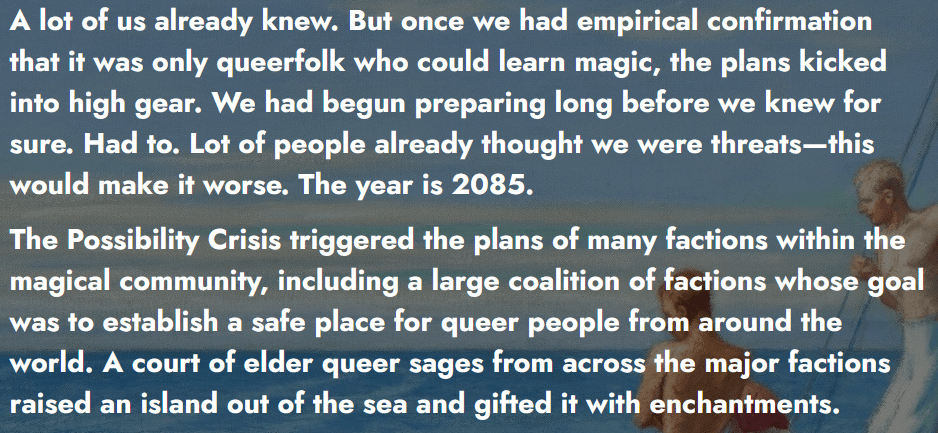
This is the general pitch on the itch page. It’s several decades in the future, magic exists, and only queer people are capable of it. Hence, several groups of magical queer wizards have banded together to construct a magical island as a safe haven, which travels the world.

The vision of the world beyond is… dubious. To those uninterested in the continental United States, it is an entirely blank slate, and within that context, we have painted a vague vision of calamity, with a strong current of Those Evil Southerners. For those without the extremely specific context of the intensely-tiresome US geopolitical landscape: the southern states trend more right-wing in their elected political bents, for a variety of reasons. This is, of course, bad for the people living there, especially the queer people. It also sometimes prompts a particularly awful sort of callousness from people inclined to tar entire states full of people with that brush, in the vein of, “oh, people in Texas deserve what happens to them for electing Republicans over and over.” As someone with queer acquaintances in Texas and Florida, this is horrendously cruel, and the common second comment in that vein, “perhaps they should move,” is also cruel, but more insidiously so. To lose one’s home, especially to have to travel far away to somewhere new, is no light thing, and claiming that it is the fault of those driven out is a horrendous failure of allyship and support. If you hear anyone say anything to that effect, that means they do not respect your value as a person based entirely on where you happen to live, and they are not your ally.

Now, Titanomachy has not said any of those things. And I don’t wish to claim that’s their intent in this paragraph. But it’s certainly the veneer, alongside a sort of sneering “our enemies are incompetent” vein. That is, Texan militias (all right-wing and evil) are inherently defeated by the “superior Mexican military,” a phrase that strikes me as very out of place in a text that would otherwise seem to benefit greatly from not fetishizing militarization, and Florida’s consumption by Disney is a running gag among people inclined to mock the Republicans there.

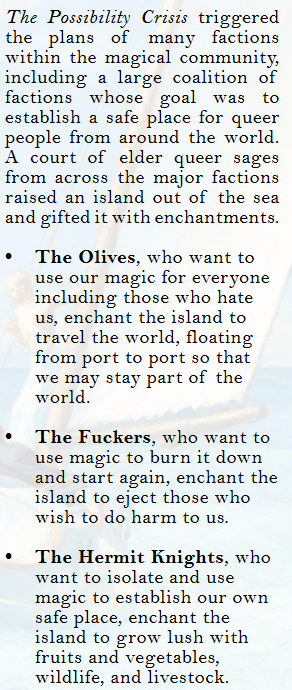
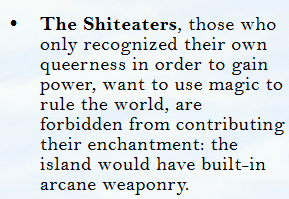
The island has some more elaboration to it, but, this is where things really start to get alarming. Mentioned in equal measure are a group of violent accelerationists and complete isolationists, and only then in the final faction do we get any notion of these being groups that are not considered fine and dandy in this hypothetical utopia. (The tone whiplash of half of them being called “Shiteaters” or “Fuckers” and half of them having names that I would recognize as, faction names in a story of magic and politics, is its own complaint, but much lesser than the structural concerns at hand here.) It presents the island as “a fresh start for anyone who wants one,” prompting one to question if we are to assume the Olives are somehow a ruling faction or considered the “right” one, since, that certainly doesn’t seem to suit any of the other concepts offered before us, but, an outwardly hostile veneer and isolationist perspective seem to be supported later on as the ideal, so, no?

It’s trying to be a queer power fantasy. And it is also trying to engage with politics, which queer life in the modern day cannot help but do. But these two goals are not easily compatible. A power fantasy is a complex thing to examine, from a political lens, and not one to easily indulge in. The concept being presented is a semi-isolationist state where queer people have inherent power due to the nature of magic, and inherent structural power due to magic being a core part of how the island sustains itself. This is presented as a triumph, as a utopia, because we assume the reader is queer. And thus, the reader will hear “this is a group of people who can exclude and hurt your enemies, and you can have power over them,” and they will enjoy that. However, I cannot have that and also be genuinely invested in or thinking about the politics at play. If I want to indulge in a power fantasy like that, a prerequisite step is forgetting what a power fantasy like that means, and what ideologies would sell it to me. I don’t want to think about suffering under the boots of power, and then be told, “now you can have power!” and have the followup left unstated but very much gestured at. Especially with what queer separatism has tried to do to people like me.

Which brings me to a more personal reason to feel alienated by this.

This one, I am willing to presume is not the intent. But it was also the first thing that, when reading, made me sigh and go, “ah, got it, this is not for me.”

As an aro/ace person, my relationship to queerness is, complicated. And that is immediately a fraught statement. There’s an unpleasant history of people attempting to externally litigate whether I, or someone like me, can count as [truly queer]. And, my immediate stance, and if you disagree, shut up, is that, yes, I do, and anyone like me does as well.

But, that’s easy to say, and more difficult to internalize. When I realized I was trans, a part of my initial rush of relief was realizing, now, I would likely never be denied being [truly queer] again. That’s an experience I’ve known several other trans people to share, in fact, which speaks to a certain exclusionary vein in many queer spaces I’ve frequented. If you aren’t considered legitimate enough, you will have an inherent push of discomfort at you for your presence in the space, and, often, that gets internally amplified. Which is a reason I’m discontent with the premise in general – being able to draw an easy line between [truly queer] and not based on, hey, you can do magic, simply will never sit right with me.

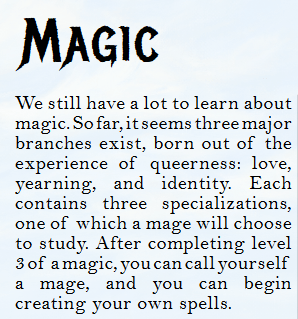
Here, however, it tells something more than that. It tells me that [love] and [yearning] are fundamental queer experiences. That to be queer, as this game-prompt describes it, those are parts of who I am.

I have, in my own scattered notes, a concept of a game exploring queerness. It’s something I come back to every now and again, but it always leaves a bitter taste in my mouth. I don’t know if I’ll ever actually make and publish it. The premise is as follows:

Magic is real, and powered by [true love]. You are among a group of chosen ones, who must use this magic to fight against a great evil. You are aro/ace.

Now, it is popular recently to expand [love] into more than just, attraction. Love for one’s hobbies, or love for one’s friends. But, I find that rather dissatisfying. There are words for those sorts of relationships, too. And it removes the exploration of the ways people actually do relate to attraction of various kinds, how that intertwines with their other forms of interactions, and what that is like for someone who Does Not Get It, especially when pressured into going along with it nonetheless. If [true love] gives power, and power can save the world, do you have a right to express discomfort at [true love]?

Like I said, it’s a bitter idea. It’s dear to my heart, but hard to work with for long.

Things like this remind me of it. Things that say, “ah, being in love, yearning, these things are fundamental experiences.” And, for a lot of queer people, I’m sure they are! I don’t mean to discount that at all. But I don’t feel that way. Even in broader, abstracted forms of these definitions, the times I would yearn for, say, a more-fitting body are rare. The times where I care for those I know intensely enough that it might be called “love” are also rare. Matching those titles to my experiences would, at that point, be stretching them to accommodate who I am. And if that, why not stretch them to accommodate anyone? If I love, surely straight people do. This providing of the magical bounds of queerness tells me, I am not queer.

No, worse than that. It tells me, if I found myself in this world, and the world deemed me queer, the powers I got would not suit me. I would feel invalidated for my empowerment. And, of course, I would feel invalidated lacking it! That would be the world cosmically saying, I do not count as queer. And, how dare you, world! You do not define me.

Now, these are critiques of the concept. And, like I said myself, I find the concept of magic entwined with love, or identity, or queerness, or whatever else, fascinating at times. I don’t want to say, this concept should never be explored, or this concept should only be explored in a way that satisfies my fringe existence in particular. If this expresses what queerness is to the author, fair enough. But it rings hollow, it rings exclusive, to the ear I have trained in my heart.

It’s not queerness as queerness is to me.

And now, the part that convinced me to write this post.

Some of these are fine. Mostly the ones exploring the island itself and the relevant locales therein. It’s the first and fifth one, the red ones, that leapt out to me immediately. It’s these that set off my alarm bells.

The last one, the JK Rowling pastiche, is just, entirely hateful. The whole of the prompt is, “You know this person you consider an enemy? You can ruin her life now.” There is no other way to read “she just laid off the majority of her security” and the mention of her not being at home as anything other than an invitation to intrude on the place and… well, it’s left unclear what, exactly, presumably whatever the players feel like, noting that they have literal magic on their side. It’s the entire power fantasy of the pitch laid bare, and exactly what I was disquieted by earlier. “Imagine you could hurt these real life people.” I can’t say I don’t understand the appeal, and I wouldn’t particularly bat an eye at someone having a fantasy of hurting someone who has done a lot of harm to the world, but you cannot sell me a power fantasy and a utopia in the same package. If I am to be working to foster a community and make a better world for all, or, at least, for those the queer separatist factions and the metaphysics deem worthy, then, do not also tell me “hey, here’s an opportunity to cause problems for this celebrity cameo you hate, give it up for being mean to JK Rowling, folks.” And in trying to be both at once, with a mean-spirited veneer, it simply makes me, disquiet with the utopia. It reads like a story being told in a fundamentally unpleasant society.

If I were to write anything for this setting, and, in truth, I did ponder it, it would be of those marginalized by the expectations of the writing. Of those that would not be considered fitting for the island, or the magic, and how they navigate a world where their ostensible allies are seemingly interested only in themselves and those they seek to hurt.

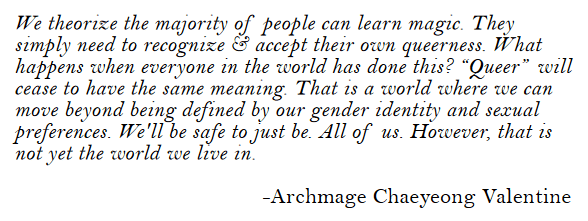
As for the first prompt, I wanted to bring this quote up. It was put at the beginning of the booklet, but I noticed it last. And, in truth, it frustrates me. Not least of which for the angle of, “oh so many people are secretly queer and haven’t even realized it,” but in context of the first prompt? Of the Bad Gay Man? In the same breath, it says both that magic is from self-understanding and if everyone could embrace who they truly are then it might not be locked to queer people at all, and that a politically powerful bastard who happens to be gay can be a problem in a way that he never could if he happened to be straight instead. He has power because he is gay. Not because of any deep inner recognition of himself. I have had many deep conversations with cis people coming to terms with their gender identity, with straight people coming to terms with their attraction. Many lovely internal explorations of who they are. That introspection holds no weight here. It has nothing to do with power. You can be selfish, and cruel, and awful, and so long as you happen to not be a very particular subset of arrangements of gender and sexuality, there you have it.

The prompt seems to take as given that queer people are good, and should be protected, and their vision of a bad queer person is one who hurts other queer people. To that end, being exclusionary, being cruel, being violent – these are fine, as long as you’re in support of the group of [truly queers]. There’s an us, and there’s a them, and we will empower the us and keep the them out.

Like I said, that’s a nice fantasy, but taking that bent to real modern politics that hurts a lot of real people is miserable.

And, I mean that literally. I showed this thing to a group of friends when I stumbled upon it, and, universally, people were hurt. It upset them, it invalidated them, mostly it just activated all of their “oh I recognize that shitty ideology” alarm bells and I can absolutely see why. And that frustrates me. To see something talking about queer existence, something trying a novel structure in the space of game design to build a design community, and the result is it hurts people to read…

I hate that.

And, I don’t know what to do with that. In all likelihood, this post won’t do any material good, right? The best I can hope for is someone reads this and learns a bit on other perspectives of queerness and structures that support that, but, that’s unlikely. Mostly, this is just me spitting vitriol into the void, and either nothing happens or it spits back. I’m wasting my time either way.

But, I had to write these thoughts out, and I had to at least know that they’re out there. For someone to read. I don’t want Possibility Crisis to exist in the world and have people look at it and all they see is people nodding along and collaborating with that. I don’t want to be part of a community that does that.

Honestly, at times when writing this, I thought, “maybe the queer community isn’t a place for me.” And I don’t want a document that does that to exist uncommented on.

So… here I am making an angry callout post, I suppose.

I don’t have a better conclusion than that.

The Ghost Engine, or “shoving the infinitely-complex peg of human imagination into a square hole”

I like to talk about games as engines. [Engine] is a term you’ll find here and there in RPG spaces, usually describing specific systems and mechanics – like, ‘running on the PbtA engine’ if a game uses a bunch of specifically-codified moves to shape the progression of play, say. The idea behind that usage is, here’s a mechanical core that defines how you play. It’s what makes the game move forwards, like the engine of a car.

That’s not what I mean here. Or, it’s only a part of it. An RPG, in its entirety, is a process to move ideas around. The players navigate that process, usually through the form of characters, but, there’s plenty of games that provide player-level inputs (metacurrencies, the ability to highlight or veto particulars – arguably, safety tools qualify, even!) – the point is, it’s a series of inputs and outputs that you move through, and that’s what play is.

This is a definition of [engine] that is broad enough to be meaningless. It’s “something that you can argue is consistent but has internal flow”. But, as I’ve talked about a few times on this blog, analyzing that flow in specific is quite valuable. In games with different modes of play, you can split them into sub-engines and examine how the play flows between them. In games with any sort of medium-term resource tracking or modeling, looking at the shape of the flow of play and where things branch into points that cause people to lose or gain resources, gives you an idea of how frequently those will fall down. (Taking the same HP math between two games, but one has several procedural layers that it’s unlikely to get through before you reach an effect that deals damage, yields very different results!) And this isn’t restricted to rigidly-defined mechanisms, either. You can map the flow of intentions, for instance, based on what are desired mechanical or narrative outcomes in a given point of the engine. (And notice conflicts between them – if you’re at the end of a cool boss fight, winning in a way that stops them for good is a mechanical ideal, but, depending on the kind of story your game is built to produce, giving them room to slip away and escalate may be more desirable on that level, and that’s a tension that will put strain on that joint in the engine! (See, the metaphor has lots of ways to apply it like that. That’s why I like it. Pressure on joints being pushed in multiple angles, wear from both overuse and underuse, varying levels of rigidity needed based on the task the component seeks to accomplish, etcetera.)) Figuring out and modeling the flow of what players will want in a given context, and what goals they bring to the table, is quite valuable in modeling how the engine you build will work out.

And here is where we hit a snag.

Players are inscrutable, confusing beasts. You can guess at what they might enjoy, based on what you and the people you know enjoy in RPGs, for instance. You can write a whole sales pitch to tell the players what to expect from your game – hey, come here if you want to play an edgy warrior of destruction having a personal breakdown and struggling to cope with a peaceful life, here’s the kinds of things you’ll do and see here. For instance.

But a player is a whole entire person. Even worse, lots of RPGs are multiplayer affairs – and not only are multiple people much harder to model on an individual scale, you now have interpersonal dynamics to work with. And no matter how elegantly your system of mechanized guilt-tripping and familiar obligation manages the game’s side of the interpersonal dynamics, there’s a whole segment beyond that, that only exists in tables far away that you’ll never get to see. You can’t know, for certain, everything that players will want out of a game. And thus, you can’t figure out, entirely, how that will change over the course of play.

However… you can get a sense of how your game relates to it.

Say, for instance, you’ve got a nice snappy little combat system. A cute little battle egg, a short list of powers that are strings of keywords and numbers ’cause you tightened them up all snazzy-like, great. You get into a fight, you pull out the egg, you get the enemies going, and one of the players says “actually, I want to just talk this out, let’s not fight”.

How does that go?

(This is a trick question, the answer is entirely “it depends on what the game prioritizes,” but, bear with me for a bit here.)

Now, sometimes, your answer, as a very cool and prepared game designer, will be that not only is that a step in the proceedings, if they look at page 4 of their pregen packet, they will find bespoke stats and procedures for the talking-things-out mode. Very well done, best of luck with the game, applause and acclaim for thee. But we’re assuming that’s not the case. This game wasn’t built with mechanisms to perfectly replicate your particular vision of what social interaction is like, you made it to be about fighting things. What then?

Well, if you’re me, you say “no, this is a game about fighting” and that’s that. There’s all these fancy game mechanics, and I’d much rather get them used than not, and if you aren’t here for that, then, you should probably play a game that does support tense deescalation negotiations on a mechanical level. That sounds neat! But it’s not what we’re doing today.

This is, I think, a fair answer to give. It’ll vary from reader to reader how much they would agree with that sentiment, but, this is my default approach to games. They’re built for what they’re built for, and they function only within the context where the players are accepting what the game is built for and staying within those lines. That’s how I design games and how I play games, and, it would be hard, in my eyes, to form an argument where that’s an inherently wrong approach.

But it’s not everyone’s approach. In fact, it’s probably not most people’s approach. Meaning, acting like that’s the one answer, or the correct answer, as much as it’s the one I like the most, would be foolish.

I think, for the most part, people would look at that as an opportunity. Usually, in the story surrounding games about fights, there’s, like, some amount of narrative importance to the fight and the characters involved. Trying to talk that out could, just on a story level, be neat! You can highlight the contrasts in priorities between the sides, what they value and what they won’t budge on. Maybe you decide, this is just going to be pre-fight banter, nobody’s minds will be changed. But, let’s say you don’t decide that. Maybe, after the talk, the foes back off, and decide not to fight. Or maybe the players decide not to fight! Maybe they get convinced, and they decide to work with their enemies, for a bit.

What just happened?

Well, on its face, it’s pretty straightforward what happened. You talked, and, one way or another, you’re not fighting anymore. You’d think that’d be normal.

But, in terms of the game. What just happened?

You hit a point where the next step was to shift to the fight mode. You were all set for that, the mode was queued up, ready to transition everyone’s thinking in there… and then you talked for a while, without using any pieces of the game, and then… you did something else.

From the perspective solely of the game’s engine, this is a failure, or, a glitch, or a user error, or something. It’s wrong. It’s just, not how it works. You had the expected behavior, then you hopped off to do something else, and who knows what’s happening. (This is the primary limitation of that model that I’m trying to address here, spoiler alert.) From the perspective of the engine of play, none of this is part of how the game is supposed to go.

Which means, that piece. The [and then you talked for a while]? That’s just not right, when looking at the engine. It’s not a part of the game.

Which then begs another question: were you playing the game then?

For the most part (I read Wisher, Theurgist, Fatalist recently enough to feel compelled to qualify this claim), I think most people would respond, that’s a silly question. You don’t stop playing the game just because you happen to take a digression into nonmechanized places. Playing a game isn’t something you just jump into and out of on a moment’s notice. When you discuss where you want to move or who you want to attack, have you stopped playing the game until you make a decision? When you play a solo journaling and pause to think about what you’re going to write before you do, have you, in that moment, failed as a gamer? It’s a silly question.

But, then, if [playing the game] expands beyond the components that are the game, up to and including actively skipping by or ignoring those parts… that means we’re missing a piece of the [game]. There’s a component that encompasses the rest of it, to get a full model of play, and if we don’t have that, then, we’re flying blind.

In response to this conundrum, I posit that we are all haunted by ghosts. Or rather, our games are.

If we want to model the flow of play, in its entirety, then, we need to address our [glitch] somehow. Our “you are here” dot flows from the [not in a fight] section, moves its way towards the [in a fight] section, and then, something happens and it moves somewhere else. This [something] wasn’t part of the game, at least, as we’ve modeled it thus far. An incorporeal hand grabbed it, and put it somewhere else. That’s the ghost.

These ghosts will be everywhere, to some degree or another. If you watch the flow of play, you’ll see them skip past sections because they seem unimportant, or specifically hold things in place, slow them down, lingering on what they enjoy. You’ll find them moving between modes of play, if your game has modes of play, and sometimes, you’ll find them calcifying whole sections into new modes of play, just through repeated experience. The ghosts move to what’s important to them, and they brush off what isn’t.

However. This is still movement. You can still model it. You can draw an imaginary line between modes of play, a pipe that you haven’t really built, and go, look, this is what the ghosts do. When our current position encounters an [importance gate], the ghosts judge how much it matters, and depending on their answer, either it flows to the fight like it should, or it follows this imaginary pipe off somewhere else.

And then, you may note, [importance gates] exist in more places than just that.

See, the sad truth is, the mechanics of the game don’t tell the full story of play, even beyond when the ghosts intentionally skip around them. Sooner or later, when you look at the start state of the game, you’ll find, [phantom inputs]. Heck, every decision gate is essentially that. If you’ve got a mechanized mode for negotiation to prevent combat, like that very clever game designer hypothesized earlier, then, the play gets to a start of a fight, the engine goes “great, now select between negotiation and combat,” and… well, somewhere, someone presses a button. The ghost nudges us in one direction or another, and off we go. The game didn’t do that. But it sure directed the flow.

There’s [phantom outputs], too. In fact, every part of the engine gives them. We get through our clever mechanical negotiation, we hit the segment that says, “okay, mission accomplished, skip the fight, direct back to the noncombat mode,” and we follow that. The ghosts don’t interject, things flow as expected. But. The ghosts are riled up. They’re opinionated now. The fact that there won’t be a fight, alongside the obvious mechanical repercussions, means something. The way the mechanized negotiation went struck them in a certain way, and now, the next time the character who we were negotiating against shows up, they tug us every which way to avoid fighting them and hear more of their backstory. We didn’t build a learn-their-backstory subsystem, we’re not that clever, and now they’re avoiding anywhere that triggers the fight mode, even conceding on things that are supposed to be tense mechanical downsides to give up. They’re compelled. They care. Because of what all we pumped out of our engine, into the ghosts beyond.

So. To review. Confusing and stressful as it is, we have outputs to them, and inputs from them.

That means we can control them. (Or, at least, model them – see what inputs to them can produce what outputs.)

The will of the beyond

Ghosts want things. They expect things. They want the game to be [cool], or [dramatic], or [heart-wrenching], or [fun], or whatever else. They’re capricious lots.

On its own, that doesn’t help at all. What’s “fun”? We’re an engine, we just move people around. I can show you some dice tricks, I guess? But that doesn’t really help. So, let’s dig a little deeper.

In my experience, the most common reason for ghosts to interfere in standard processes is, “that doesn’t make sense”. That is, something occurs that the ghosts have an idea of what [makes sense to happen] afterwards, and then, what the game outputs to them is different. When this happens, (depending on how hardline these ghosts are about such things,) the position gets nudged. You get moved to where does “make sense” to be instead, and go from there. Sometimes that’s applying effects, sometimes it’s removing or skipping parts of the game entirely, sometimes they add a whole new chunk to the engine that didn’t exist a second ago, and now you have to deal with that. Really, it can be anything.

…Which means we need to go even deeper, because “it can be anything” is, once again, unhelpful.

Your game has a concept. A pitch. A [thing that it is about]. It has a lot of those, actually. (And here’s where we get to how the analogy breaks down just a little, because we’ve hit “the color you paint your car will influence how it drives”.) It communicates that in several ways, one of which is its shape. That is – if you have a chunk of the engine off to the right, then the space off to the right is what the game is about. One would expect it to see use, or it’s just dead weight and shouldn’t be there.

Ghosts aren’t deterministic. They don’t see the decoration and shape of the engine, go, “got it, here’s the pitch,” and work with that. They’d be so convenient if they did! But it’s more complex than that. They interpret, and then they modify, to some degree or another. You give them a whole long explanation of what the game is supposed to be, with aesthetic trappings, and then, with that, they build their own idea of things. (And, “how do aesthetics and communication influence people’s thinking” is unfortunately far too complex a question to solve here.)

That idea of things is what they’re pushing for. What [makes sense] to them. When the engine diverges from that, they’ll nudge it. That’s where the ghost-hands come from. This idea, this concept of [what this game should be], that’s the torso controlling it all.

Like I said, the ghosts build this on the fly. It adapts over time, too, even. The engine’s trappings aren’t its only source, either. You’ll find, depending on the temperament of the ghosts and the needs of the engine, things like “well, this is how it works in the real world,” or, “I think it would be cooler if this happened,” or, “I’m uncomfortable with this, let’s skip it,” or many other such sentiments pouring into the pot as well. And, we can’t control that. It’s outside of our reach. We can’t put pipes in it, we can’t put walls around it, the ghosts have their own realm and we can only communicate with them or put walls around how they move through our engine.

So, we communicate.

We drape our engines in art, and prose, and cool paint jobs, and give them fancy titles, to say, “hey, here’s what this is about.” Maybe we annotate the engine itself, put a little sidebar to tell the ghosts, “hey, this part is for making so and so happen, that’s pretty important, please don’t touch.” Maybe (in fact, often), we have bits of the engine output to nowhere, for the ghosts to take, with a little message saying “hey, think about this, care about this, change what you’re doing because this just happened now.” What’s “thinking”? What’s “caring”? Hell if I know, but by giving the ghosts that, we give them a better idea of what our very fragile little device is supposed to do, so they know what steps are important and when to not skip things.

Again, they’re not deterministic. They don’t actually do it quite right, or quite predictably. But you can do enough to get them to understand, just a little, how to approach your engine, and work with it. And that can be useful!

Sometimes parts of the engine aren’t so important. Hopefully they’re at least a little. If not, just take it out and your thing weighs less. But, you don’t really have a way to control the flow in a way that always goes there when necessary, and skips it otherwise. Heck, maybe you don’t even know how to codify that at all, maybe it’s more of a [does this matter] question. Ghosts are good at that! And if you ask them nicely, “hey, if so and so circumstances regarding this don’t qualify, and you want, you can take the play from here to over there and skip this chunk,” then, maybe, depending on their mood, they might do that for you. They might do it better than you trying to figure out how to automate the skip would.

You can use them as input, too. In fact, most of the time, you already have. They’re who the engine is for, really, though they need you to make it work for what they need. Ghosts can’t quite make everything they want without us. (Wellllll… I’ll get back to this point in a bit, but for now, assume I’m largely right about this, and we’ll put a pin in it.) When we have levers, and buttons, and “choose to go this or that way and that tells you which chunk of the engine to go to next,” it’s the ghosts who actually press those buttons and flip those levers. And, it’s the ghosts who read what happens and go, “hey, that meant something,” and we don’t know what meaning is, but it changes their core, and that changes what their moves are in future.

When a ghost behaves, it’s a well-oiled machine. They fill in all the gaps and the nebulous “assume we get to the next point” steps, and it’s beautiful.

Communicating, through direct input/output, through annotation, and through aesthetics, are how we give them an idea of how to behave. They want to, for the most part, or, at least, you can just brush off and not build for the ones that don’t, but just like we can’t build a device that defines and optimizes [meaning], they can’t just arbitrarily intuit what’s important where.

…Right.

…Okay, fine, yes, I admit it, that was all a bit silly.

To pull back the curtain a little, and maybe make a few things less obfuscated by metaphor. The Ghost Engine is the term I use for the components of an RPG that the players, in play, bring to the game. Specifically, the way those components influence the actual mechanical element, because that’s what we can design for. Sometimes they change or remove important mechanics, sometimes they add play assumptions or homebrew subsystems that don’t make sense, sometimes there’s a whole unhealthy social dynamic between the players, who knows. We don’t, and we can’t predict that, but it’s still on some level a common pillar that games rely upon. (For a time, I used the term Ghost Pillar to refer to this, in fact.)

More specifically… the Ghost Engine is the smallest game there is. It’s freeform roleplay. It’s improv. It’s riffing back and forth on an idea. It’s a conversation! (I’ve read so many passages professing “ah, you see, this game is just a conversation,” and here I profess my counterargument – conversations, in and of themselves, are a type of game.) This is, notably, not mechanicless. I often see freeform roleplay described that way, but that’s certainly not the case. “One player writes a post, then the other does, then repeat” from forum roleplay is not only establishing an order of operations and initiative, it also defines a unit of action in the [post], limited in what can be contained there, defined by the medium the play is being enacted in. “You may not directly narrate the actions of a character another player controls” is another.

But these are… emergent mechanics. Norms, as much as they are walls. They evolve, and twist, and even just in the time it takes for two people to learn the comfort levels and interests of one another, they’ll have grown complex patterns and guidelines for how to engage each other. They’re building, between one another, an engine of interaction.

It’s soft. It’s malleable. It’s, well, ectoplasm. You can shape it, but you can just as easily bend it, or push past it. If the way we approached conversations was rigid and litigious, humanity as a whole would be very different than it is. That isn’t how we work. Freeform roleplay has mechanics, but it doesn’t have, you know. Capital-m Mechanics. There’s caution tape, but no walls. It’s all ghostly.

This is, in my eyes, one of the primary appeals of roleplaying games. They give you walls. When a game tells you “you must do this,” or “you can’t do that,” or even gives you a choice by way of “you must pick one of the following things,” or “you must do something like this,” that’s hard. That’s material. You can’t look the game and put puppydog eyes on and get it to do something else, the way you can when you’re talking to another person. You can shove a ghost around, but the physical engine is gonna stay how it is.

You can just, go past it. You’re a ghost, you can phase, you can throw things that aren’t supposed to move around the room all scary-like. But… well, to tell the truth, I find that as an observation rather unsatisfying. It’s a recognition of autonomy, to be sure, but it also becomes an argument that no game is better than freeform roleplay. That an engine really is just something to push around like so many words, and if it gives you a structure, ignore it. I don’t like that, because, I like RPGs. I enjoy the medium for what it does, and, while I’ll happily spend time doing freeform roleplay, I go to mechanics because I want more. I want the solidity of an engine. I have enough ghost time in my life.

To some degree, all RPGs are hybrids. They have hard sections and they have “ghosts, please fill in here” sections. Even if those aren’t clearly labeled, they’ll grow in the cracks and wrap around it like ivy. Some of the most enjoyable and dramatic stories I’ve ever played out happened in the time between fights in Lancer, without the game prompting that all that much, literally in the pauses of “the next fight is coming our way, but, let’s riff for a bit.” Having the structure of those next fights, and knowing how the game would keep up past that, made me more interested in exploring that than if that hadn’t been there. That’s not something the game brought, it’s something I brought (alongside my fellow player/ghosts, of course,) but the game’s structure supported that.

Some games are more constraining than others. Some are constraining in different ways, at different times. What fits best is a complex question, based on what you want your game to be, how you want people to approach playing it, etcetera. But I will propose a categorization method, of sorts, in the form of another metaphor:

Sometimes a game is aspic, and sometimes a game is a tartufo.

Aspic is something I’ve never actually had, and to tell the truth, I’m somewhat loathe to change that, though, I do believe in the spirit of experimentation and trying new things, so, perhaps one day. In short, as I understand it, it’s a savory gelatin that is served with other ingredients floating inside of it, consumed as such.

A tartufo, by contrast, is something I have very much had, and quite enjoy. It’s a gelato encased in a hard shell of chocolate, sometimes with melted chocolate or fruit in the center. (I may have something of a sweet tooth, but even beyond that, it’s a quite nice dessert! I recommend giving one a try at least once in one’s life.)

As you can see – in the aspic, the solid components are captured within the more wibbly parts, while in a tartufo, the inverse is true. The ghosts are the gelatin and the gelato, and the mechanics are the chocolate and whatever all goes in the aspic.

Aspic is how I would describe a game like Legacy: Life Among The Ruins. The ghosts float around freely, doing their ghostly business as though operating under freeform play. All well and good. Until, eventually, one of them stumbles onto something solid. A piece of “now, resolve this mechanic.” And so, they indulge, and the mechanic tells them where to go next, pushing them forwards. On some level, they could have simply swam around, and ended up anywhere they pleased. But, the solidness of the mechanic saying “this is now true” sends ripples through the gelatin, and reshapes things for the future. For the most part, the mechanics are subordained to the ghost engine, being pulled along as tools to suit the broader needs at had. You can imagine these mechanics as little pipes, floating in the ectoplasm, perhaps slightly more apt than a chunk of meat, since they do have a directive and propulsive character. The ghosts define the space, and the mechanics nudge them around it.

In contrast, in a game like the aforementioned Lancer, encased in its delicious chocolate shell, it’s a lot harder to simply go “I think this should be like that instead” and skip ahead. The game has a solid mechanical framework to its primary mode of play, in combat, and an explicit list of what you are allowed to attempt and at what cost within that mode. Some leeway is given to GM arbitration, but even then, within the mechanical constrains of the action economy and the statistics and powers you have in front of you. And, in turn, the ghosts are expected to look at the engine in terms of, “what can I do here to engineer the outcome I want within the structure of this game system.” (The mechanics are rather more complex than a flat chocolate shell, as that would make for an unimpressive engine.) It’s a tartufo. The ghosts do not have the power to roam free.

Games are very rarely entirely one or the other. In fact, you may note. During the mention in the aspic section of mechanics as pipes, surely, when you enter that pipe, for a moment, have you not made yourself go inside of the engine, constructed a micro-tartufo? In turn, in the Lancer segment, I already mentioned prior how room for freeform character drama found a place in the cracks between play. There’s a hole in that chocolate shell, and the ectoplasm seeping out is looking remarkably aspic-escent.

These are more, design preferences. Expectations of play. They often shift from mode to mode (if a game has multiple modes), and from moment to moment based on how much the mechanics are being engaged with. But, they are especially important to recognize as a designer. The general threshold of “how much do I want the players to be running around in their own ghostly way, skipping past or invoking mechanics as they see fit” has significant impact on how your engine operates, after all! Knowing, and communicating, what moments should be kept as tartufo-like as possible, and what moments are room where you can allow them to control a little more, matters a great deal. After all, if the ghosts don’t know, then, they’ll default to what they’re used to. Some of them assume games are like aspic, some assume they’re like a tartufo, and the ones that assume wrong, one way or another, will have an unpleasant time.

There’s obviously a lot more to be discussed regarding the Ghost Engine. It roughly reduces to the sum total of human interaction and experience, and that’s no easy tool to work with. There’s been a lot of writing, both valuable types and dubious ones, regarding how to control and navigate group dynamics in RPGs, on a human level. And, on a human level that probably needs to stay. You can never entirely control the people who play your game, sad to say. But you can convey to them, here is how I want you to approach it, here is how to make the engine work, here are the points where you must bow your head and subordain yourself to the engine, slip your ethereal form into this juicy chocolate shell and allow to come what may.

They might not always listen. Ghosts are cruel and capricious beings, after all. But the ones that do, if you can learn to work with them, will go through things better than any deterministic machine could. And there’s beauty in that.

In conclusion: freeform roleplay is interesting, and fun, and worth examining further! Especially as it invades and underpins a lot of the fundamental expectations people tend to have in RPGs. But, for the most part in terms of this piece, honest communication to your readers regarding mechanical intent and play expectations is a very valuable thing. One of the primary motivators for me to actually sit down and write this was getting inordinately angry at several games invoking “The Golden Rule”, a dubiously-founded bit of advice to simply change any mechanics as the players desire. That is, declaring the entirety of a game to be aspic, even when it has more mechanically-detailed modes that would have their balance broken entirely by casual shifts. Remember, ghosts are silly creatures! You have to be clearer than that! Tell them what is important, and why, because they’re very bad at figuring out what’s important. They can only see what’s meaningful.

The marriage of those two is what makes RPGs beautiful, I think.

New Year’s Resolution Mechanics

(Inspired by this post: https://www.prismaticwasteland.com/blog/new-years-resolution-mechanic)

In my recent ponderings on ttrpg design, failure stakes, and resolution mechanics, I’ve come to what in retrospect seems like a fairly obvious realization – what you choose to put in focus for an uncertain resolution is what you, as a game designer, declare is important to have a chance to fail.

Specifically, I’ve been playing a lot of tactical combat rpgs lately, they appeal to me on a lot of levels. And, rpgs being the never-ending swirl of discourse that they are, a perennial topic within the space is that of the [attack roll]. That is, when you roll to hit, and if you don’t get a good enough roll, the attack whiffs, to (usually) no effect. You know, you’ve played Dungeons & Dragons before.

The arguments against having this as a step are, I find, rather compelling. It’s often paired with a second roll or resolution step for what the attack actually does when it hits, at minimum rolling some damage, so it doubles the time it takes to resolve an attack. More importantly, the risk of missing is, in and of itself, questionable regarding whether that’s even good to have. In a tactical rpg where you want people to spend time strategizing around and optimizing their turn, if random chance can say that the big thing they do on that turn does nothing at all, then, not only do they have the gamefeel hit of being inconsequential, they also have the practical time loss of the rest of the round, with everyone else going and doing their things, before they even have a chance to try again. The large time cost of a round of combat, especially in games that work to make combat have a lot of complex decisionmaking, is a significant hurdle.

As a result, a lot of the games that do attack rolls well do it by changing the core assumptions I just mentioned – most commonly, that a [miss] means [nothing happens]. If that isn’t the case, if it’s essentially a roll of how effective a hit is, instead (giving, say, more damage, or a stronger lockdown effect, or what have you), then the uncertainty goes from a bad thing to a good one. If you have a chance of doing less damage than you expect, but not of doing nothing, then you have to recalibrate your plans around that risk, and that’s fun! That’s good gameplay! That’s an interesting tactical consideration, which is exactly what a mechanic like that should provide, without the downsides.

That said, that’s a pretty biased framing of it. When presenting it like that, I expressed [recalibrating plans based on circumstance] as desirable, and [nothing happening as a result of your actions] as undesirable. I will happily form more detailed arguments for why those would be the case in a hypothetical tactical combat rpg, but, arguments or no, that is my vision of what that game ought to be – and, in this hypothetical construction, I am taking the role of advisor to the reader, the presumed author of such a game, meaning the reader would have the final say over the vision of what the game ought to be. If, in your (or rather, the hypothetical “your”) eyes, your game necessitates “my attack has no effect” as a standardized risk, if that adds to the dynamics and fantasy the game is seeking to express, then declaring that as a [downside] is fundamentally off the mark.

Let’s zoom out a bit. An attack is a resolution system. But, in broader terms, so is a fight, in its entirety. Two sides (or more, depending on if the game is built for that) bring opposing goals, battle one another through a mechanically-complex mode of play, and then, at the end, an end condition defined one way or another (most often by there being a [downed] state for entities, and all of one side being inflicted by that, but commonly with more custom objectives instead), one side wins and gets what they want.

The wrinkle there is I so rarely see them treated as such. A lot of people’s first instincts, coming from other media, is that, if a fight is important enough to be actually playing it out, then, the heroes win, right? The closest analogue is a video game, wherein, a loss usually prompts you to reload and try again until you do it [right] – the correct outcome is that the main characters are the victors. Certainly, plenty of stories in further-afield media like books or films will have dramatic losses played out, but, generally, only when it actively fits the story to have the heroes lose. When it makes a point about them as characters, and has a chance for them to regroup, and doesn’t just go “and then they died, the end”. For a fight, or really any mode of play with a large-scale unit of “this can resolve in multiple ways” that you may find in a game, the dynamics of a resolution mechanic emerge – and if the players aren’t prepared to treat it as such, to have the stakes resolve either way as established in advance, and, to establish those stakes in advance, you get smoke and mirrors. The illusion of a fight, where one side is scripted to win. Which is certainly enjoyable in its own right, but, both as designers and as players, I think we have a responsibility to do better than that.

(I’ve been doing a fair bit of work on Draw Your Last lately, my card-game-anime-rpg, and a lot of thought going into it has been on this very subject. The boasts about how hundreds of people will lose their souls if the hero doesn’t win at a card game are an important part of the tone, but actually making that a risk drastically affects the game and how people approach it, and fundamentally that just isn’t the kind of thing that the stories it’s trying to emulate would let happen. So, the split has to come between what is diegetically at stake and what is actually at stake – while there still has to be enough actually at stake to make it a genuine resolution mechanic. It’s an interesting quandary!)

But, I do digress. The point of the challenge was to construct a resolution mechanic, not to discuss my thoughts on what a resolution mechanic can be and ought to be. So, without further ado:

Factory Floor

A challenge is presented by an integer, no more than 4 digits long. For simple tasks, multiples of 2 and 3 are ideal, while for more complex endeavors, a prime is ideal.

A timer is set, beginning at 3. After the acting player depletes their dice pool, reduce the value of the timer by 1 and reroll their pool. Once the timer hits 0, the remaining integer value of the challenge represents how many souls are eternally lost from the wheel of reincarnation. (This isn’t a card game anime – that’s a genuine risk!)

The acting player begins with a pool of 5d6, and rolls them. They must then spend them individually on reducing the challenge’s integer value, either subtracting the die’s value from the challenge’s value or dividing the challenge’s value by the die’s value. So, for instance, if the challenge is at 3363, and my current die value is a 3, I can either subtract it to 3360 or (much more desirably) divide it to 1121. It must divide evenly, no truncation or rounding is allowed – so if it was 3364, I would have to subtract, pushing it to 3361, or to use a different die.

If you do not appreciate the result of a particular die, you may instead change its value to that of the timer. For instance, if the timer is at 2 (meaning this is the second roll of my dice pool), and I roll two 1s, I could replace both of them with 2s, or just one of them, or leave them both as 1s. Same for my 3, 5, and 6, but I definitely want to keep those.

The challenge is labeled according to the task the player is trying to accomplish, but note that they always succeed. As champions of humanity, they can always consume power from those they fight for in order to overcome impossible odds. The question is how hungrily they must feed, how much of humanity they will consume in their quest to save it.

Keep track of the total number of souls lost from the world. As it grows, a death spiral begins for the world. For every order of magnitude this value hits beyond the first two, the players have one fewer die in their pool for the rest of the game. (That is – all souls lost up to 99 are free, but the 100th soul robs a die, the 1,000th soul another, the 10,000th a third, etcetera. Once 1,000,000 souls have left the world, the tears of the sun dry out and hope ceases to be.)

Keywords, games-as-languages, and engines of meaning

For the sake of demonstration, let us construct a hypothetical game.

(Don’t worry, in this case, “hypothetical” means it won’t be a whole thing, and by “us” I mean me. You don’t have to lift a finger.)

This game contains, among many other components, the following snippet of rulestext:

“When you activate an Action, suffer its Consequences.”

This tells us a few things about the game right from the get-go. We know at least two defined components of the game: Actions and Consequences. We also know that each Action has Consequences specific to it, that Actions are activated on some occasion of the play, that Actions are enacted by individual players and their corresponding Consequences applied to them, etcetera. The game has denoted two important concepts to us, and in so doing also given us more insight into their interconnection, and existence within the broader context of the game. (Which we still know nothing about beyond this one line.)

Now consider a second game – similar in structure and goal, sharing much of the same DNA as the first, but still distinct in its specifics. This second game contains, instead, this snippet:

“When you Activate an Action, Suffer its Consequences.”

This tells us more than the prior one did, alongside everything it did. We have two new keywords, words designated as Important, to work with – Activate and Suffer. And precisely because they’re designated as such, we can’t just fold them into the presumed operations of the previous keywords. They mean something now. Can you Suffer other things, in other contexts? Can you Activate things that are not Actions? Or, perhaps, is Activating an Action a more specific thing than we might consider as “using” it – perhaps a given Action will Activate itself three times over the course of its resolution, prompting three instances of Suffering said Consequences. Or perhaps there are multiple ways to “use” an Action, of which Activating is only one – you could Gamble it, or Belay it, or Activate it, and only the last prompts you to Suffer the Consequences – ooh, but maybe Gambling it prompts you to Inflict its Consequences, a wholly different operation using that same Consequence field, and-!

Well, that’s enough of that for the moment. The point isn’t to actually build these out into games, as potentially compelling as some of those thoughts may be. Instead, it’s the simple note that, marking out words as keywords gives people insight on how the game works when they read it. Whenever you designate a given word as Important, in whatever format you use – it doesn’t even have to be capitalization, it could be italics, bold, or however else you want to make the word pop out – that tells the reader that it means something, and as they navigate the rest of the game they should keep an eye out for what it does mean, and what it can tell them about the rest of the game. And then, when they get to the point of sitting down and playing, they’re all primed and ready for exactly what Activating an Action means, and what they should worry about when they do it!

Of course, the fact of the matter is this is a question of presentation. “When you activate an action, suffer its consequences” is just as feasible a line for either game, and could mean everything the given lines meant, and it could also just as easily read “When you apply Operation X to Type A, apply Operation Y to Type B” and, on a mechanical level, mean the same thing. But I think you can already see the problem in both approaches. The former is, while fine, less indicative at a glance. Is suffer an important keyword, like it was before? Is action, even? We can guess, and are more likely to get it right the more we know about the game, but think about how much we got, both of explicit knowledge and of potential implications, from out prior examples. As first impressions go, it’s much easier if you get told which words are directly meaningful and which ones aren’t. And as for the Operation X approach, well, that’s all well and good if you’re plugging it into a computer, but the players will have to read that, sigh, flip to the glossary to figure out what Operation X does, flip back, then do the same three more times to identify the types of items you’re calling for and what you’re doing with them. A player can read “Suffer” and get the gist of what is supposed to happen even if they don’t know what it means in mechanical terms – and that’s going to help things run much smoother even once they reach the point where they do know that much.

That’s not to knock the Operation X approach entirely, of course. It’s certainly not presentable, and a headache to navigate, but as a design step, it’s honestly quite useful to sit down and write out all the processes you have for the game, and what, in mechanical terms, they do. That way you can see what components have the most hooks into them, which are relatively extraneous and could be integrated further (or removed altogether!), and the general flow of operations as you go through the game. Initiate Fight to Activate Action to Suffer Consequences.

That model of operation-flow, and what parts of the game are called upon by each step, is gonna end up looking like a weird engine diagram, and that’s precisely what it is. A game is an “engine of meaning” – a device that flows between concepts by using operations that are themselves also concepts, with tokens and progress marks and dice rolls and hit points exchanged to determine specifics of how it flows when. What you’re staring at, that diagram you’ve made, is a map of the engine you’re building, and what parts you gave for it. And you can see better that way if a certain part is top-heavy, or overstressed due to high traffic, or what have you.

The discussion of keywords is a question of how you translate that to language.

Most players, if you give them a flowchart of processes, are gonna find it rather obtuse. The more complex it is, the more useful it might be to see it presented in that way, but, readers like words. They want to be able to flip through the book and see, written out, what you should do when. And that’s why you get lines like “When you Activate an Action, Suffer the Consequences.” The flowchart is for your benefit first and foremost – it’s important for players to understand the shape of the game they’re playing and how it flows together, of course, but ideally in broad strokes. You can tell them that sometimes the game transitions to combat, and combat is a sequence of Actions and the effects of them, ramping up to a big Finale that ends the fight, and then it swaps over to the politics in the commentator’s booth mode of play, and really, that’s enough. The specific, moment-to-moment operations get to go in their own section of how you resolve Activating an Action, how you resolve Suffering, etcetera. By breaking down the concepts into small chunks that the players can get used to on an instinctual level, they can read a sequence of words that’s actually describing a whole chunk of the flowchart, and still get it.

There is, in some game design spaces, a sentiment I often encounter that this kind of thing is to be avoided at all costs. That it takes the reader out of the experience to read a suddenly capitalized word, to be told by the game that it is Important, that when it says “make an Attack” that means something mechanically specific. I understand this impulse! For people far less used to building mechanical things as their primary perspective on creation, it is jarring to see that. And writing things out in natural language that makes for easier-seeming prose can feel like the sensible course of action. But, the flowchart of play is going to be a truth either way, and writing it in unclear terms will make that harder for the readers to understand. If some uses of the word “attack” are not an Attack, and some Attacks never use the word attack, the player will struggle to have a concrete “here is the process of Attacking and I know when I should do that” in their head. And even when they do get that, the edge cases will make the worst effects of that fraying shine, and you do not want that.

The fact of the matter is, on an initial readthrough, a player will encounter “make an Attack” and will, inwardly, think “oh right, this is a game”. But the second time they read that, they won’t think that, they’ll think “oh, I know what to do when I Attack”, because of the clarity that a keyword brings. They can construct, in their own head, using their own mental infrastructure, their own flowchart, their own sense of the shape of the game and what each cog and bellow does when they call upon it. And once they’re clued into that, you can write things like “Resolve: Activate, Attack, Activate; Consequences: 1 Harm”! Seems like a string of gobbledygook, but to the player who’s already read that far, they can easily parse that that’s an action that makes an Attack and causes them to Suffer 2 Harm – 1 before the Attack, and 1 after. And then, when they’re down to 2 Harm left to take, and there’s an enemy that will go down to one Attack, they know they can use that power to win, and their thoughts are flowing precisely through how that flowchart wants them to.

It’s a handy feature of games that the substance that composes them, meaning, is so easily communicable. Each player can have their own copy of the device they’re toying with inside their head, and unlike with examining blueprints of a car or the code of a program that insists on crashing on launch, the engine can literally be inside of their head. For most players, showing the blueprint of the game and the flowchart of play won’t do that, but being clear about the components, the processes, and how things are expected to run, that can translate it much more effectively than it might seem.

That’s the power of keywords.

Genre emulation, or “how can birds be real if our eyes aren’t real”

I’ve had a really longstanding game project on the back-burner for many years now, long enough to have gone through several iterations of “now that I know more about game design, I need to scrap all of this and start over from the base concept”. It’s called Draw Your Last, and it’s specifically built to emulate card game anime. (By which I mean, “I watched Yugioh Duel Monsters and the first half of 5Ds and really liked them.”) In the last few weeks I have once again pulled it out from the pile and started chipping away at a new draft, and, with the benefit of once again getting to examine the first principles I’m building the game from, I wanted to talk about them, and how they can inform how you form your own concepts of games to build.

In short, the premise of Draw Your Last is an opinion shared by I and my sister: that card game animes rule and the drama and heroic willpower and battles of conviction are amazing, but actual card games are miserable to play and work nothing like that. At least that last point is true: if you’ve ever sat down to play a game of Magic with someone, and held within your heart a burning conviction to win, well, that doesn’t really mean you do win, now does it? That’s down to what strategies your deck is built with, and what luck you get in draws and effects and blunders on both sides. Which is, y’know. How you’d expect a multiplayer competitive game to work. Dare I say, how you’d want it to work.

But not if you’re trying to build a story about it.

See, in a card game anime, there’s a whole lot of waffle about the heart of the cards, and how your deck is a manifestation of the friendships you’ve made and the ways you’ve grown, and you can demonstrate how you’ve learned to use your power for good and not hurt the people you care about if you just draw the one symbolically-relevant card that happens to finish up your combo and assure a win, and what a surprise, you do. When I say I want to make a card game anime rpg, that’s what I mean! That, to me, is what makes card game anime cool, and what I’d want to build a game to emulate.

That’s not everyone’s take.

(It’s certainly not something my card-game-enjoying friends appreciate, when I tell them I think their fun hobby is boring and sucks and needs more speeches about the power of friendship.)

That’s the big trick of genre emulation. It’s about identifying your take on what makes a given dynamic tick, and building for that. I’ve seen a handful of other card game anime rpgs here and there, and while none of them are ones I particularly like for my take, they’re clear about what their own take is! Sometimes they’re building specifically for tournament arcs, sometimes they’re trying for a more casual “just two friends playing cards (while still having speeches about friendship)”. sometimes they’re actually directly in opposition to my thing and trying to build the direct feel of playing a card game. All of those are neat, and, if you were to set out to make a card game anime game (gotta love turning nouns into adjectives to get nonsensical strings like that), they’d be fair approaches. If they were what you wanted. But they’re not what I want, which is why I’m setting out once again to make this one.

This is, I find, the biggest stumbling block people have when discussing and recommending games to each other. (Especially people with little games literacy.) They’ll be able to go “got it, this is [insert genre]” – y’know, like, “got it, this is fantasy”, “got it, this is horror”, “got it, this is a paranormal romance”, they’ll be able to read narrative signifiers and look at the cool art and figure out what the genre is, but not the structure of what’s going on. Not the most important question. How is this genre being emulated, what bits of it are, and how.

Genre is an arbitrary categorization for reader convenience. It’s not actually a real thing.

Which means you’ve got the surprise homework of understanding what you actually want to emulate, in order to emulate it.

There’s an old CGI show that I really really love, called ReBoot. It’s mostly a kids show, with a fun episodic premise for the first big chunk of it, and it’s a concept that, every so often, I feel the urge to try to put to dice and paper. (When all you have is a hammer, every interest looks like a nail, okay? This is just how I enjoy things.) The concept of ReBoot is that it’s set entirely inside of a computer, called Mainframe, with the main characters being somewhat-unclearly-defined parts of that computer as people called Sprites. Other than being, say, blue and with metallic hair (there to flex the bleeding-edge ability to kind of render reflections, ish), they’re more or less just people – one of the main characters runs a diner, and has episodic shenanigans and not-intense-enough-to-mess-with-the-kids-show-dynamic romantic tension with the charming trickster hero here to protect the place from the evil computer viruses. (The viruses are amazing. Banger characters. Really all of the characters in this show are amazing.)

…Right, sorry, I was going somewhere with this. This isn’t just an excuse to gush about the show.

One of the big overarching dangers in ReBoot is the threat of games. (This isn’t going anywhere meta, I promise.) Essentially, whenever the user wants to play a video game, a big apocalypse cube descends from on high, and consumes a whole chunk of the city. Unless the citizens from that chunk manage to fight the user off, they win, and then that whole chunk of the city is destroyed and everyone who was caught in that game is dead. Which is a hell of a premise! And it’s a big part of what said charming hero is here to do – dash into games as they come down, play them well enough to make the user lose, save the day. Throw in tension with said diner-owner and her precocious younger brother, and whatever shenanigans the viruses have decided to get up to this week, and some now-outdated pop culture references, and you’ve got a solid episodic format for a show.

Gamifying that formula can go in a lot of different ways, really, depending on how you wanna do it – rotate the players through various “power sources” of what kinds of shenanigans occur, one getting to be a game, one getting to be one of the viruses, one getting to be the dissatisfaction in one of the main characters prompting them to do something dumb with catastrophic consequences, use that as a scenario-builder, then go through a codified series of steps to guide the roleplay of fixing that scenario, for instance. Focus specifically on dealing with games as the primary mechanical space, with something like abstracted node-map combat/control rules for fighting against the user and keeping them at bay, with the sections outside of games being more framing sequences. Specifically running a virus as an automated boss fight where one player has to do a territory-control phase to manage their infection of the city, one player has a social dueling game to charm them and keep them distracted, one player has a stealth game for sneaking through their base and stealing the terminal window they have open or some such, etcetera. There’s a lot of things in this format you could point at and go “that, there, that’s what I want to make”, and build for that!

But, see, I’ve buried the lede a bit. ‘Cause ReBoot takes a turn at the end of season two. The rather-routine x-files reference turns into a bit more than it bargained for when a full-on nightmare alien from murder space (the web, as opposed to the cool space of other bigger city-computers called the net) shows up, and then opens a portal in the sky to said murder space and now there’s a whole army of nightmare aliens attacking the city. Which, as you can imagine, puts the status quo on pause! Everything becomes a battle for control of the whole city, with the viruses working with the heroes to fight off the nightmare aliens, and none of those game ideas built for the old format would work. You could totally make a new thing for this! A system-structured war game about battling for territory, maybe actually using more literal computer architecture than the show used, with different kinds of powers for retrofitted command programs and for computer viruses, fighting together against invading code-monsters, could absolutely be a neat game, and I’d love to see that, but it wouldn’t really be what the rest of the show was until now, now was it? And a game that encompasses both wouldn’t really be good at either.

That’s not the end of the story, either. This is where the show gets wild.

At the end of the invasion, right before they seal the portal murder space, the evil virus who’d been allying with the heroes betrays them (shocker) and full-on launches the cool hero main character into said murder space. Which then closes. Leaving a season finale where the protagonist is fucking gone. And next season is not his cool adventures in murder space, no no! It’s still in the computer world, exploring how rapidly things go to shit without him. ‘Cause he was the only one fighting off the viruses well! So suddenly it’s another war of control, and we follow the kid sidekick character as he tries really hard to fill the shoes of the old protagonist, and fails.

He fails hard. Like, he full-on loses in a game, which, if you recall, kills you. Which is a traumatizing moment for the now-dwindling cast of characters for sure. But we do follow him thereafter. Thanks to some prior shenanigans involving an actual AI (which is distinct from a Sprite), he manages to survive losing the game by changing himself into also the form of an AI and “riding” the game out. The game then goes to a different computer (this is how video games work in real life, trust me, I know what I’m talking about), and he gets out there. And now it’s a quest of hopping games and exploring new computers to find his way home. Which, remember, his home thinks he’s dead.

Also he becomes turbo-ripped and becomes an edgy badass who calls himself a “renegade, lost in the net” and he has an actual gun and the gun has a name, the gun’s name is gun.

I fucking love this show.

This is a hell of a shark-jump. And it makes for a whole new status quo for the show! A badass one! It’s now a matter of hopping between whole new computer worlds, some of which are fucked up in various ways and heavily overtaken by a virus or some such, and using the games to transport between them. That, too, is its own cool setup you could build a game around. A concrete rhythm of “here’s a new computer world, go explore it and solve its problems and find out what’s going on with it” to then riding a game out of there, and once you leave a world, you proper leave it all behind? That’s absolutely a gameplay rhythm you can mechanize, and a balance of how much you wanna focus on the games vs the computers is a valid question no matter what your answer is. But, all that stuff we talked about earlier for a ReBoot game? None of it meshes, because so much of it is about your interaction with the computer-world and how it changes over time, not leaving it all behind with each step! Could you make two similar-functioning games with different focuses for that? Yeah, but the same game wouldn’t fit.

Eventually, we meet back up with the old protagonist stranded in murder-space, and there’s some scary space adventures, and once they get back to their home computer, there’s a big ol’ war for control with the virus who conquered the whole place essentially unopposed, and it’s also really cool and you should watch it. I’ve already spoiled a bunch of what happens, but trust me, it’s cool as hell, the first three seasons of this show are a fantastic watch. And, again, this can kinda be lined up with an earlier game concept for this – it’s the same war for territory-control against the viruses premise, just much higher-stakes and with a harsher tone. (And, naturally, the stakes and the tone are things that affect how you build a game.)

But, the point is, given all that… how would you build a ReBoot game?

You wouldn’t! ‘Cause that’s a lot of totally different things that that show does, and it has explicit moments where the formula and status quo changes. You could easily have two or three completely different games that line up with one particular status quo of this show, and then get a whole new batch whenever it pivots. And any one of those could do great for the specific status quo they’re trying to emulate and what parts of that they want to focus on, but put them in the other dynamics and they sure don’t align well.

That’s the thing with trying to emulate a genre, or a show, or what have you. There’s always gonna be moments like that that fundamentally change the game, one way or another. Usually not as extreme as ReBoot‘s, but, that’s why I picked it as an example! Sometimes they’re not really great, or they’re just not done at all – Leverage‘s season with Damien Moreau as an overall arc villain, a big change from their usual format, kinda just… forgets about him, such that in the finale when they do actually take him out he has no idea who they are, but if they had proper committed to the whole season being about targeting and taking out one big guy, well, that’d be a lot different from the episodic stuff! You could do it with an episodic game, with just handwaving the impact each individual caper does on the big bad as just a lead-in into the next one, but actually playing up the “taking down an empire” premise and dealing with inter-episode backlash would be its own neat thing! It’s a different status quo, and thus, the potential for a different game.

What composes a “genre” is a difficult question, in part because it’s actually a nonsense one – genre is a categorization for readers, not for writers. They can be useful aesthetic shorthand, and communicate a sense of tone, for sure, but as designers, it’s important we expand and analyze all the shorthand we use. The same comes from wanting to make a game “like [insert X other piece of media]”. You have to analyze the core structure of how that media flows, and then decide which parts you think are important and you want to emulate. A ReBoot game specifically about the cool computer-hopping with a gun is a separate beast from a ReBoot game about the desperate territory war with a rampaging computer virus. A card game anime game about tournament arcs where everyone is coming in with their own dream and it’s up to the cards to see who reaches it is different from a card game anime game where a small friend group challenge a man who would become god to save the city he rules with an iron fist. They’ve got different dynamics, different needs, and thus, different mechanizations that would be right for them.

As for which choice is correct, well, that depends entirely on what you prioritize! And your audience is gonna be the people who also look at the media or genre you’re emulating and go “yeah, this is the bit that’s important”. (Or, at least, that agree that it’s important enough to want to try out the thing you made.) That’s the actual meaning behind what “genre” something is – what dynamic you choose to make most important in it.

So, yeah!

A gross perspective on games

If you get squicked out by kinda-disgusting descriptions of anatomy, maybe skip this one. Speaking as someone who fits in that category, why did I write this?

“Mechanics are the bones of a game.” That’s a thing I say a lot. It’s pithy, and short, and kinda communicative. Enough for a quick remark that people can nod along to and move on. But it’s grown in my head to a whole perspective on how to build games, to the point where I think it’s doing it a disservice to not present the whole grisly image. Which is what this will be!

A game in motion, being played by people, is like an animal. It has ways it moves and wants to move, things it wants to go and do, as a product of the pitch and inner workings of the game and people playing it. Maybe it wants to go frolic down to the lake and sip up some of that delicious water of tragic-vengeance-quests-ending-in-a-hollow-victory, or it wants to munch on the higher-altitude leaves of the tree of killing-god-as-an-analogy-for-coming-out-as-trans. That’s great! We love to see a strange new beast taste of the fruits of this world and learn of good end evil.

As designers, we aren’t pet owners, or caretakers, of this creature we seek to gift life. We aren’t even gengineering it, really. We’re building it. We splay out a bunch of diagrams of bones and muscles and “how the fuck do lungs work” onto a table, draft up some plans, and spend the rest of the time frequently panicking and redrawing the plans when we realize that the poor thing needs to vastly increase its oxygen intake or it simply won’t survive.

I say mechanics are bones because the big thing they do is define and support the shape of the creature. Can you make something with very few bones at all? Sure, we’ve all oohed and ahed at Lasers and Feelings, and if we consider its one mechanic to be like a backbone, it can be a pretty nice snake-worm-thing. I love snake-worm-things! But if they try to grow out, or up, or too big, that one thing isn’t going to support all the meat it wants to have. Unless it has other strong supports, it’s gonna collapse. There’s only so intricate a game of Lasers and Feelings can get, and it’s not trying to be intricate.

Suppose you want it to be more than a snake-worm-thing. You wanna give it a lump. Okay, fine, a limb, something useful, whatever. If you don’t extend any bones into its new fork-tendril, it’s kinda gonna struggle and flop there, and be limited in how it can move. It needs strong musculature to compensate, which, I’ll get to that in the analogy a bit later. So, you go, “okay, I want some space politics intrigue in my Lasers and Feelings, and I want it to work with the mechanics, let’s figure something out for that!” And you make a little faction sheet each with their own laser-to-feeling ratio and maybe a little token economy they spend on influencing the PCs to do things, and hey presto! The snake has an arm now, and it can finally fulfill its lifelong dream of punching a rock.

Unfortunately, the players don’t really care about punching rocks. Or, the space politics. So they just don’t interact with that, except for when the mechanics absolutely force them to. Whoops.

So now there’s no meat on that bone! It kinda just dangles there, while the snake-worm-thing slithers about like it would normally, and occasionally its bone-protrusion bangs into a passing rock and hurts it a bit. The thing’s worse off than if the bone wasn’t even there, and, realistically, for a game as simple as that, sooner or later the players are gonna talk and agree to just snip that part off.

See, when a designer’s done with their mad biology and maniacal cackling and “I’ll show those fools at the institute”-ing, the end result isn’t a fully living creature. It’s just a game. Like I said, a game in play is a creature. ‘Cause the players, and the specific dynamics they’ve got, bring another important component a designer can’t make all on their lonesome: muscles.

(Yeah, I said it. No game designers are swole. Not a one.)

A muscle is a way for the creature to move. It’s a way it wants to move. Specifically, it’s a way the players contributing the muscle want the game to move. They all want it to move somehow, since a game that’s still is a game that isn’t doing anything, and if the players wanted to sit around not doing anything, they could just do that in a room or discord call or some such, put on some music, hang out, and call that a day. And honestly? That’d be pretty nice! If you just wanna do that, go for it! We’ll be here grumbling and swearing vengeance against whatever part of the rpg space we imagine to be the foolish academics who cannot comprehend our brilliant but dangerously amoral designs.

But if the players do want a game, they want a game that moves. They want Lasers and Feelings to slither about through the grassy plains. And maybe they want the space-intrigue-arm to reach out and punch rocks! Or maybe they don’t want that at all. If they don’t want it, like I said, they don’t bring the meat to the bone. The arm hangs limp, and does nothing beyond get in the way when it moves.

But what if they do want it, and the bones aren’t there? That is, what would happen if they’re playing Lasers and Feelings normally, with no modified skeletal structure, but wanna focus on space intrigue? Well, bones indicate to players where the muscle might want to go, but players are gonna do what players do. They’re gonna push out a lump-arm, bones or no.

This can work! Kinda. Octopuses have tentacles and elephants have trunks that are supported all by musculature, and don’t need any bones. And there are always microbones – established tone, the frustratingly-unreliable “what would make sense to happen here”, even as simple as the play-by-post etiquette of “player one posts, then player two, then repeat”, all of these are mechanics! Freeform roleplay is not truly ruleless, even if the rules are often left to emerge from community norms. But those aren’t enough to support a whole arm unless the muscles are carrying a lot of the work, like a tentacle. The players have to really go “wow, let’s examine a lot of the power struggles between these space factions and dedicate our focus and thought to that” to grow the snake an arm with no bones in it.

Now, the fact is, the simplest answer to the players who would play Lasers and Feelings and Space Politics and not care about the space politics is “hey, what are you doing, literally just go play Lasers and Feelings“. And it’s important to note that, a lot of the time, that won’t need to be said, the players will do that on their own! Mechanical literacy in players can vary quite a bit, so it’s not something you can always consistently rely on, but mechanics are a way of signalling “this is a thing that is Important to the game”, and players will usually pick up on that enough to go “hmm, this intricate flower-arranging minigame with hooks into every other mode of play doesn’t exactly fit what I want out of Doom Tabletop, I’ll try something else”. (This hypothetical player has terrible taste, and I want to make Doom Tabletop Featuring Flower Arranging now exclusively to spite them, but, so it goes!)

As an aside – this is the core of my dissatisfaction with a lot of the OSR design ethos. (With the disclaimer that this is my understanding of what the OSR design ethos is, and I know that’s somewhat of a contested topic.) In short, the idea is that combat and health-attrition have the most hard mechanics, with other interactions favoring a “rulings over rules” prioritization of making the GM do all the actual design work and arbitration. The thing is, combat is implicitly to be avoided – it’s generally punishing, and pretty much always viewed as a punishment for failing to figure out a way to bypass the combat. Which is fine in its own right, but it means, if the players actually do play “correctly”, it’s a big ol’ ribcage floating in the open air that contains nothing! It’s the snake’s fleshless arm banging into rocks again. The upshot is that either it’s a mechanic you’re never supposed to interact with, or the game is supposed to be set up where the players can never actually do it “right”, and then they get tossed through the ribcage of you-fucked-up in a way they couldn’t avoid, so what’s the point.

Right, grumble over.

Designers are, like I said, beast-builders. Bodybuilders? Wait, but I already said none of them are swole… whatever! The point I want to emphasize is what I didn’t say – that they’re skeletoncrafters. That that’s all they are. ‘Cause it’s not! We do make skeletons, make mechanics, and slot them together, and hoo boy do we grumble and yell at each other about them, and go “ooh, that bone shape is real neat, I gotta remember that one”, but a game is more than just a jumble of mechanics. And a thing to remember about muscles, however insistent the players may be about what they want – muscles need blood to get to them to work. If they don’t have that, they can’t move.

The veins of the creature are its tone. Which, you may note, is a thing designers totally set up! When you write your paragraphs about the Vampire Queens and how the scars of their Profane Right have afflicted the stars to this day, such that every PC has a constellation in their eyes that shall eat their heart in a year and a day, yeah, that’s setting things up for what people expect! People are gonna aim for broody vibes, maybe some angst about impending mortality, probably some edginess, and then if they find out the actual mechanics are about courting your princess of choice for the upcoming ball, well, that might not be where they expected those veins to go. (But, that’s a matter of how you present the prose! You could totally lean into the angle of a temporary romance between those poisoned by the blood rites of the past, and then the tone would be communicated a fair bit more. It’s all in the presentation!)

Except, that’s a lie. It’s only some in the presentation. The rest is in the potluck – the handful of veins the players brought to the table, to stick into the creature as it is being made. They bring the muscles and you bring the bones, but both of you give the veins. Which is why the communication is so important! If you say “broody vampire game”, but don’t tell the specifics of what the point and focus is, well, they’ve got their own ideas of what broody vampires are like, and that’s gonna affect what veins they bring. You can’t control it, either. The one who reads a lot of Blade comics might bring a lot of veins to push towards the cool combat and gratuitous violence wing, and when they find out later that the game doesn’t have a combat wing, it doesn’t have any wings, it can’t even fly, well, that’s a thing to catch before they’ve gotten themselves worked up about the veins they plucked fresh this morning to bring to the potluck.

But hey, even with that example, you can present the whole schtick, and players will still have their own bits of tone to bring! Maybe their thoughts of romance trend light-hearted-adventure-swoop-them-off-their-feet-y, and the impending mortality of the player characters gets sidelined. Or maybe the players really wanna play up the angst, and how their courtship is inherently temporary! Maybe the cutthroat intrigue between the Vampire Princesses sounds most compelling, or maybe they just want a nice moment for all of them to share before half of them die. The beast template you provide them will nudge in directions, to be sure, but it won’t control which ones they take, which veins they bring to the table.

And it shouldn’t! You don’t know the tastes of every group of players who will pick up your game. They might like parts of it you consider only ancillary, and not care about the things you’d say are the point above all else. But if what you’ve got works for them, and with their tones, and their muscles, they can make it live, and set it loose to run and frolic and live, and that’s a beautiful thing.

It’s sometimes hard to remember, when measuring bones down to the millimeter and debating which vein shape will transport our brilliant new hemolymph cocktail and shaking our fist at the ingrates who dared to mock our grand vision, that what we’re making is gonna be out there, eating fruits and basking in sunlight, but we can’t be the ones to bring it all the way there. It’s the contribution of players that makes it live. And that can be a beautiful thing! But, among other things, it’s an important design constraint. If the shell of a beast you make can’t align with what players will think they need to bring to it, the best it can do is limp along. If a bone is jutting through a muscle, or the veins lead out to nothing at all and the blood spills on the ground, that poor beast will suffer, and won’t truly get to live.

And you wouldn’t be showing those fools at the institute that way, now would you?

(Postscript: oh no, I might actually want to make that vampire game. It sounds neat. This is the danger of giving examples, folks!)

“Fun” isn’t real and it can hurt you

(Fair warning, this one’s pretty much just an angry rant.)

So there’s a refrain I’ve heard a bit too often in game design spaces. “You’ve convinced me that it’s bad, but I’m still convinced that it’s fun.” Usually in regards to, like, “hey, this power gives the players a giant headache and screeches the game to a halt as they have to cross-reference several things and completely change how they approach the game”, or “hey, there is literally no way people have any impact on what happens here, so instead of supporting any interesting gameplay dynamics, you’ve essentially just made a gambling machine where the reward is how much you get to play the game”. So, y’know, serious, structural issues with the thing they built.

Thing is, the “fun” defense is… nebulous, at best. “Fun” pretty much means anything people can enjoy, ie, anything, and more specifically when making a game, it’s “the specific kind of enjoyment that this game is designed to induce in its players”. Now, the mechanical framework and flow of the game is how you induce that joy, so, a disruption to it is at baseline a disruption to that, but, you can’t really conclusively prove it won’t produce the brain chemicals, y’know? It might not enable any interesting player incentives, or it might enable actively perverse ones, but, what if that still feels good despite the structure of the game you’re making?

The trick is, that’s not really a useful response to feedback, nor does it actually help give a sense of where to go with a thing from there. If a thing doesn’t give much room for any interaction, or the interaction it incentivizes is fundamentally not good for the dynamic you’ve set up, even if that is fun for players, that means you’ve got a new headache of figuring out why. You’re trying to induce a certain experience in players, and the mechanical framework you’ve built up is supposed to do that – if you make a thing that doesn’t have interesting hooks in, and players enjoy that, that means you’ve gotta shift your framework so that this thing does hook in, and potentially change how the hooks work entirely, ’cause oh no, people aren’t enjoying that as much as this thing that’s a disruption to it! But, the thing is, I rarely ever hear this in response to genuine play feedback. This is from the ideation phase, when trying to think of ideas to fill out a content roster before giving them any testing. And usually, it’s said in resistance to the realization that an idea is not worth pursuing further.

(To be clear, this isn’t just the concept doing the defending. Designers are stubborn lots, and it always stings to have an idea that seems cool and then have it pointed out that it’s fundamentally not gonna work for the setup you’ve got. The impulse to reach for a defense is always gonna be there! The trouble is, it’s decidedly one of the easiest to reach, and it does bad things.)

“Fun” is, in game design terms, doing one of those linguistic tricks where it hides more specific and useful analysis. I’m a big proponent of analyzing player incentives with everything you make – including the incentives you’re relying on that drew players to your game in the first place. In a game where the pitch is being haunted by the ghosts of your past murder victims until you succumb to your guilt, it might sound “fun” to let you have a power that has a random chance to double-murder a ghost, eliminating it for good, but if players came for a story of clinging, eternal guilt, it’s not gonna be. And if it is fun for them, that means what “fun” is isn’t aligning with the original pitch, and you should reexamine that! If players do want the ability to fight back, then that’s now gotta be a part of the game concept, and one power with a random chance nobody has control over isn’t gonna cut it. Can you pivot the game to now being about managing to forgive oneself for one’s past misdeeds, and give the ghosts defeat conditions? Sure, if that would still fit what you want from the game! (Remember, sometimes the answer to players wanting something different like that is “that’s not what this game is going to be, it’s not what you’re looking for, you should go play something else for that”. Make a game to match a concept, but the players have to be willing to align with that concept, too, in order for them to play it right. Figuring out that concept and building for it is what this art is all about!)

What do they want, why do they want it, how can the framework be modified so that something like that can fit with it, should that be a thing they can get considering how it can change the gameplay and themes of what this game is. Those questions are very important to ask, and all are buried under the word “fun” in a most insidious way. When analyzing parts of a game, and when building them, you want as much perspective as you can, to see how the parts fit together and what can be discarded or turned. If you think a thing will be fun, but it doesn’t play well with the framework you’ve got, why will it be fun? That’s not a rhetorical question, it’s a serious one! Analyze and dissect the concept of fun until it’s splayed out in front of you on the anatomy table, and figure out what path of incentives and effects you want the thing you’re building to send your players on. If you conclude the worst, you can just set the thing aside and have it be the seed for a new project in future. Just ’cause you’re committed to the Silent Hill ghost-guilt here, doesn’t mean you can’t make a cool psychopomp-with-a-shotgun romp later down the line, if that still tickles your fancy! It’s just important to recognize that that should be a different thing.

One final note, which a friend brought up – the corollary to this, that because “fun” is a concept that’s more harmful than helpful to consider without elaboration, so is “not fun”, isn’t true. Much of the time, it can be – if you get feedback that an ability isn’t fun, your first step should be to examine what it incentivizes and how that plays with the framework at large, but, sometimes it isn’t that! Lancer, which is a D&D 4e-derived mech combat rpg, has one of the most elegant examples of this. There are two defensive ability types that come up I wanna analyze here – Resistance, which is just “whenever you take damage, halve the amount”, and Invisibility, which is “whenever you are attacked, there’s a 50% chance the attack misses”. There are many foibles and interactions that make these not quite analogous in expected result, damage that doesn’t come from attacks, attacks that deal damage even on a miss, attacks that don’t deal damage but do do nasty things on a hit, etcetera, but the short version is, hey, if you’re getting shot for X damage, the expectation value from having either of those effects is X/2 damage. Different dynamics, similar oomph. Sounds good, right?

Well, it turns out, no. Because everyone complains about Invisibility. Invisible enemies? Utter bastards, hate them every time. Invisibility-granting PC systems? Bane of every GM’s existence. Does Resistance have this same ire? No, of course not! The reason is very simply, if Invisibility does work on you, you lose everything you worked for. Did you unload a gun, or overheat yourself, or move out of position, to try to attack a target, only for Invisibility to mean the attack doesn’t happen? That’s all loss, no gain of any kind. You took a gamble, and you didn’t really have any control over that gamble, and you lost, and that just doesn’t feel good to people. If you’d gotten a half damage hit, that wouldn’t feel anywhere nearly as bad – because it means you get something. Brains like getting things when they try things, and get immensely upset when they don’t.

Now, is this a problem for Lancer? Not necessarily. Every attack has an attack roll alongside it, and while the math is intentionally shifted down so those hit more often than they miss, it still means every attack, Invisible or no, is something of a gamble where the loss condition is just “no forward advancement occurs from this action”. Having played Panic at the Dojo once, I have become infatuated with tactical rpgs where that isn’t a risk, and were I to make something like that myself, I would take cues from Panic in that regard, but Lancer isn’t doing that, and, that’s more than fair! It’s a game where that kind of gamble is part of how a lot of effects work, and that’s central to how it’s built to function. When you find out that something like that is getting consistent “this isn’t fun” responses from players, that can be your answer! But, if you’re making your own Lancer, and don’t know if misses actually add much to the game, and then get feedback like that? It’s something to consider!

So what was up with Champions?

So, I had a chat with my dad a bit ago, and, as our conversations are wont to do, it turned into ranting about tabletop roleplaying games. Specifically, as it had been on my mind lately, I expressed my retrospective bafflement at what exactly Champions, a superhero rpg that honestly doesn’t feel much like that, thought it was going for, when it so clearly did not capture anything that accurately modeled superheroics.

In response, my dad brought up a different game of the era, Villains and Vigilantes.

In Villains and Vigilantes, he explained, the characters begin as unpowered humans, and, they don’t know what powers they’ll get at the first session. They’re completely randomized, character creation is of the mundane stats and whatnot. This, obviously, makes it hard to plan things out or build up expectations, and, notably, it’s absolutely not an accurate portrayal of what superhero comics are like to read, nor does it mesh with a writer’s perspective of the same.

What it is emulating is the experience of the characters. Plenty of origin stories are things the character has no idea is coming, and, like, if you’d asked Peter Parker what superpowers he would imagine himself with, he probably wouldn’t say the athletic capabilities of a spider. Once that occurs, what you end up with is definitely not what superhero stories are like when there’s, y’know, a team of writers and a universe to create and play with that are planned around what is planned to happen, but that beginning step, the panicked confusion phase and awkward working out of how one’s powers work, that’s what it’s trying to capture.

Which brought us back to Champions. What Champions is trying to capture isn’t a character experience, but an audience experience. (I think those are the three obvious categories to fit things into – is this a thing that lines up with something the characters experience, something the audience experiences, or something the writers experience? Usually, it’s a mix, but it’s a mix with priorities and focuses.) Specifically, it’s going for the kind of audience experience that does distill superheroes down to a list of powers from generalized types.

It’s power-wiki fannishness. Who-would-win-in-a-fight fannishness. The approach of going “we’ll consider this person’s powerset to be Level X Energy Blasting, Level Y Energy Shielding, Level Z Physical Shielding, etcetera”. And, obviously, the upshot of this is you don’t really get something that fits the flow of superhero comics, and it especially stumbles into the problem that, lukewarm take alert, “who would win in a fight” is boring and dumb and the answer is, especially in superhero comics, always “whoever the plot/authors want to win”. So, this didn’t really increase my respect for Champions as a game. But it did make it more understandable to me, and, I think, for that as being the angle of what it’s trying to do, it’s not so bad at it.

This then came back to how we got on this topic. I’d been reading through Legacy, and was talking about some of its design decisions, and how while it looked pretty well-composed, it didn’t really thrill me to read. (Which is a far less tangible response, but, so it goes.) Being a writer, and as scornfully opinionated as I in his own way, dad presented his take on the various PbtAs he’s encountered as mostly being built from an authorial perspective, but, as he put it, a bad one. Specifically building things from “and then here’s what happens because it’s the plot beat this character archetype would cause”, like someone writing solely from having read tvtropes. I’m of the mind that this is a bit unfair, but, I do think it catches a bit of the thing with move design there – it’s making “here’s a thing that this character archetype does that affects the plot” into the explicit mechanics of it, and so the structure of the game and what approach it’s trying to emulate becomes building the arc of a story built around things like that. The comparisons to prestige tv writing have resonated the most with me there.

Cool! Now let’s talk about me

It’s been bandied about a few times, for good reason, the advice that to design a game you must capture the vision you’re designing for. What do mech battles look like and mean to you, and what parts do you want to emphasize? What about card games? Whatever your game’s premise, everything you mechanize is something you claim to be capital-i Important. I think part of the core of capturing this vision, as well as clarifying and extrapolating upon it, is determining the cocktail of perspectives it is from.

To use myself as an example, Draw Your Last, a game which is in progress but technically fully playable, is a card game anime rpg I’ve been working on for several years, and, at times, struggled with quite significantly. Specifically in this regard. What I’ve settled on, vision-wise, is in contrast with every other card game anime rpg I have encountered – there aren’t very many out there, but, there are a few interesting notes.

Specifically, most ones I encounter emphasize, as I aim to, the large thematic and motivational stakes present in any given card game. This is something that exists in all three perspectives – the writers must insert high stakes, often literal life or death, to give the card games “legitimacy”, the audience, similarly, is rarely there wholly for a play-by-play of card games, and the characters are obviously most invested in their own motivations being in conflict. Some of the games I encountered, one in particular, is there to construct a play-by-play of a card game – it operates one level of abstraction above simply building its own Yugioh-alike, and is explicitly made for the target audience of genuine card game players watching such an anime, those who would enjoy recognizing the specific strategies at play from a real-world card games perspective. This is, essentially, similar to what Champions does. It’s taking one section of the interest base, one category of fannish approach to a given subject, and saying, “here, this approach, this is what our game will be”. (I respect this choice of approach far more than what Champions aimed for, but, well, so it goes.)

One thing in which I definitely took a more authorial-perspective focus than any of the card game rpgs I examined were was the outcome of a given card game. In Draw Your Last, it is an explicit narrative certainty that the protagonist in a given card game wins. This is, generally speaking, how card game anime works. There are rare instances otherwise, at pivotal arc moments, and the game includes in the arc-building rules mention of how to construct such darkest-hour occurrences, but, from a structural perspective, that is the only context where such a thing occurs.

Obviously, however, from a character perspective, from trying to emulate fully what any given character experiences, the risk of failing the card game must exist. This yields something like the Villains and Vigilantes arrangement, where things do not go as a superhero story would, because, what happens in a card game with sufficiently drastic stakes, but then the hero loses? This must be papered over in some way to keep the story on its original track, but, doing so would be very inelegant, and so most card game anime rpgs I have seen take a concessional stance. This will not accept the grand stakes where heroes simply cannot fail, because, in the terms of the game, they can.

This is also one of those things I’ve seen come up in, like, tactical fighty rpg spaces. One of the easy GM issues to fall into is just not being prepared for what happens if the main characters lose, because in cool dramatic fight stories, when the heroes go off for a dramatic fight, usually, they win. This can depend from story to story, tone to tone, and setting to setting, of course, but a lot of the time for dramatic fights especially it’s common for less experienced GMs to end up floundering to avoid just having a game-over when things suddenly don’t go as expected.

Now, I’m a big proponent of “every outcome, every choice, in a given game should be worth making, otherwise why is it there” as a thesis. And to their credit, I’ve seen a lot of tactical rpgs put in work to communicate how to make the outcome of losing worth occurring, how to make it interesting if it happens instead of just “alright well I guess we stop playing now”. I do think it’s fair to include choices and outcomes that are conditionally bad, I won’t rail on Lancer for “I can pick talents for weapon types I don’t have and then have no usable talents” and whatnot, but especially for things like this, what possible outcomes of a given scenario, encounter, what have you, exist, they should all be, like, interesting and fitting.

And what “interesting” and “fitting” are loop back to the earlier thing – they’re entirely based on the vision, and the perspective, you’re building for! For something like the game trying to simulate actual card game play, having the outcome set from the beginning definitely would diminish that experience. But, hell, one of the core thesis statements I’ve been working under is that actual card games are boring as hell, and I’m trying to play to the experience of people who watch card game anime not at all for the mechanics of the card games, and, for that perspective, that level of simulation is absolutely a detrimental design choice! For someone who wants to build a game about superhero team-up episodes that emulates the classic structure of starting off with a fight and then teaming up once the confusion gets resolved, depending on what they want to focus on regarding the dynamic and tone shifts for each character involved, a “who would win in a fight” approach might grind it all to a halt, or it might be exactly what’s called for.

So… yeah! In short, thinking about what perspective and experience you’re trying to build for can tell you a lot about where to go with any rpg you make, and, it’s helped to parse a lot of design decisions I’ve found baffling in various contexts – usually because I absolutely do not share the perspective it’s built for! And that’s okay.

(Edit: The game being discussed was Villains and Vigilantes, not Mutants and Masterminds. M&M is a different superhero rpg with the alliterative naming scheme of Dungeons & Dragons. Whoopsie.)