I don’t like dying very much.
(For clarity, this is a post about RPGs. My thoughts regarding death in real life are a matter for another time.)
I get attached to characters easily, and, often, some of the most fun I have in games involves slowly exploring the nuances of their personality and what riles them up. It’s what I enjoy, and, naturally, if that comes to a sudden and abrupt end, that’s upsetting and inconvenient in equal measure. It makes me less likely to bother getting invested in whatever I play next, and it disrupts any ongoing plans and plotlines centered on that character. It’s just not my cup of tea.
This is, in my experience, a pretty common opinion. (It’s also, I think, a big source of culture clash between different interest spaces in RPGs, because what it isn’t is a universal opinion – but, I’ll get to that in a moment.) And, it’s most definitely a solvable problem, both on the system end itself and on modifying the system table-side. Even just making death an opt-in risk goes a long way to resolving this conundrum, let alone anything more nuanced.
But that’s not what I’m here to talk about today.
There’s a game called Lancer that I really like, which I’ve brought up as an example here a few times. It’s a combat-focused mech RPG, and, in the course of that combat, the character you’ve spent all this time on can randomly and unexpectedly die.
Kind of.
The combat is, usually, giant robots fighting other giant robots. Enemies can be more varied, there’s rules for tanks and infantry squads and giant monsters and ectetera, but, that’s what the players are. And, for the most part, their character is the squishy pilot inside of that mech. That pilot is immune to all damage, can’t even be targeted, until their mech is destroyed and they need to bail out. Once that point hits, which is usually an adventure’s worth of attrition, the pilot can run around the map doing attacks for a bit of damage so the player is engaged a little. If that pilot goes down to 0 HP, they are downed and can’t play anymore – and then, they roll a d6 and only have a 1 in 6 chance of actually dying. And, for the most part, shooting a pilot just isn’t worth it vs shooting a mech, since mechs can contribute to the fight way more – this usually only happens if the GM does it on purpose or a big flamethrower blast clips the pilot or something.
So, that’s a lot of layers to get through before that actually happens. But it can happen. Technically.
I’ve seen it happen once, in all the time I played Lancer. To me, in fact! At the very final boss of the campaign, the last mission. We’d all gotten battered hard, my mech got wrecked on account of me making a few reckless plays, and then my pilot got caught in an area-blast effect, and I got unlucky with the d6 roll and died. A combination of misplays on my part, difficult enemy tools to deal with, and a few moments of bad luck in a row.
We actually lost that fight. We all died in the narrative aftermath, but I was the only one who died mid-fight like that. Our GM had prepared for that possibility, and had an epilogue prepped for the eventuality that we just beef it like we did, but, they were pretty anxious throughout it. They said they felt bad that this was how it went. This was the final boss, the big capstone of the whole campaign, the wrapping up of everything we’d set up. We were supposed to win.
That’s not supposed to happen
I have a policy, or, really, a guiding principle of design. If something isn’t in question, don’t make it a question. If you don’t want a certain outcome to take place, don’t make it a possibility. If the game can’t handle the impact on character arcs and narrative expectations of a PC dying, don’t make luck have a chance to kill them off. For instance.
I stand by this. I think, in broad terms, it’s just baseline good advice for game design, and a lot of the problems I encounter in games are borne from that issue. (People get a bit too attached to the idea that anything can happen, I think.) But… is it actually true, for Lancer, that character death isn’t “supposed” to happen like that?
Well, to ask the question another way. If it is supposed to happen, why is it so unlikely? Why is there a specific writeup for how you can just clone your character for next mission with a minor personality shift rolled from a chart and that’s it? And, heck. Why are there tightly-balanced enemy designs, and pages on pages of how to design difficult fight objectives that might be won or lost, if, in the big final boss capstone of the whole campaign, we’re just “supposed to win”? What is any of this for?
Today I’d like to pick apart “supposed to”, desire, illusion, and fear.
To start with, let’s get the obvious and (in my opinion) meanest interpretation out of the way. Lancer has random chances of characters dying because it’s unrealistic to expect that that wouldn’t happen. Because, if a dismounted meat person gets shot by a mech, they might die, intuitively. That’s probably something you would expect to happen.
I say this is the meanest interpretation because I have a very dim view of it as a logic for design. RPGs are not systems of logical intuition. They are not engines of realism. They do not craft a world that is entirely coherent, because an entirely coherent world is an infinitely complicated structure. What they do is approximate that, and use those approximations to compose a coherent and enjoyable (for whatever “enjoyable” means) experience for the people engaging with it, and then, under the principles of design, are expected to tune that approximation to better suit the experience and needs of the user. If a game designs itself in a way that “makes sense” but is worse for the player experience, I consider that design a failure.
However. To argue against myself a little. The player experience does include their own irrational foibles. And one of those consistently is a sense of [makes sense]. (It varies from player to player and audience to audience, of course – but it recurs in multiple humans, at least.) So if a game does something that clashes with their intuitive expectations, then a subset of players will have their experience diminished, will be pulled out of the experience, even if those intuitive expectations produce a worse and less-well-crafted play experience. Learning to discard things like intuition is an active skill when engaging with RPGs, one I myself needed to learn in my own time with the medium. For players who have not practiced that skill, or do not wish to, this is an obstacle.
The next obvious angle, I think, is to interrogate our givens. Maybe characters are supposed to die every so often. Which, again, brings out the rarity question, but, that does maybe have an answer. You’re only going to be out and about as a pilot at the very end of the mission, for the most part, since Lancer is an attritional game. And even then, it’s pretty unlikely that happens. So, it’s on the table, but rare enough that it won’t happen more than once or twice during a campaign – without having to make an explicit “once this happens, it cannot happen for the rest of the campaign” type rule that people would try to take advantage of.
But, like I said. Most of my time with Lancer, full campaigns or otherwise, it never happened at all. The odds are too slim if that’s the idea.
But then, on the subject of taking advantage of the rules. I said that you can only have your pilot in play once your mech is destroyed. But that’s actually not the case. You can just dismount and run around the map, and if you’ve invested in an AI to control your mech, you can control both it and your pilot at the same time. That’s some extra damage output, from the small contribution your pilot would give. It’s, potentially, something that everyone would toss on for the free extra bits, if it weren’t for the risk. Right? So it serves as a deterrent!
Except, because of the aforementioned cloning thing, it kind of doesn’t? You could just have your pilot die each mission and have your AI run the mech, as incongruous as that would be. So, other deterrents exist. Your talents, a big part of your build, don’t work if you have your AI piloting your mech instead. There is a way to circumvent that, but it itself costs several talent points. Frankly speaking, the extra plinks of damage from the pilot just aren’t worth the cost, with or without the risk of death. The only builds that really play on this do so with an extra talent on top that lets their pilot do free heat clears, a rare commodity in the resource economy of the system. But that talent also makes your pilot have a shield that makes them immune to damage and pops them back in the cockpit when shot, safe and sound. So the risk still isn’t a meaningful deterrent.
So, what’s going on here?
I think the answer is a bit complicated. Contradictory, in fact, which is why it’s a bit hard to tease out one answer from the above summaries that feels like it gets everything. So, instead, I want to put a pin in that, and shift tracks to something else that’s been bothering me in all this.
That final boss fight. We were ‘supposed to win’ it.
Lancer is a game about fighting. Those fights are pretty difficult. There’s a pretty solid system in the game for giving those fights objectives that aren’t just [kill all the enemies], usually tuned so that when such an objective is in play you can’t kill all the enemies, you just have to hold them off from the zone you’re trying to capture for six rounds, or such like. The game wants its fights to be hard to win, and for you to be prepared to lose and the story to deal with the consequences of that.
This group knew that. We’d been totally prepped for defeat in many pivotal fights, with stakes clearly established if we failed our objective. Which is good! That’s the best approach to take with these things. It’s what the game needs to make it so the fights itself aren’t just smoke and mirrors. It made the game as a whole a lot more satisfying, to win and to struggle through both.
But then we hit the final boss, and, that, we were supposed to win.
See, a boss fight is kind of a paradox, in terms of the motives behind it. You want it to be a big dramatic setpiece, with pivotal implications for the characters involved, since it’s capping off a whole arc, or potentially several. You also want it to be a struggle, so as to avoid invalidating those dramatics with a cakewalk. But. If it’s decently difficult, there’s a meaningful shot our heroes lose. If they lose, there needs to be some direction to go from there that still serves the dramatic wrapping-up-the-arc purpose, in an at least semi-satisfying manner. Sometimes that makes for a good hook for the troubles of a future arc, but, if it’s a final boss? The end of the whole going? That means you’re all going out on a losing note all of a sudden, and if the villain’s plotting something dastardly… do you just let that follow through? The world was destroyed, that’s a shame, hope you enjoyed the game?
There’s a lot of possible answers to these questions. Some satisfying, some less so, many entirely table-taste-dependent on how much of an issue they are. But, I think the easiest one is pretty apparent. Throw the fight. Give a good spectacle, pull in character arc references as needed, but make it so the final boss doesn’t actually get a real shot at it. You know, make it so the players are supposed to win. It kinda just lines up better with how we expect stories to go, a lot of the time, and, usually, for players invested in the arcs of the narrative, how they want it to go.
I tend to get pretty invested in mechanical struggle, myself. I like winning, I’ll admit it. I’d rather win than lose. But, honestly, given the choice between a difficult fight and a free win, I’d rather have the former, even with significant stakes for loss. The thought of the victory just being handed to me feels iffy. But… I didn’t notice, really, until we actually lost. I didn’t think, “gee, is the GM throwing?” even at points when, maybe, they were. (Which makes the loss a bit more embarrassing, but shhhhh.) From my end, as a player, it looked the same as any fight where loss was on the line.
Here’s a question, then, in that vein.
Does everyone like to lose?
…Well, that’s an extremely loaded question, actually, which I need to deconstruct a little myself first. So, bad job, me. See, I don’t like to lose. I’m rather averse to it if I can help it, and frustrated if I can’t help it. But, I just said that when I’m faced with a challenge, I want it to be on the table. And, honestly, even that needs qualifiers. I quite like games that are built on failure per se not being an option. I just got my beta copy of Kedamono Opera, which I should talk about sometime, and its whole tech is based around automatically overcoming the challenges before you, but you roll to determine what other tragedies are foretold in the process and how difficult it is to get through. I find that neat! I don’t mind that at all. But the game’s upfront about it. If I’m playing a game that says, hey, here’s a challenge, it’s up to you to play well so you win and don’t lose, I expect that to be true. If a fight is a struggle to win, there ought to be a timeline where I don’t, and it’s on me actually paying attention and playing well to ensure that doesn’t happen.
That’s what I’m asking. Do you think everyone is like that?
‘Cause, I don’t.
I’ve played games with people who always reacted to loss with frustration. Not in the way one gets frustrated at bad dice luck, or having misplayed, or thinking your fellow players misplayed, or etcetera – not frustration at the process, frustration at the result. I’ve played alongside people who have said, in the same cadence as before, “I was supposed to win.”
Now, in most competitive games, I think people would have a rather dim view of that comment. I imagine words like “salt” or “toxicity” are springing to mind. But, I’m not here to cast aspersions, because I’ve found that with RPGs, a lot of the time, the expectations are very different. I imagine some subset of the readers are currently balking that I analogized a GMed RPG to a “competitive game”. There’s an idea in the zeitgeist, in players and GMs both, that it’s specifically not that. That challenges are a performance to explore how people overcome them, but not if. You’re supposed to win.
But you can already see the problem, right? Or, there’s several steps that could be the problem.
The key string of words, in my eyes, is:
“I’ve played games with people who.”
This is me speaking from personal experience. It’s not only speaking from personal experience, I’ve talked to other people who’ve observed this, I’ve talked to other people who have been this person themselves, I’ve read a whole bunch of dubious RPG advice predicated on the concept.
But why, when I’ve laid out my tastes, have I been playing games with people like this?
The solution is obvious, right? Some games are built with losing as an active aspect of play, some aren’t. Those games will require a different design paradigm to be interesting. When I’m playing for the struggle to win, I should play a game in the former category, and if I’m playing alongside people who don’t, I should be playing something in the latter, or they’ll be unhappy. If losing is on the table, it should be something that’s supposed to happen. If a player isn’t here for that, why are they here, with me, in a game like that?
And I think the answer is… they aren’t. We’re playing the same game, yes, and that game is built with structural expectations, but they aren’t coming here based on the expectations of the game itself. They’re coming here with their expectation of [how these things are supposed to go]. The game tells them they can lose, and they say, yeah, but I’m supposed to win.
So, again. The solution is simple, right? These people who aren’t me are just thinking wrong, and need to change their ways in accordance with my brilliant vision. Ship it, I’m so smart, I love it when a thesis comes together in a way that lets me change nothing about how I think.
Except…
I’ve laid this out to people. (In slightly less rude terms, I hope.) I’ve talked to them about this, and what they might want. I’ve proposed games that aren’t built around playing to win and accepting defeat as a primary mechanism of play. Games where you are, structurally, preordained to win.
And the most common response I get is some variant of, that’s not interesting. That’s cheating. Where’s the fun in that?
Now, I don’t want to answer those responses. I think they’re very answerable, though it’ll depend a lot how compelling any one answer is to a given person. Instead, I want to posit an idea of why this is the common reaction.
To wit: There’s a disconnect between [what’s supposed to happen] and [what a game is supposed to include]. The game, as its own object, has expectations put upon it. When I proposed that a game should only contain things that are supposed to happen, in that moment, my logic diverged.
That sounds familiar, from our earlier discussion of character death. Why can a pilot die in Lancer, but practically speaking that’s just not going to happen? Because, while it’s not supposed to happen, the game, as its own object, is [supposed to have it]. If Lancer had its pilots roaming around, but no way for them to die, some section of the audience would say “hey, that’s not right”, even though that section wouldn’t want that to actually happen. (The game has some affordances to make it so even if it does happen, it doesn’t, as I mentioned before – you just make a clone with the same personality at no cost and move on.) And so, as an appeal to that audience, the mechanics are included, just made unlikely enough that they don’t matter.
Simple enough, even if I don’t agree with the logic designwise.
Except… (again…)
What if you’re someone who does want that to happen?
You know, I frame all this like I do because I don’t particularly enjoy character death as a randomized possibility. But, I’m not everyone. I know that’s a whole contingent of RPG players. And there’s games built with that as a baseline, and games without that.
A player like that could read Lancer’s pilot rules, right? There’s no law saying players of certain tastes can’t read certain games.
What then?
Well, some of them might be confident enough in their guesswork when reading the game to go, got it, there’s enough steps in the way that this probably won’t happen. But I don’t think they all would. I don’t think that’d be a fair expectation to put on them, given the game’s new to them in this hypothetical. There’ll be some prospective Lancer players who go in, comfortable and interested in PC death, and think the rules support that.
If they’re a player, isn’t that going to be a bit of a problem for their expectations?
If they’re a GM, what if that becomes a push in their eyes to nudge the gameplay towards circumstances where that does happen? And where does that leave the players at that table, who maybe aren’t interested in that?
You see what I mean, right? These are all reads of the game that people come away with. I’d be happy to argue that mine is the most valid read, that people just shouldn’t get other impressions of what the game supports like that, but, they have, and they will. I’ve talked to all of these people. My question is, why is this happening, and what does that mean?
Don’t we know what we’re doing?
RPGs are built on communication. They’re social activities. A lot of the time, they’re only social activities – you just talk back and forth until you hit somewhere the game has opinions on. Understanding what you want, and what other people want, is core to the experience.
But it’s not automatic to the experience. If you’ve ever had to read a section on safety tools when flipping through a rulebook, you already know that. Humans aren’t psychic, and they’re all operating on different baseline expectations. And some of those baselines are often seen as [so obvious they don’t need to be said].
If you were to ask me, on a lazy day, on a day where I’m not really bothering to think about this post, about that? I would absolutely classify “PC death is intrusive and bad for a game, it should be avoided” as that. I’d just, figure that’s how it is for everyone. And I’m not the only one there. I have been trying very hard to dance around the D&D in the room, but, I recently happened on someone talking about the game, and they very casually talked about character death as an active intrusion, and, worse, a sign of a bad GM. That a good GM would actively rein in and change mechanics on the fly to ensure it doesn’t happen. That wasn’t even the argument, it was the lead-in to what their actual argument was – it was a given.
But, it’s not given, is it? It’s not as if someone could read D&D, where hitting 0 HP puts you right on the fast-track to losing your character, and deterministically conclude the game doesn’t actually mean that. Just taken on its face, I’d feel obliged to say the people who think that death is expected are right! I mean, it’s right there in the rules! But now they’re running the game wrong, because they came to a different unspoken expectation than I did?
That sounds like a social trap, and I don’t like those. It’s an expectation of coming to a certain conclusion, in defiance of what’s put in front of you on the surface, and a social punishment if you don’t come to that conclusion.
Buuuuuut, I am not here to gripe about the cultural mores surrounding D&D. (Directly. Everything I’m saying here does apply to that context, but it’s not specifically about that.) Instead, I want to loop back to one of the things I posited earlier, in regards to a new question:
Why don’t we just speak these expectations?
Why wouldn’t a game just go out and say that PCs aren’t going to be dying from these fights? Why would a player set a social trap of expectation instead of just say it?
(There are more complicated social factors regarding the latter question. Players are in an odd position, and many are timid. But the former? Games don’t have anxiety, they’re just words on a page. They’re fine!)
Or, to put it another way.
Why would a player who doesn’t want this as a part of their game, say it’s [cheating] for a game to work like that?
I think the answer is – players are liars.
Yeah, no kidding, I just lined out a mismatch between expectations and stated interest. But I don’t mean that. I think a lot of players are lying to themselves, and more specifically expect games to do the same.
(And, I don’t think that’s a bad thing! Frustrating to design around, maybe, but I want to be clear – lying is morally neutral, in my framework, for this.)
See, the answer to “why don’t people just say what they expect out of a social context” is that that’s hard and people often don’t know how to do that. And, trust me, I find that frustrating too! Navigating interpersonal stuff would be a lot more convenient if people could just hand you a business card outlining what sorts of interactions appeal to them or frustrate them. But that isn’t how people work, entirely, and it’s not how they expect to work. Without sitting down and dissecting their own tastes, it’s not contradictory at all to say both “I expect a game to have provisions for characters dying” and “I actively do not enjoy it when my characters die”. Those are just two impulses that emerge from a given player’s thinking, and that’s all they have to navigate with.
The onus is on the game, or, often, even worse, on the GM role, to resolve this. To turn a set of impulses back into a structure that suits everyone, while, and this is the important part, still appealing to all of those impulses in how it presents itself. Because [I do not enjoy PC death] is structurally more important, the game has to be built around that – but it has to claim to be built with both in mind, or one of those impulses will cry foul! The game is expected to lie to them, to claim it covers every base they could ask for, and then actually only do what they structurally want!
Now, I might have been a bit misleading before. Saying I “don’t think this is a bad thing” isn’t strictly speaking true. I think this whole arrangement is frustrating to navigate, often leads to a lot of stress put on whichever player is put in the GM role, and my smug neuroatypical-on-the-internet take is that clearly people should just get a hobby of dissecting their own psychology and enumerating their structural desires, and we can return to that business card idea. But, that’s dumb. People aren’t going to do that, and it’d be nonsense to expect that everyone would. So, this is something that RPGs have to work around when presenting themself.
It’s also something that we have to work around when writing RPGs. Because, while I like to put people in boxes, game designers are, in fact, a subcategory of player. And I think it would be foolish to say that examples like this are included exclusively in opposition to the designers’ wishes, the designer filtering out which of their own wishes are lies they want to tell is something worth recognizing. Character death isn’t even the only one of these in Lancer – there’s a mechanic I really hate in there, primarily for how intrusive and yet nothing it is, regarding the game’s AIs having a risk of going rogue upon getting shot too much, and it’s a very similar story. Extremely unlikely to ever come up, it’s a literal 1 in 20 chance upon taking serious damage, but directly reflective of a conceptual facet of how AIs work in this world. They’re big naturally-occurring machine intelligences that have to be calibrated to think in a human framework, and that calibration can be knocked loose, and this is a reflection of that idea. The mechanic itself, frankly speaking, contributes nothing and makes the game worse for its presence. But! Its existence is a thing the players will read and go, “oh, this is an important part of the setup, this is A Thing That Can Happen”. It’s a flag. It’s a lie.
So, mechanics can be there to provide signals to readers about what’s conceptually possible, even though the mechanics themselves practically aren’t going to come up. Using a part of the device as though it were an extra layer of paint. And because players are primed to read mechanics that way, sometimes you get people fundamentally disagreeing on what [the actually important parts] are, and that way trouble lies. My obvious conclusion is – think about this more as something to communicate, and that way you’ll be able to separate people who read character death in Lancer as expected, people who read it as possible but unexpected, and, me. Those boxes would probably have a better time playing Lancer with one another, than someone grumping about this like me, right?
A digression of discourse
Have you ever heard of “fudging”?
It’s a rather contentious topic. “Fudging” is the act of specifically changing the result of a dice roll (or other randomization method) to a different outcome that is considered more interesting, desirable, or [supposed to happen]. (You can probably see where I’m going with this.) Notably, fudging is usually only considered for GM-role players in particular. Non-GM players doing the same thing are usually said to be “cheating”.
I’ve seen a lot of stances on the concept, often hardline. Fudging is never acceptable. Fudging is only acceptable if you’ve informed the players in advance that you do so. Fudging is only acceptable if you skew the outcomes in favor of the players. Fudging is a necessary component of GMing and refusing to do so makes you a bad player. Etcetera etcetera. I have my own thoughts on the matter, I cannot resist a bitter argument between unchanging viewpoints, but, I’ll spare you that today. Instead, I want to look at the notion in the context of what I’ve examined above, and see what the contention of fudging might be able to imply about broader concepts of what is [supposed to happen].
At its core, the drive to fudge something is the same drive as to apologize to the players after they lose a fight. The game produced an outcome, and the players, or, specifically the GM, declared that outcome wrong. The philosophical underpinning of fudging, from that lens, is that it’s better to do what’s supposed to happen than to do what the game tells you, even if that makes part of the game an artifice. In that sense, say, changing the rules of Lancer so that pilots don’t have a risk of death when being downed (something I regularly do) is not unlike fudging in concept.
However, then there’s the deception angle. One of the common complaints I see regarding fudging is that it’s lying to the players. They are told they can succeed or fail, based on GM-facing mechanisms, but then if the GM chooses to turn a failure into a success, or vice versa, there was never any chance at all. If the GM told the players that this effort was just going to succeed, or so this contingent claims, it wouldn’t be as much of a problem. The core of the issue is when the players are being lied to.
Now, there’s an easy way to tie this digression back in. Some set of players of RPGs expect to be lied to, some really dislike the thought, this produces problems when those sets are poured into the same pool. It’s a simple conclusion, and, I do think, a true one. But, see, it’s not quite that simple. I’ve seen people in both categories. People who raise this specific complaint about fudging, but then actively prefer a setup like Lancer‘s to out-and-out not including death as a stake.
That perspective implies a difference in the type of [deception] it is. And, when I’ve asked about it, the most common answer I’ve gotten is hesitance to call what the game is doing deception at all, followed by, after my trademark stubbornness and charisma, a begrudging acceptance of that with the qualifier that it’s “more fair” when the game does it. That, if this is the standard of deception I’m using, most of what an RPG does is deception.
I recently wrote a bit about stunting, a mechanic I don’t particularly like, and I expanded my thoughts into the archetypical skill roll from a bunch of different systems and how they share several of the same problems. Naturally, I think I did a great job. But I’ve been mulling over a lot of what I thought about since then, stunts and the like are a topic I have a lot of thoughts on, and, I’ve started to wonder if, in the context of this post, I’m the problem.
That is – if stunts are only a problem if you think about them.
For those of you who don’t want to go read a whole different blog post for context, which, fair enough: stunting, in the broader definition I examined, is [if the GM or the players as a whole enjoy your narration, you are mechanically rewarded]. With that having several emergent social problems when people try to game it, or make it fair. If you try to succeed at a game like that, the primary winning strategy is to appeal to your friends in a cynical repetitive way to maximize how many reactions they give you. The incentives get perverse in many dimensions.
But what if you… don’t?
If you don’t, then, you kind of just have it come up when people narrate something cool. Some people will get it more than others, some will try a bit harder at narrating, and… this still does have social problems, several of the complaints I wrote about in that post still apply, but, also, many of them matter a lot less. The mechanic works better if people just take it at face value.
And, hey, that brings me back around to the first anecdote I shared.
I like Lancer. I especially like it’s combat, that’s the brunt of what it’s about. We faced several fights, boss and otherwise, over the course of that campaign. Many of them were close shaves, and I had a lot of fun with them.
If I had been thinking, in those moments, ‘oh but I’m supposed to win’, would I have enjoyed myself as much?
I’m honestly not sure.
I think, what I would have enjoyed the most is that actually not being the case. Knowing that losing was expected would make me feel less like I’d failed as a player if we actually did hit that point (vs just slipping up on a tactical level), and it would make the victory feel more genuine. But if the big capstone fights had to be like that, as a concession to the concept of a boss battle with high stakes? Maybe I’d be happier if I just didn’t think about it.
I did get my mech destroyed before, in that campaign. Multiple times, I played a reckless frontline bruiser type. And then I was running around as my pilot, attacking enemies for light damage and trying to stay out of harm’s way. It was tough! And it felt all the more tense because the risk of death was there. Even though it wasn’t, really. Even if I got downed, it was supremely unlikely. It was an illusion, but because I bought into it, it affected my experience.
I think that’s what I’m getting at.
I like thinking about the structures of game design. It’s a hobby, it’s a passion, it’s what this blog is for. And, I think for designers, it’s very important, and for players, it’s valuable to think about what a game is doing and why. If I’m playing a game, I want to dissect it. And then I’ll want to play in accordance with what it most wants out of me.
The thing I’ve realized in pondering all this is that a lot of players don’t do that. I don’t just mean that not everyone thinks about RPG design as much as I do, anyone could have told you that. I mean that I think there’s a specific joy in being willfully ignorant. In playing a game where you can’t meaningfully lose, and being told that you can by the system itself, and believing that lie.
I don’t think I want to do that, too much. Like I’ve said. I like thinking through systems, and I like it when games are honest about what’s supposed to happen in them. This whole story started with what goes wrong when you buy into a lie like that, and it lets you down. I believe that an honest game is a better game.
But, at minimum? This is going to be how a lot of people will approach anything you write. On a meta-level, they probably expect lies where there might not be them. Being clear about, no, I mean it, this one actually matters, is, probably more difficult a challenge than it might seem! It’s like trying to indicate you’re not being sarcastic. Everything you try will be just as commonly used in sarcasm.
But it’s worth it, I think. To try to be clear about that.
And maybe, sometimes a game will work better if you just lie about things a bit.
Like I mentioned before, I recently backed the Kickstarter for the translation of Kedamono Opera, a fascinating game with some tech I quite appreciate. I’d be happy to gush about it sometime, but I want to leave on a bit of GM advice that I think represents a fascinating example of how to use this exact sort of deception.
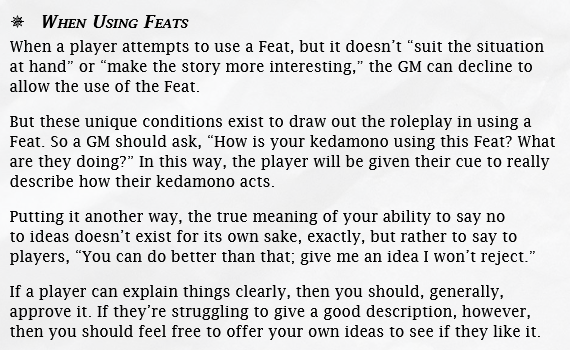
Every player is a monster with vibe-defined powers, like, say, spinning a magically-sturdy spiderweb trap. The use cases are vague, and left to the player to pitch and the GM to approve or veto. A similar arrangement to the stunting post from before. To the players, that’s what it is. To the GM, however, it frames their veto power like this. Not as a refusal, but a nudge. The point isn’t to say no. It’s to say, “give me some more to work with,” and if the player backs down, the GM is actively expected to intercede to give ideas of their own to make it work.
Facing the players, these powers are limited in use to what makes sense. The GM knows, however, that they can actually be used anywhere – the veto power is there to try to push the narration to feel more plausible, even in outlandish cases.
In other words, the player-facing mechanic isn’t as constraining as it claims. And because it’s smoke and mirrors, you get the conceptual benefit of a stunting mechanic, without the social limits being anywhere as strong.
That, I think, has a lot of interesting potential!