
In a story, how do you know what should happen next?
Well, of the writers I know in my life, the answer to that usually comes down to “hell if I know,” “I realized in a moment of inspiration that it would be this,” or “I was halfway through writing out my elaborate plan when I decided to change everything and now it’s a lot better.” Stories are rarely perfectly-planned things, and even when you have a proper plan for everything, a willingness to change it as you get better ideas is an important skill for a writer.
So, it would be wrong to claim that a writer perfectly knows everything that is going to happen as they sit down to write. It’s a more dynamic and reactive process than that.
But they mostly know. There exists a story that they have set down to write, and the things they write are in service of producing that story. If they have an idea that means said story can’t happen, they don’t do it. (At most, they might try to think of a version of their new idea that can still ensure the victim gets murdered, or the world gets saved, or what have thee.) If there’s a moment in future that needs to happen, they know that moment exists, and are conspiring the events they write to reach it. A simple (if reductive) way to model a story as one is writing it out is the set of these moments that need to happen, and building the connective tissue from there.
This is true of all composed artforms, realistically. Or, at least – since we are talking about narratives, it is true of all composed artforms that are structured as narratives. You can make an analogy that applies it to, say, composing music, but it wouldn’t be all that accurate. It’s true of storytelling.
Which means that most RPGs are not a form of storytelling.
Right?
See, RPGs are in a weird boat, in terms of the shape of the medium. They’re performances, in no small part – taking an analogy to theater, an RPG in play is a performance following the script produced by the rules. But theater scripts are a lot tighter, and actively work to define the things that happen in a stage performance in a fair bit of detail. They’re comparable to (and arguably are the same kind of thing as) several forms of improv game, some of which are described as storytelling in an improvisational manner – distinguished from structured storytelling by actively not having anything in advance planned out. (With the definition of “storytelling” I just laid out, that would be classified as a different thing – I like “riffing” as a term, personally.)
But they’re talked about, most often, in literary terms.
Moreso even than gameplay terms! Engaging with an RPG as a game is a somewhat-controversial endeavor. But describing them as a storytelling medium, that’s often taken without issue.
Much ink has been spilled on the contradictions there. One popular conclusion I see is that it is not that RPG play is analogous to writing, but rather, that after the fact one can look back at the events of an RPG and compose a story out of them. Using the events as the aforementioned set of [things that will happen] for creating a story. That’s been a popular method of engaging with the medium for a long time. In Ron Edwards’ incredibly disappointing Sorcerer, older than I am, the game presents its philosophy in contradiction to that assumed baseline approach – it pursues “Story Now”, such that the process of playing the game in and of itself functions as the experience of writing.
This, I am also interested in. Though, I suspect my definitions and interests differ considerably from Edwards’.
Moments to come
For the play of an RPG to mirror storytelling, as I’ve considered it here, there is one straightforward need that must be filled: a nonzero set of expected or necessary future events, with the writing arranged in service of reaching those future moments.
Or, in other words, most RPGs are storytelling, after all. They’re just rather sneaky about it.
Suppose I’m playing a game of D&D. Whatever options I pick, the vast majority of my toolkit and gameplay is focused on combat. Therein lies the heart of the game. Unless I and my group am willfully avoiding that part of the experience, which would produce a gameplay experience that is failing to really be D&D, there is an inevitable future event planned: the heart of gameplay is combat, therefore, a combat is upcoming. We have an entry on our list of future events.
It’s just a very hollow entry. “In my story, there is a fight that will happen. Against someone or something, no details required. We have to build up to that.” This does technically fulfill the conditions of storytelling. It’s just… very bland and bad storytelling, if that’s all it is.
That isn’t all it is. Our GM’s been hard at work, after all. We have a whole pitch about the dark emperor looming on high with a castle that we must assail and defeat. [We fight the dark emperor] is a far more specific point to have on the list of things that must happen. And, with context, it gives direction to draw the connective tissue. [The players go up and siege the keep] or [the players wait in ambush for the dark emperor’s next trip out] are neither necessarily on the list of future events, unless those are locked in by the players or GM as what must happen, but that locking in can happen – and even if it doesn’t, that’s the forming of connective tissue between points. That’s already a part of writing, either way.
In other words, we do have sources for a [story template]. The set of future events to aim for and string together to form a cohesive story. It’s just, unclear sources.
People do play D&D without ever getting into fights. I said a few paragraphs about that such a thing is “failing to really be D&D,” and I stand by that, but a classification argument doesn’t make something not exist. So it’s not inherently true that [a fight happens] has to be in our story template. It probably should be, but we can’t be certain.
In fact, this inconsistency is a strong source of differences in approaches to playstyle. If you’ve had a [sandbox campaign] pitched to you before, it’s in essence a promise of the lack of a [story template]. “You can go anywhere” means the absence of “you must go here,” after all.
So, one of the sources of the story template (or lack thereof) is the conditions of play and preferred playstyle, negotiated by a playgroup at runtime. This is where you have truisms like “you must bring a character who will participate in the plot” come in – for a playgroup where that statement makes sense, [participating in the plot] exists as one or more steps in the story template, and players are expected to oblige that baseline. A sandbox pitch, by contrast, does not implement a direction as part of a story template, and actively allows pursuing directions as the players see fit – a preference away from storytelling and towards mechanically-augmented riffing.
Since both playstyles can exist in the same game, played by different players, we are not solely considering the realm of what a game’s design can produce. While that is an important factor, the biggest ones instead come from the players.
What can happen?
I have been running a campaign of Exalted recently.
(This one is not a hypothetical. I have genuinely been doing this. It has caused me some difficulty.)
Exalted is an interesting game in terms of story templates. It very much gears itself towards open-ended sandbox-esque play, puts a lot of weight on the GM to fill space in both mechanical and narrative terms, and has a wide space of possible character premises and goals even when restricted in the options they can pick from down to one of the many flavors of chosen-one the game offers.
Rather than pick apart the whole of that, I want to focus on one particular facet of the experience.
Exalted is… it is billed as a mythic fantasy game, where you are playing as high-powered chosen one wuxia-ish heroes doing great deeds. It has a large interest in heroism as a powerful and not-necessarily-righteous force, wherein people with great strength succumb to personal foibles and wicked ambitions. That is the genre and aesthetic trappings the game wears.
To that end, it attempts to enable a variety of potential specialties that players can engage with as their grand powerful focus, and to mechanize them in some detail. It does this to wildly-varying levels of effectiveness, but its social gameplay is one of the more interesting layers. It has some rather detailed systems for persuasion.
…In particular, Exalted is a game that wants to enable the play archetype of the wicked seducer. A character who is a charming tempter who leads the powerful to ruin and sways hearts with their looks is a build premise that is enabled for both the player and enemy side, is an expected challenge for any given group to have to deal with, and has at least one power tree supporting that approach for each of the possible player options. Alongside persuasion power trees not focused on seduction in particular, I might add – the focus is very specific and intentional.
For as much as I find Exalted an intriguing game in places, it does fundamentally have a particular target audience that I am not in.
This, then, is a piece of expectation. [A wicked seducer appears as a threat] is not inherently part of the story template of a campaign of Exalted, but it is implicitly there as an option. If such a character appeared in the hypothetical D&D campaign from earlier, I would probably be giving the hypothetical GM a very tired look. It would be [more out of bounds], so to speak, even if not fully out of bounds. Exalted, by forefronting the possibility, makes it more plausible. In the same way that D&D makes a combat more plausible, even if not necessarily certain. (Arguably, D&D does a nonzero amount to enable this possibility also, with its stats for succubi and the like – it would be even more implausible in a game with less support than that.)
Plausibility establishes a few tiers that surround the story template. Alongside the definite events within the template, there are might-happens and likely-to-happens around but not yet within the template. These can then be added as definite future events (if a mechanism for defining future events exists – which is more common than one may think, but we will get to that), or left in the subjunctive. Around that, there is the realm of the implausible or unexpected, which can be received with hostility when it appears – a pressure to keep it out of the template. This is me and my tired stare at work.
The most recent edition of Exalted has made attempts, in places, to reckon with some of the more questionable aspects of its past as a game in prior editions. To varying degrees of success, perhaps, but in one manner in particular that I find quite interesting for the current discussion:
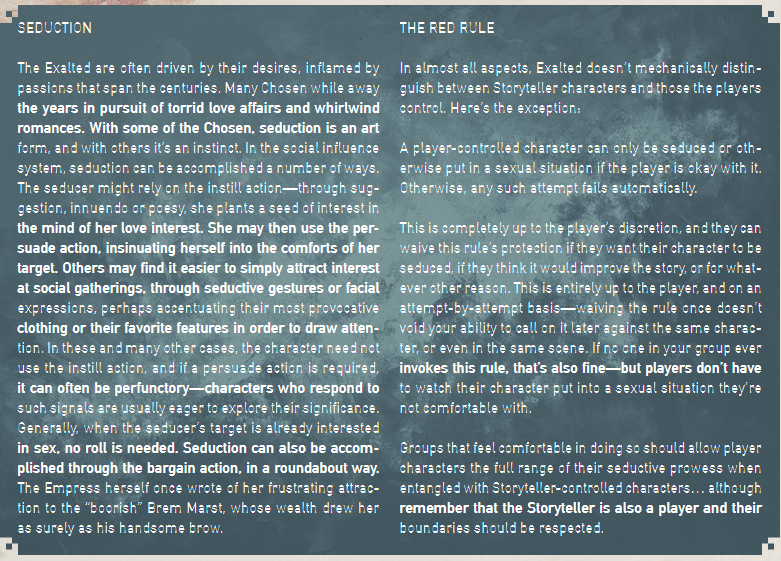
…Right. One of the ways in which 3e fails to iterate on prior struggles is in making its text readable. The right section is what we are interested in, so, for the sake of everyone’s ability to follow along, I will copy it here.
“The Red Rule”, as it is called, reads as follows:
“In almost all aspects, Exalted doesn’t mechanically distinguish between Storyteller characters and those the players control. Here’s the exception:
A player-controlled character can only be seduced or otherwise put in a sexual situation if the player is okay with it. Otherwise, any such attempt fails automatically.
This is completely up to the player’s discretion, and they can waive this rule’s protection if they want their character to be seduced, if they think it would improve the story, or for whatever other reason. This is entirely up to the player, and on an attempt-by-attempt basis—waiving the rule once doesn’t void your ability to call on it later against the same character, or even in the same scene. If no one in your group ever invokes this rule, that’s also fine—but players don’t have to watch their character put into a sexual situation they’re not comfortable with.
Groups that feel comfortable in doing so should allow player characters the full range of their seductive prowess when entangled with Storyteller-controlled characters… although remember that the Storyteller is also a player and their boundaries should be respected.”
(The “Storyteller” in this case is the game’s term for GM.)
There’s a few interesting facets to this, which I think bear examination individually. First off, this immediately counters one of the things I said earlier, if the players wish it to. The threat of the [wicked seducer] is optional to the players, in a way that, say, the threat of an army coming to kill them, or a magical plague infecting them, or a non-seduction-based effort to persuade them to take action against their interests, is not. In all other cases, the players must reckon with the game mechanics and what they demand. With seduction in particular, however, a player can simply refuse to be affected.
The logic for this is quite plain – in this matter in particular, the game wants the player’s consent. Without that, it is uncomfortable forcing a sexual situation upon them. This is a baseline logic I approve of, whatever my thoughts on the result. Getting someone’s consent before putting them in a sexual situation is a good baseline, and the game is pointedly not making the declaration that [playing the game] constitutes giving that consent. Which, that should not be considered an equivalence, so, very fair!
Secondly…
As I mentioned, I am running Exalted right now. Running puts me in the position of Storyteller.
I don’t get anything from this rule.
The protection in the text is specifically only for characters controlled by players other than the Storyteller. As it says, in fact, this is the only mechanical difference between the two. (This is a bald-faced lie, but that’s another conversation.) If a player were to wish to apply a seduction attack against one of the NPCs I were running, I am not afforded the meta-protection on the grounds of consent that my players would be. In that sense, the game claims, [running the game] does constitute giving consent for having to play out that sort of thing. At least, tangibly moreso than [playing the game] does.
There are, of course, a few differences in dynamics between these positions. A GM, we must remember, controls an arbitrarily-large number of NPCs. A player has only the one, and thus, only the one build. If the GM introduces a wicked seducer, and the Red Rule is invoked to stonewall them, the GM probably makes a mental note that their players do not want to do that sort of thing, and just does not use that NPC further in the same way. From then on, they introduce other sorts of threats instead, and the game continues.
If a player introduces a wicked seducer, and the GM, I, were to try to resist on a meta-level… that player suddenly has no meaningful access to the powers they have invested in. The game allowed them to build in such a way, after all, and to invest quite heavily. If they do that, and the GM refuses to engage, that player then simply does not get to play the game.
Now, I can provide many potential solutions to such an occasion, such as “tell a player not to bring that build in the first place,” but that’s besides the point. That is the underlying logic behind the discrepancy here, or at least one big part of it.
Interestingly, when one takes the game in aggregate, the GM also has tools on hand to almost yield the same result. Among other things, the social gameplay section features the following:
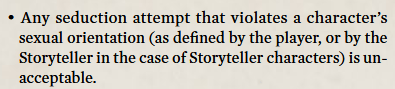
An “unacceptable” social action automatically fails, at no cost.
Except that many playerside powers, including seduction powers, can provide the ability to force through unacceptable influences. “The wicked seducer who is so beautiful that even those who would never ordinarily be attracted to them are now smitten” is, after all, still the sort of character that the genre conventions of the game expects to have around.
So, a GM could just coincidentally declare that every NPC around is asexual, so there, but not only would that be against the expected spirit of the game, it wouldn’t even accomplish the same thing.
Exalted, as I’ve seen it described, operates on a presumption of “vacuous bisexuality”. That is to say – without much depth of implication to it, the default expectation to it is that any given character can be attracted to anyone, because otherwise seduction builds are arbitrarily weaker than any other social build. It’s not as if seduction powers are made stronger with that presumed limit, or anything like that.
(That is [vacuous] as in the way a logical statement can be [vacuously true] if it is true because the givens make the statement meaningless, not any particular judgement on the cleverness of bisexual people. Just so we’re clear.)
The Red Rule, then, exists as an exception and makes a strong point of not making that exception a norm. The players are afforded the privilege of consent, for the sake of a healthy table dynamic – but the expectations of the game require that seduction be broadly applicable, that instances to the contrary be specific and notable. The presumption, the default, is that a wicked seducer is able to get to you.
I have… several thoughts on this arrangement, some more harsh than others, and I shall spare you them for the moment. In short, sufficeth to say that I am naturally frustrated at the lack of support for my interests, but my players have done a good job of not pushing past where I would find unpleasant, and I recognize that the aro/ace experience is in some ways a fundamentally cursed problem for games that wish to center allo engagements in various ways. (I may have recently written a rather bleak solo game interrogating that exact topic.) I have several issues with Exalted‘s implementation of the Red Rule, but I can follow the logic that led to its current form.
My interest, instead, is in the vacuous bisexuality. In the unstated but omnipresent presumption of the wicked seducer as something that not only should show up, but should be able to affect and sway people in accordance with that skillset.
Exalted defines this as part of the field surrounding the story template – the likely-but-uncertain things. And then, with the Red Rule, it defines a particular exemption. For the sake of player safety.
Player safety, and comfort, is often centralized in relation to defining the space of what can and cannot happen. This is its own conversation, really the history and nuances of safety tools could be a blog post all to itself. Lines and Veils from the aforementioned Sorcerer are an excellent case study, quite useful within their specific niche and utterly terrible in how they have been taken outside of said niche. They take as given, and rely heavily upon, a preexisting understanding of the space of likely-but-uncertain things, carving out undesired pieces for the sake of being able to focus on all the rest. You need that preexisting space, then, to get much of anything out of the tool.
(But, as I said, that could be its own blog post.)
Even games in the sandbox style fundamentally rely on the likely-but-uncertain space. As I said, in fact, that is the gameplay style Exalted presents itself to be run in. In lieu of an explicit story template, the elements nearby to the template have to apply themselves even more in order to produce an experience one can expect anything consistent from. In other improv games and performances, prompting serves this purpose – and a skilled improvisational performer does so by pulling as many likely-but-uncertain items out of the initial prompt and the responses of their fellow performers as possible.
The premise and biases of gameplay produce a lot of this space, as well. Most combat RPGs are geared such that the players are expected to win pretty much all of the time. Nothing about that is strictly speaking scripted, but the odds are heavily tipped to ensure a likely outcome is what happens. There’s a line of [should] cutting through the space of what can happen, which this also runs afoul of. I can’t count how many times I’ve seen GMs say something like “I beat my players last session, that wasn’t how it was supposed to go.” That sense of [this should happen] is what lets the margins bleed between the story template and the space surrounding it.
And if that was the whole story, I would have been right, at the start. RPGs are an interesting sort of game of structured riffing and improvisation, which, through player expectations and the presumptions of the game, can somewhat approximate and bleed into forming a proper story template but don’t make it all the way.
But that’s not everything. Of course it’s not.
What will happen?
Due to recently getting back on a Kamen Rider kick, I (even more recently) gave Convictor Drive a read.
Convictor Drive is an interesting game. It’s quite closely tied to a particular structure of adventures. To play it, a flow of events is obligatory: first you play through a set of investigation scenes, then you do a fight, then the mission is over.
The game comes with an example mission, with some quite illuminating diagrams:
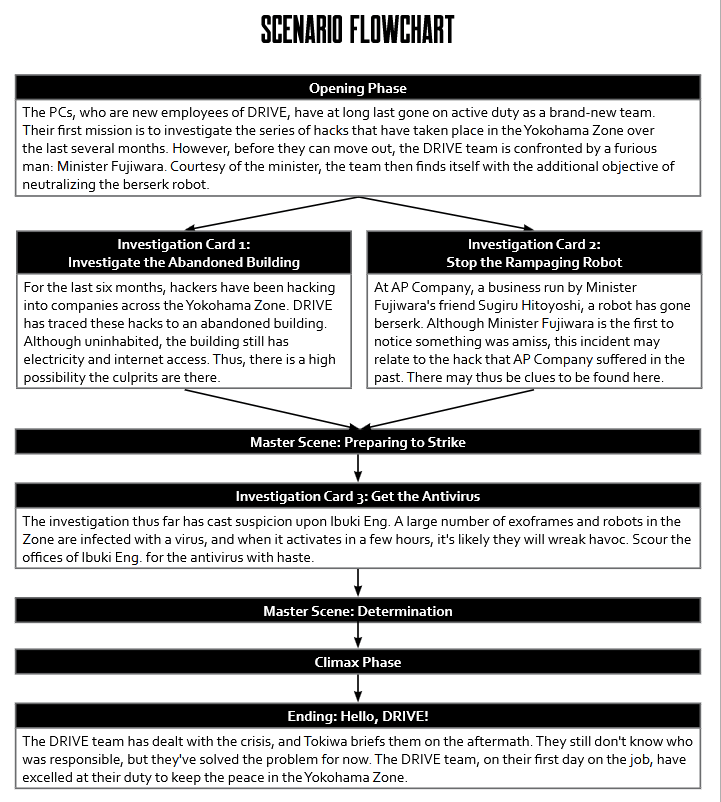
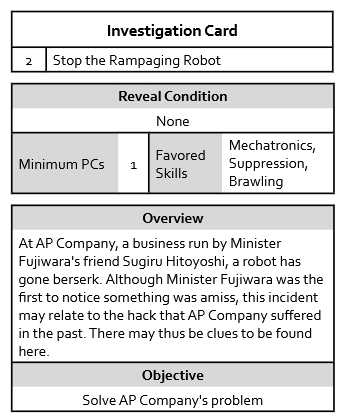
In short: the steps are laid out, from beginning to end. Gameplay occurs during “Investigation Cards” and the “Climax Phase” – the former represent skill checks to make progress, whereas the latter is where the interesting combat system comes into play. One may note, too, that the Investigation Cards are just presented as steps on a path, rather than a point to branch out. The Investigations aren’t failed even if the players do not roll well. Instead, they just build up a time penalty which sabotages them once the fight actually hits.
In other words – this is a story template. Every step on this list is obligated to happen. Even the two parallel Investigation Cards, 1 and 2, aren’t a “pick one” arrangement – you must do one and the other, just, the party may split up and do them at the same time. Every step here happens as prescribed, and the players and GM both are navigating through that template and conspiring to ensure the future events make sense.
Per the established definition, Convictor Drive structures a story in the same way writing does. This is storytelling.
Convictor Drive is unplayable without a scenario. The buildup of Investigation Cards is the gameplay. At most, it tasks the GM with writing their own scenario, in advance, to put the players through, with the same level of structure as this one.
However, that tightness is in a sense the only anomaly here. As it so happens, RPGs with pre-defined modules to play through are quite common. Call of Cthulhu, Dungeons & Dragons, many very popular titles sell modules for the GM to plug in and run the group through. And those modules, to varying degrees, define what is going to happen during their gameplay.
…With a wrinkle. While Convictor Drive leans heavily on a particular structure for its modules, many games do not. In fact, it is often a point of criticism, when discussing, say, D&D modules, if the experience is seen as too constraining, or too linear.
In other words, there’s another question at play – should RPGs be storytelling? After all, if a constrained story template is a mark against a module, that implies an interest base that dislikes having such things.
As with many questions of the form “should X be Y?” the answer is more or less that different people will enjoy different sorts of things. I quite like the constraints of storytelling, for instance, which is why sandbox campaigns have never worked for me. For the exact same reason, I benefit more from scenarios that resemble story templates. This is a personal preference, which leads me to desire games in that vein – it means very little for the broad question of what RPGs, as a whole artistic medium, should be.
I think it helps to dispel such notions by taking a step back and asking oneself similarly sweeping questions about, for instance, movies. Books. Music. Pretty much any broad “what should this entire medium be?” question about a form of art is silly to the point of uselessness. I quite enjoy scripted-storytelling elements in RPGs, but I do not wish this to be read as a claim that all games must have them.
But I digress.
How do we reckon with games that do not run on modules?
Or rather – how do we reckon with campaigns that do not run on modules? I can claim pretty easily that Convictor Drive has a strong story template built in, when the game mandates precisely that. But D&D may present a module containing a dungeon wherein certain rooms must inevitably be past through (as an emergent virtue of the map, more than explicit prescription, but the effect is similar), or it may simply have a GM do their own thing. And the GM doing their own thing does not need to resemble the shape of a module, unlike with Convictor Drive.
What is it that a GM does, when they ‘do their own thing’?
Generally speaking, they start with some manner of plan. A concept for the campaign, or at least the upcoming adventure, alongside the expected beats and potential resistance to be fought through. A lot of the same legwork that a module will provide, maps, encounters, characters to meet, etcetera.
It would be wrong to claim that a GM’s plans are equivalent to a module. Most often, they more closely resemble the adjacent space discussed in the last section – a space of things that can happen, that might happen, but it’s not necessarily guaranteed that they will happen.
With a few exceptions. [We fight the dark emperor], for instance. It’s rare for a GM to plan something that includes no scripted moments, no ideas that are guaranteed to occur – and in most cases, the plans are like that as a willful choice based on the preferences of the GM or table.
“What happens next?” is often a strong source of guaranteed moments, in particular when a session break occurs. Answering the question of what to open the next session with is almost guaranteed to be an instance of constrained storytelling – it’s not as if the players have a meaningful way to change it, beyond interpersonal communication. The moment play begins, that is the next moment they will reach. If the moment is a fight, as is common for D&D or other games with a complicated and in-focus combat system, this can have several implications!
Then again, a near-future scripted moment has a fairly different texture from a far-future scripted moment. Considering the time delay between a human making a decision and their body acting to make it happen, could it not be said that every decision made in an RPG is scripted, at the latest, a few moments in advance, when the player makes a decision? That wouldn’t be a terribly useful argument, but it might be technically correct!
It can be said that it only really counts if all players are aware of a story template in advance and can play to it, but that argument doesn’t really hold water. It’s an approach to differentiation, to be sure, but in that case even Convictor Drive‘s rigid scenarios don’t technically count, because only the GM knows the future elements. There is certainly a texture different between that and everyone knowing what’s to come, but the experience of play that comes from knowing where one must go in the next moment is present in both. More to the point, the phenomenon I am trying to gesture at, the set of [scripting tech], I think must include Convictor Drive‘s format – so this isn’t a satisfying claim.
Another point of divergence is the question of outcome.
Convictor Drive, you may note, prescribes this. The Investigation Cards will be succeeded, the question is simply how costly they are to reach that point. You are guaranteed to make it through to the fight. It is taken as given that the players are likely to win the fight, as well – a phenomenon shared with other combat games, a lot of the time, but made quite explicit here.
The wiggleroom of “how does this moment resolve?” is something that varies from game to game. In many schools of thought, you will see it claimed that a moment in an RPG is made meaningful because it could resolve in multiple different ways, and the interaction of player and system is what locks in an answer. Of course, there’s no reason it has to be that way. Scripting an outcome is just as feasible as scripting an event and leaving the outcome uncertain. In the example of fights and particular, the outcome is often all-but scripted, but the gameplay hinges on not acknowledging that facet and acting as though loss is a likely phenomenon. (Attrition and secondary narrative punishments then serve a gameplay purpose for reintroducing stakes, adding a new question to the “how does this resolve?” set.)
I don’t think scripting needs to prescribe an outcome (though I do wish more games played with it as willful technology). If it did, for one, this would be a far shorter post. But more importantly – if the question here is in what ways RPGs can resemble written storytelling, the fact of the matter is that stories also don’t prescribe their outcomes. Not always, at least. The question of “how do I get from this moment to the next moment I have planned?” often involves rewriting or discarding how you expected a given moment to resolve, when you think of a better idea or a new course. If the definition of storytelling can’t acknowledge revision, it’s a rather lacking one.
The timing question is, in my eyes, the most fruitful for determining the difference in experience. When writing a story, you have an idea of the distant future. Where you expect characters to end up, what circumstances you need for the big finale to happen, etcetera. That idea of the distant future becomes a guide for the near future. It informs how you write both clearly-scripted and unclear “how should this resolve?”-type events.
From that lens, it is usually an experience only reserved for a long-term GM. Even in the example of Convictor Drive, the players only know this and the next moment. The GM reads the scenario, but they do not. In a planned campaign, the same holds true. In my Exalted game, I know what the end of a given adventure will look like – and with that knowledge, I can corral players towards reveals and characters that are connected to that.
Even with that example, there are some differences. With my Exalted game, I can plot to the end of the adventure – but not the end of the campaign. When we move on to a new adventure, I begin a new phase of storytelling. I determine a new set of future events to have happen, and those become my new set of distant goals to write towards. In this sense, each adventure can be its own story-like experience, but the campaign as a whole meanders more. (Which, in and of itself, can resemble the process of writing more serialized stories, where you plan through a certain point and then have to keep writing after.)
Of course, as a player, you can also plan this sort of thing.
…Not all that effectively, on your own. As with many player actions in GMed games, it works best by requesting to borrow the GM’s authority and hoping they play ball. But it’s not unheard of for players to go, this is where I think my character will end up. This is the sort of ending I want. Usually it comes in more tragic setups, in my experience – players wanting explicitly doomed endings, or perhaps the game billing itself precisely as that. (In my brushes with the World of Darkness, I’ve spotted people doing precisely this here and there.) This type of request can, itself, be a form of scripting. As can more localized near-future scripts! “I think this is what should happen next” is a common refrain from players in most games I’ve been in, especially for the straightforward question, what scene should we do now? While it can ultimately only work by borrowing GM authority, or directing it solely at fellow players, it is a scripting methodology. At a certain timescale in advance, it can very much resemble a story template. I’ve played in campaigns with long queues of defined upcoming scenes, to be played through in order. (You could probably make a whole RPG where the mechanism is queueing up scenes in advance and playing them out. I’ve drafted games like that, even!)
Structure and gameplay
I think about my post about ReBoot every so often.
In essence, ReBoot as a show does something very interesting that overturns a lot of the formula of the show before that point, in a way that would be quite difficult to meaningfully RPG-ify. What RPGs do is define a structure of play, and then produce gameplay that follows that structure. A story, which only needs a series of moments, can radically change its structure more or less without fear.
…Without fear of compromising the substance of the artwork itself, that is. Angry readers are another threat.
But an RPG can break itself. You can step beyond the bounds of what’s expected and the game either will not accommodate you or will actively strain against you. If you do not match your systems to your play goals well, the game can start off broken.
I think this, ultimately, is why RPGs and storytelling (as I have defined it here) struggle with one another. A written story can change its formula to suit the moments that must happen. An RPG can’t change its formula without stapling multiple RPGs together and swapping which one you’re playing – and even then, it can only ever encompass the gameplay that one of its subsystems can support. In that light, it makes a fair bit of sense to change the moments to suit the formula. If one can’t mutate, the other has to give.
This is a very real concern with an RPG that is too strongly scripted. The result, having nowhere to give, may resemble a story – but in a way that is far more formulaic than a written story needs to be.
It’s no accident, I think, that Convictor Drive is a battle-tokusatsu game. The Kamen Riders and Super Sentais of the world are, ultimately, very formulaic stories. I love ’em to death for it, but a gameplay loop directly of “follow some defined investigation scenes, finish it off with a fight that you win, go home” can accurately model a large number of episodes. Because the stories the game is riffing on are already formulaic, the formula constraints of an RPG work.
Gameplay needs and formulae are a source of scripting, in a sense. They define moments to come. If you play D&D, a fight is coming. If you play Lancer, a fight is definitely coming, and, unlike D&D, the attrition economy is meaningfully paced to the point that you can know how many you need to face in a given adventure. “A fight is coming” is, from a storytelling perspective, rather hollow – but from a gameplay perspective, a necessary element.
Since it’s a necessary element, it can do the same thing.
“I need this character to get here so they find the macguffin” is a piece of writer-logic. “I need the character to start a fight” is a piece of RPG-logic. Both are forces that can inform what point B is, and how we should navigate from point A to try to make it a reality.
(Of course, much of the time, only the GM sees the whole course, and the players have a vested interest in reshaping the formula to minimize their costs – but that is its own discussion, one I’ve already spilled much ink on.)
Explicit scripts are, for my money, underutilized technology in RPGs. There’s a whole spectrum from Convictor Drive locking in the shape of the story and just letting you play it out, to Glitch‘s Quests (see below) offering a defined set of moments and giving progress based on achieving some, if not all, of them, to a well-defined capacity for players to propose future moments and scenes and be sure they will actually come up. They’re something I wish more games played with!
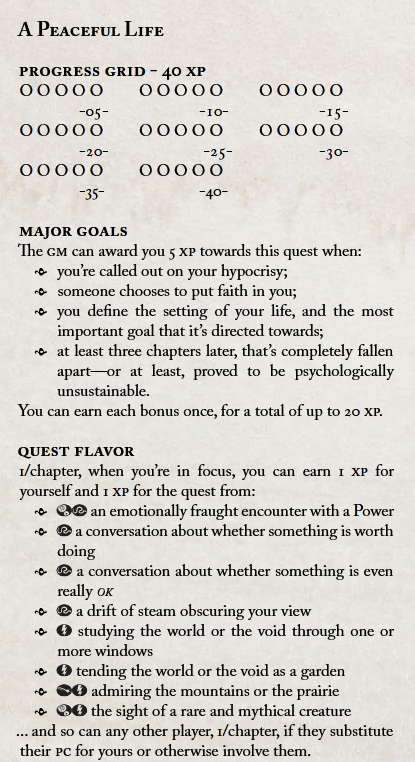
But, ultimately, there’s reasons why they’re rare. Some tactile – players tend to balk whenever they’re explicitly told what to do, even when that’s the whole purpose of an RPG. Some traditional – if something isn’t how RPGs historically have been done, then, there tends to be inertia pushing against making something that works that way. Some subjective – playing in a script just isn’t to some people’s tastes, and there’s nothing wrong with that. But beyond all that… RPGs struggle to make work what does not fall under their purview.
In stories, all the time, characters will get once-in-a-lifetime moments of miraculous providence. They’ll be faced with the world at stake, and we the audience know they’ll win, because that’s how things are done. But the story tells us this is acceptable, and we roll our eyes and pretend to believe it.
An RPG has to structure a moment like that, to have it be part of the game – and if it does, then we already know it’s lying about the stakes. That, or it has to let it be uncertain.
If you let the fate of the world be uncertain, the game might end then and there. That can be a feature, or it can be untenable. It depends what you want out of the experience. Either way, that just isn’t how writing works.
Formulaic stories work on a suspension of disbelief where you pretend not to notice the formula. In RPGs, obfuscating the formula by pawning it off on the GM is commonly done to try to approximate that – but ultimately, it’s in the rules, and the rules are something the players read and interface with all the time. It’s a lot harder to deny in an RPG, vs in any other medium.
I think a big part of the rarity of scripting tech is that a lot of people want that sense of uncertainty, of deniability. They want what comes out of reading a story, more than what comes out of writing one.
When you’re writing, you never believe that the world is at stake. You already know what happens next.

